
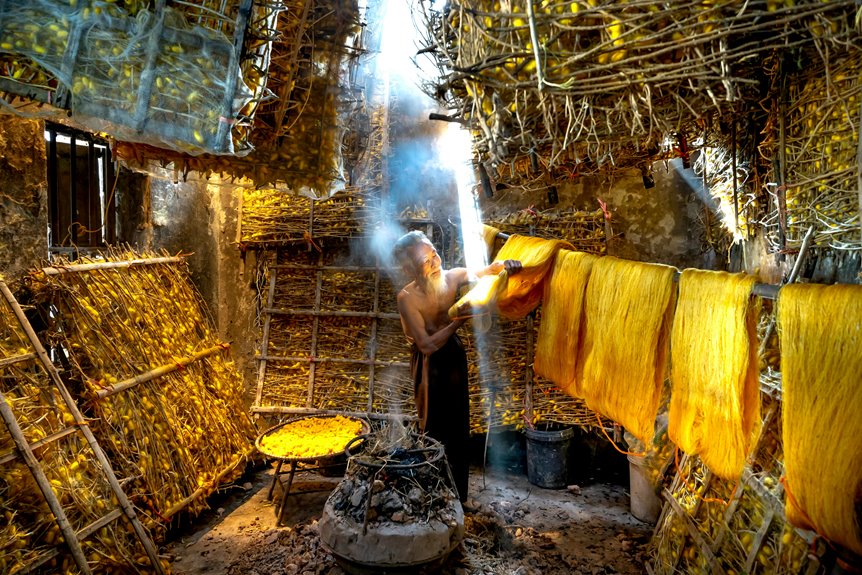
You start making Chanderi silk by carefully selecting high-quality mulberry silk threads known for their smooth texture and sheen. After preparing and softening the threads, you set them on a handloom with precise tension. Using traditional weaving techniques, you interlace silk and metallic zari threads to craft delicate motifs like floral patterns and geometric shapes. Finally, you finish with washing and gentle ironing to enhance softness and shine. If you explore further, you’ll uncover the deep cultural stories woven into each piece.
Key Takeaways
- Chanderi silk originates from Madhya Pradesh, blending Malwa and Bundelkhand weaving traditions with lightweight, sheer fabric qualities.
- The finest mulberry silk threads are carefully selected, prepared by untangling, soaking, and stretching to enhance durability and sheen.
- Traditional handloom weaving involves precise yarn preparation, tension control, and interlacing silk with zari for intricate motifs like Butti and Jaal patterns.
- Designers create culturally significant patterns featuring floral vines, peacocks, and geometric shapes, enhanced with shimmering metallic zari threads.
- The weaving process includes setting the loom, inserting weft threads, beating for compactness, washing, ironing, and quality inspection for flawless elegance.
The Origins of Chanderi Silk
Although Chanderi silk is renowned for its elegance today, its origins trace back centuries to the town of Chanderi in Madhya Pradesh, India.
Chanderi silk’s timeless elegance originates from centuries-old traditions in the historic town of Chanderi, Madhya Pradesh.
When you explore its history, you’ll find that this silk reflects a rich cultural blend, influenced by the weaving traditions of both the Malwa and Bundelkhand regions.
You’ll notice how the intricate designs carry stories from the past, passed down through generations of skilled artisans.
As you learn about Chanderi silk, you’ll appreciate how the craft evolved under various rulers, adapting while preserving its distinctive lightweight texture and sheer quality.
Understanding this background helps you see why each piece feels timeless, connecting you directly to the heritage and artistry that define Chanderi silk.
Selecting the Finest Silk Threads
When selecting silk threads for Chanderi fabric, you’ll focus on different types of silk fibers and how they affect texture and strength.
You’ll also learn to assess quality by looking for uniformity, sheen, and durability.
Plus, sourcing ethical silk guarantees the fabric’s beauty aligns with responsible practices.
Types of Silk Fibers
Since the quality of Chanderi silk depends heavily on the fibers used, selecting the finest silk threads is essential.
You’ll primarily work with mulberry silk, known for its smooth texture and natural sheen, making it perfect for Chanderi’s delicate weave.
Sometimes, tussar silk is blended in to add a subtle, earthy tone and a slightly coarser texture, giving the fabric unique depth.
You might also encounter eri silk, prized for its durability and matte finish, though it’s less common in traditional Chanderi.
Choosing between these fibers depends on the desired look and feel of the final fabric.
Quality Assessment Criteria
Choosing the finest silk threads requires a keen eye and a deep understanding of quality indicators.
You’ll want to examine the thread’s luster closely; high-quality silk shines with a natural sheen that reflects light evenly.
Feel the texture—top-grade silk is smooth and soft without any roughness or unevenness.
Check the thread’s strength by gently pulling it; it should be resilient without snapping easily.
Consistency in thickness is another critical factor; uneven threads can weaken the fabric and impact the final weave.
Finally, look for purity—threads should be free from impurities or discoloration, which can affect durability and appearance.
Sourcing Ethical Silk
Understanding how to assess silk quality sets the foundation for sourcing ethically produced threads. When you choose silk, prioritize suppliers who guarantee sustainable farming and humane silkworm treatment.
Look for certifications or transparent practices showing minimal environmental impact. The finest silk threads come from cocoons harvested without harming silkworms, often called “peace silk.” This method respects both nature and tradition, giving you fabric that’s both beautiful and responsible.
Always verify the origins and processing methods, so your choice supports artisans and eco-friendly producers. By sourcing ethical silk, you help preserve the delicate balance between craftsmanship and environmental stewardship, guaranteeing each Chanderi silk piece carries integrity from thread to weave.
Preparing the Silk for Weaving
Before weaving can begin, you’ll need to prepare the silk threads carefully to guarantee they’re smooth and strong. First, you untangle the raw silk fibers, removing any knots or impurities.
Then, you soak the threads in water to soften them, making them easier to handle. Once softened, you stretch the threads to align the fibers uniformly, which enhances their strength and sheen.
After drying, you spin the fibers into fine, even threads suitable for weaving. This process guarantees the silk’s natural luster and durability shine through in the final fabric.
Spinning fibers into fine threads ensures the silk’s natural luster and durability illuminate the finished fabric.
Proper preparation is crucial because any weak or uneven threads can disrupt the weaving, affecting the intricate patterns Chanderi silk is known for. This meticulous step sets the foundation for the fabric’s exquisite quality.
The Role of Zari in Chanderi Fabric
While the silk threads form the base of Chanderi fabric, zari adds the sparkle that makes it truly special. You’ll notice zari, made from fine gold or silver threads, woven into the fabric to create intricate patterns and borders. This metallic thread catches light beautifully, giving Chanderi its signature shimmer. When you wear or admire Chanderi silk, zari highlights its elegance and value.
Here’s a quick look at zari’s key aspects in Chanderi fabric:
| Aspect | Description | Effect on Fabric |
|---|---|---|
| Material | Gold or silver-coated threads | Adds luxury and shine |
| Use | Borders, motifs | Enhances design details |
| Weaving style | Interlaced with silk | Creates texture and depth |
| Visual impact | Reflective and lustrous | Makes fabric eye-catching |
| Cultural value | Symbol of opulence | Elevates Chanderi’s status |
Traditional Handloom Techniques
To make Chanderi silk, you start with careful yarn preparation that guarantees smooth weaving.
Next, you set up the loom with precision to create the fabric’s unique structure.
Finally, you use specific weaving patterns that give Chanderi its signature elegance and texture.
Yarn Preparation Process
When you immerse yourself in the yarn preparation process of Chanderi silk, you’ll notice that traditional handloom techniques play an essential role in ensuring the fabric’s unique texture and strength.
First, the raw silk threads are carefully cleaned to remove impurities. Next, the threads are dyed using natural or synthetic dyes, giving Chanderi silk its vibrant colors.
Then, the dyed threads are dried and stretched to maintain tension and consistency. Finally, these threads are twisted and wound onto bobbins, ready for weaving.
Here’s a quick overview of the yarn preparation steps:
- Cleaning raw silk threads
- Dyeing with vibrant colors
- Drying and stretching for tension
- Twisting and winding onto bobbins
Each step demands precision to preserve the silk’s delicate beauty.
Loom Setup Details
Setting up the loom for Chanderi silk weaving involves several essential steps that guarantee the fabric’s signature finesse.
First, you carefully warp the silk threads onto the loom’s frame, ensuring even tension across the entire length. This tension is vital to prevent any distortion during weaving.
Next, you thread the warp through the heddles and reed, which control the movement of the threads and maintain proper spacing. You then adjust the loom’s pedals or levers to synchronize the heddles’ motion.
Before starting, you tie the threads securely to the beam, double-checking alignment to avoid snags.
Each step demands your precision and patience since any misalignment can affect the final texture and appearance of the Chanderi silk fabric.
Weaving Patterns Techniques
Once the loom is perfectly prepared, you can focus on the weaving patterns that give Chanderi silk its distinctive charm.
The traditional handloom techniques rely on your skill to interlace silk and zari threads, creating intricate designs. You’ll work patiently, ensuring every motif is flawless.
Here are four key weaving pattern techniques you’ll use:
- Butti Work – Small, repeated motifs that add delicate detail.
- Border Weaving – Bold, contrasting edges that frame the fabric.
- Jaal Patterns – Complex, net-like designs spanning the fabric.
- Motif Placement – Strategic spacing of patterns for balanced aesthetics.
Mastering these techniques lets you bring the timeless elegance of Chanderi silk to life, thread by thread.
Designing Patterns and Motifs
Although creating Chanderi silk starts with weaving, designing patterns and motifs plays an essential role in defining its unique beauty.
You’ll notice that the weavers carefully select traditional motifs like floral vines, peacocks, and geometric shapes, blending heritage with creativity. These designs aren’t random; they carry cultural significance and tell stories through intricate detailing.
When you choose or create a pattern, you must consider the fabric’s flow and texture to guarantee harmony. The motifs often use metallic zari threads, adding shimmer and depth.
You’ll see how the contrast between the sheer silk and bold designs creates that signature Chanderi elegance. Designing these patterns demands patience and a deep understanding of both art and tradition, making every piece a masterpiece.
The Weaving Process Step-by-Step
Before the weaving begins, you’ll need to prepare the yarn meticulously, as this step guarantees the fabric’s strength and texture.
Preparing the yarn with care is essential to ensure the fabric’s durability and exquisite texture.
Once ready, you’ll follow these key steps to weave Chanderi silk:
- Setting the Loom: Arrange the warp threads on the loom with precision, ensuring even tension across them.
- Inserting the Weft: Pass the weft thread through the warp threads using a shuttle, carefully interlacing them.
- Creating Patterns: Use the designed motifs to guide the weaving, employing supplementary weft techniques for intricate details.
- Beating the Weft: Press the weft threads tightly against the woven fabric to maintain compactness and uniformity.
Finishing Touches and Quality Checks
After weaving the intricate patterns into the fabric, you’ll move on to the finishing touches and quality checks that bring out the true beauty of Chanderi silk.
First, you carefully wash the fabric to remove any starch or impurities, making certain it feels soft and light.
Then, you iron it gently to enhance the silk’s natural sheen and smooth out any wrinkles.
As you inspect the fabric, you look for any flaws like loose threads or uneven weaving, addressing them immediately.
This meticulous quality control guarantees that only flawless pieces leave the workshop.
Finally, you fold and package the fabric with care, preserving its delicate texture and elegance.
These finishing steps make certain that every Chanderi silk piece showcases its signature grace and craftsmanship.
Frequently Asked Questions
How Long Does It Take to Weave One Chanderi Silk Saree?
It usually takes you around 15 to 20 days to weave one Chanderi silk saree. The process is detailed and requires patience, as every thread is carefully woven to create its unique texture and design.
What Are the Care Instructions for Chanderi Silk Garments?
Like “a stitch in time saves nine,” you should dry clean Chanderi silk garments, avoid direct sunlight, and store them in a cool, dry place. Handle with care to keep their delicate beauty intact for years.
Can Chanderi Silk Be Blended With Other Fabrics?
Yes, you can blend Chanderi silk with other fabrics like cotton or chiffon to enhance texture and durability. Just make sure to care for the garment gently to maintain its elegance and delicate weave.
Are There Eco-Friendly Methods in Chanderi Silk Production?
You can find eco-friendly methods in Chanderi silk production, like using natural dyes and sustainable farming. These practices reduce environmental impact, helping you support traditional craftsmanship while protecting nature and promoting ethical fashion choices.
What Is the Price Range of Authentic Chanderi Silk Products?
Looking for a treasure? Authentic Chanderi silk products usually range from $50 to $500 or more, depending on design and craftsmanship. You’ll find that investing in quality silk truly weaves timeless elegance into your wardrobe.