
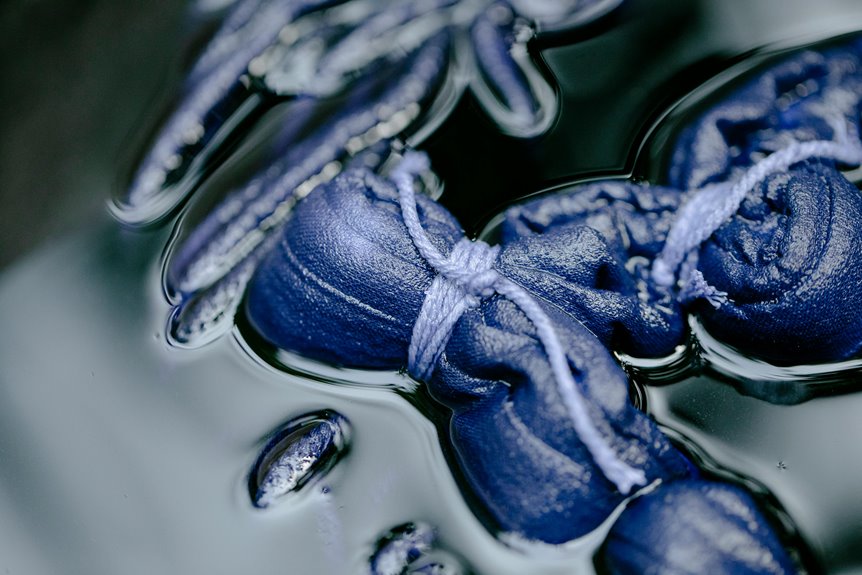
You hold the key to striking tie-dye patterns through mastering folding and binding. Folding shapes your fabric, controlling where dyes settle to create lines, spirals, or bullseyes. Binding presses folds tightly, blocking dye for crisp contrasts or loosening layers to soften edges. Using rubber bands or clamps, you adjust tension for precision. Avoid loose folds or inconsistent pressure that blur designs. When you explore these foundational techniques, you reveal the potential for bold, vibrant creations and intricate patterns.
Key Takeaways
- Folding shapes fabric sections, guiding dye placement to create distinct patterns like spirals, lines, and geometric designs.
- Binding controls dye penetration, with tight bindings producing sharp white spaces and loose bindings yielding soft gradients.
- Using clamps and rubber bands strategically enhances pattern definition and prevents unwanted dye bleeding.
- Proper tension and fold tightness are essential to maintain clear color contrasts and avoid blurred designs.
- Mastery of folding and binding techniques is crucial for vibrant, intentional, and consistent tie-dye results.
Understanding the Role of Folding in Tie-Dye
Folding is the foundation of many tie-dye patterns, and mastering it lets you control how colors appear on your fabric. When you fold your garment, you create sections that guide where the dye will or won’t reach. This means you can design sharp lines, spirals, or unique shapes by simply changing your folds.
The way you fold also affects how dyes blend or contrast. Tight folds block dye, leaving white or lighter areas, while looser folds allow more color to seep through. Understanding this interplay between fabric folds and dye absorption gives you the power to predict and create specific patterns.
Before you add any dye, take time to experiment with folding—it’s the key to turning your ideas into vibrant, intentional designs.
Essential Folding Techniques to Master
Now that you understand folding’s role in tie-dye, it’s time to master essential techniques.
Start by learning basic folds, then challenge yourself with advanced folding patterns.
These skills will help you create unique and vibrant designs every time.
Basic Folds Explained
Mastering just a few basic folds can transform your tie-dye projects, giving you a wide range of patterns to explore.
Start with the simple accordion fold: fold your fabric back and forth in narrow, even pleats. This creates sharp, linear designs once dyed.
Next, try the triangle fold by folding your fabric diagonally to form a triangle, then folding it again multiple times; this method produces bold, geometric patterns.
The spiral fold is another classic—pinch the center and twist the fabric into a tight spiral before binding.
Finally, the bullseye fold involves pinching a point and pulling it upward, then tying off sections along the length for concentric circles.
These basic folds form the foundation of all your tie-dye creations.
Advanced Folding Patterns
Once you’ve got the basics down, you can immerse yourself in advanced folding patterns that reveal even more intricate and dynamic designs.
Techniques like accordion folds, spirals, and pleats will challenge your skills and expand your creative possibilities. For instance, the accordion fold creates sharp, repeating lines, while spirals offer mesmerizing circular patterns. Mastering these requires precise folding and consistent pressure when binding.
Don’t hesitate to experiment with combining folds—layering spirals over pleats can produce stunning, multi-dimensional effects.
Remember, the key is in the details: sharp creases and tight bindings control dye flow, ensuring vivid, clean patterns.
How Binding Influences Dye Patterns
Although dyeing colors create the visual appeal, how you bind the fabric plays an essential role in shaping those patterns. When you tightly bind the fabric, the dye struggles to penetrate, resulting in stark white lines or shapes.
Looser bindings allow more dye to seep in, creating softer edges and gradients. The placement and style of your bindings control the overall design’s symmetry and flow.
Looser bindings invite gentle dye diffusion, shaping elegant gradients and harmonious design flow.
Consider these effects:
- Tight knots: Produce sharp, defined white areas.
- Loops and twists: Create circular or spiral patterns.
- Multiple bindings: Layer patterns with contrasting shapes.
- Random scrunches: Yield organic, abstract textures.
Tools and Materials for Effective Binding
Several essential tools and materials help you achieve effective binding in tie-dye projects.
You’ll need strong rubber bands or string to secure the folds tightly, guaranteeing the dye doesn’t seep into unwanted areas. Rubber bands are great for quick, uniform bindings, while cotton string allows more control for intricate designs.
Gloves protect your hands from staining and chemicals. Using squeeze bottles for dye application lets you target specific sections without disturbing the bindings. A plastic tarp or table cover keeps your workspace clean, and plastic bags help you wrap the fabric during the dye setting process.
Finally, choose natural fibers like cotton or rayon for the fabric, as they absorb dye better. Having these tools ready guarantees your bindings stay secure, creating crisp, vibrant patterns every time.
Step-by-Step Guide to Basic Spiral Folding
To create a stunning spiral tie-dye, start by choosing the right fabric and tools that work best for you.
Next, find the center point on your fabric to twist it into a tight spiral.
Finally, secure your folds firmly with rubber bands to keep the design intact during dyeing.
Choosing Fabric and Tools
Selecting the right fabric and tools sets the foundation for a vibrant spiral tie-dye. You want materials that absorb dye well and tools that make folding easier.
Start with natural fibers like cotton, rayon, or silk; they soak up dye beautifully. Avoid polyester or blends, as they resist dye and dull your colors.
Here’s what you’ll need:
- A plain, white 100% cotton t-shirt or fabric square
- Elastic bands or rubber bands to secure folds tightly
- A spray bottle with water to dampen fabric before folding
- A plastic-covered workspace and gloves to keep things tidy
With these choices, you’re ready to fold, bind, and bring your spiral design to life.
Creating the Spiral Center
Start by laying your damp fabric flat on a clean surface, then pinch the center point where you want your spiral to begin. Using your thumb and forefinger, twist the fabric in a circular motion, spiraling outward evenly. Keep twisting until the entire piece forms a tight, flat spiral shape. This spiral will be the foundation for your tie-dye pattern, ensuring vibrant, symmetrical designs.
| Step | Action | Tip |
|---|---|---|
| 1 | Lay fabric flat | Use damp fabric |
| 2 | Pinch center | Choose desired spiral point |
| 3 | Twist fabric | Keep even pressure |
| 4 | Continue spiraling | Spiral outward uniformly |
| 5 | Form flat spiral shape | Check tightness |
Securing Folds With Rubber Bands
Once your fabric is twisted into a tight spiral, you’ll need to secure it firmly to keep the shape intact during dyeing. Rubber bands are your best tool for this, holding the folds tightly without slipping.
Here’s how to do it step-by-step:
- Place one rubber band around the spiral’s center, crossing over the middle like a clock’s hands at 12 and 6.
- Add a second rubber band perpendicular to the first, crossing at 3 and 9 o’clock positions.
- If needed, use additional rubber bands to divide the spiral into equal sections for more detailed dye patterns.
- Make sure each band is snug but not overly tight to avoid damaging the fabric.
This method locks your folds securely, setting you up for vibrant, crisp tie-dye results.
Creating Stripes With Accordion Folding
Although it might seem tricky at first, creating stripes with accordion folding is a straightforward way to add bold patterns to your tie-dye projects. Start by laying your fabric flat, then fold it back and forth in even pleats, like an accordion. The folds should be tight and consistent to guarantee clean stripes.
| Step | Action |
|---|---|
| 1 | Lay fabric flat |
| 2 | Fold fabric back and forth |
| 3 | Secure folds before dyeing |
Once folded, you can apply dye along the edges or across the pleats. When you unfold, the dye will create distinct, parallel stripes. This method works great for shirts, scarves, and other rectangular fabrics.
Using Clamps and Rubber Bands for Binding
When you’re binding your fabric, choosing the right clamps can make a big difference in your design’s crispness and detail.
Rubber bands come in various sizes and thicknesses, letting you control how tight your folds hold and where the dye will resist.
Let’s explore which clamps work best and how to use rubber bands to create sharp, vibrant patterns.
Types of Clamps
Anyone experimenting with tie-dye quickly learns that clamps and rubber bands play an essential role in creating sharp patterns.
When it comes to clamps, you have several options to control how dye penetrates your fabric. Here are four common types:
- Alligator Clips – Perfect for small, precise sections; they grip tightly without damaging fabric.
- Binder Clips – Great for securing larger folds; their strong hold keeps layers intact.
- Spring Clamps – Useful for thicker fabrics; they apply even pressure across a wider area.
- Clothespins – Ideal for casual projects; they’re gentle and easy to reposition.
Choosing the right clamp helps you define edges and resist dye where needed, giving your designs crisp, clean lines.
Rubber Band Techniques
Mastering rubber band techniques lets you create unique tie-dye patterns by controlling how the dye reaches your fabric.
You start by folding or twisting your garment, then tightly wrap rubber bands around specific sections. These bands act as barriers, preventing dye from fully penetrating the fabric underneath. The tighter you bind, the more defined and contrasting your patterns will be.
You can combine multiple rubber bands in different arrangements to achieve intricate designs like spirals, stripes, or bullseyes. Using clamps alongside rubber bands gives you even more control, allowing for sharper lines and varied textures.
Remember to adjust the tension carefully—too loose, and dye seeps through; too tight, and the fabric might get damaged. Experimenting with these techniques helps you reveal endless creative possibilities.
Combining Multiple Folds for Complex Designs
Although folding fabric can seem straightforward, combining multiple folds reveals a whole new level of complexity and creativity in your tie-dye designs.
By layering different folding techniques, you create intricate patterns that stand out uniquely. Start with a basic fold, then add another fold at a different angle to introduce depth and dimension.
Layer multiple folding techniques to craft unique, intricate patterns filled with depth and dimension.
Here’s how you can imagine it:
- Accordion fold vertically, then fold horizontally for a grid pattern.
- Triangle fold followed by circular pleats for starburst effects.
- Chevron fold combined with parallel pleats for zigzag designs.
- Fan fold layered with spiral folds for dynamic swirls.
Experimenting with these combinations encourages you to push your creativity, revealing endless design possibilities.
Tips for Achieving Sharp Color Contrasts
When you want your tie-dye colors to really pop, focusing on sharp contrasts is key. Start by selecting colors that naturally stand apart, like deep blues paired with bright yellows or vibrant reds alongside crisp whites.
Use folding and binding techniques to create clear separation between color sections—tight folds prevent colors from bleeding into each other. Apply dye carefully along the folds’ edges to maintain sharp lines.
Also, avoid over-saturating fabric, as excess dye can blur contrasts. Let the dye set thoroughly before rinsing to preserve vivid hues.
Finally, use high-quality dyes and fabrics, since they absorb color differently, affecting contrast. By controlling these factors, you’ll achieve bold, crisp tie-dye patterns that stand out beautifully.
Common Mistakes to Avoid in Folding and Binding
If you want your tie-dye patterns to look clean and vibrant, you need to avoid common folding and binding mistakes.
These errors can blur your design or cause uneven dye application.
Such mistakes blur your design and lead to uneven dye application, diminishing the overall vibrancy.
Here are four mistakes to watch for:
- Folding too loosely – Your folds should be tight to create crisp lines; loose folds lead to color bleeding.
- Uneven binding pressure – Applying inconsistent pressure can cause dye to seep or skip, ruining the pattern’s balance.
- Ignoring fabric type – Different fabrics absorb dye differently; folding techniques must adjust accordingly.
- Overcrowding bindings – Binding too many layers in one spot prevents dye penetration, resulting in dull areas.
Experimenting With Unconventional Folding Methods
Since traditional folding methods can sometimes limit your creativity, experimenting with unconventional folding techniques opens up new possibilities for unique tie-dye patterns.
Try folding your fabric into unexpected shapes—like spirals, zigzags, or random scrunches—instead of the usual triangles or accordion folds. You can also combine different folding styles on one piece to create layered effects.
Don’t be afraid to use objects like clamps, string, or even household items to bind your fabric in unconventional ways. These methods can produce surprising color blends and textures that typical folds won’t achieve.
By breaking away from standard techniques, you’ll discover fresh designs and challenge your artistic limits, making each tie-dye project truly one-of-a-kind.
Embrace experimentation—it’s the key to innovation in your tie-dye journey.
Frequently Asked Questions
What Types of Dyes Work Best for Different Fabrics in Tie-Dye?
Did you know 90% of tie-dye artists prefer fiber-reactive dyes? You’ll find them best for cotton, while acid dyes suit silk and wool. For polyester, disperse dyes work wonders, so pick accordingly for vibrant results.
How Long Should the Dyed Fabric Sit Before Rinsing?
You should let your dyed fabric sit for 6 to 8 hours, or even overnight, to let the colors fully set. This waiting time helps achieve vibrant, lasting hues before you rinse the fabric thoroughly.
What Are Safe Ways to Fix Colors After Dyeing?
You can fix colors safely by soaking your dyed fabric in a soda ash solution or using a commercial dye fixer. Always rinse with cold water first, then wash separately to prevent color bleeding and fading.
Can Natural Dyes Be Used With Traditional Folding Techniques?
You can think of natural dyes as whispers from the earth, blending beautifully with traditional folding techniques. When you combine them, you create lasting, vibrant patterns that tell stories of nature’s colors and your creative touch.
How Do Washing Instructions Affect the Longevity of Tie-Dye Patterns?
You should wash tie-dye garments in cold water and avoid harsh detergents to preserve colors. Turning them inside out and air drying helps prevent fading, so your vibrant patterns stay bright and last much longer.