
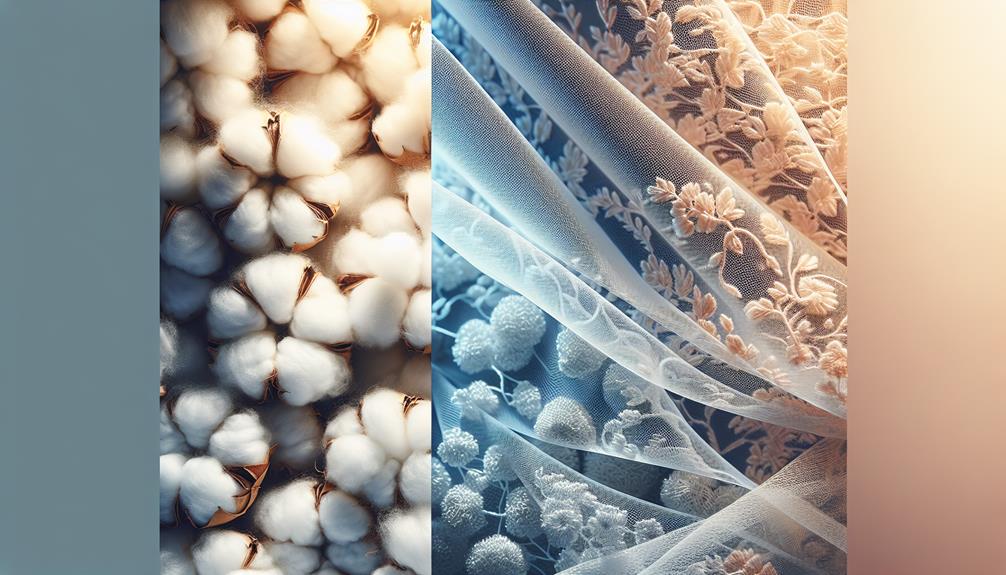
I've learned that cotton and organza are quite different. Cotton comes from natural fibers and is all about comfort and breathability, making it perfect for daily wear. Organza, on the other hand, is made from silk and is stiffer, holding its shape well. It's often used for more formal outfits because of its crispness and elegance. While cotton is durable and easy to care for, organza needs a bit more TLC to keep it looking great. There's a lot more to these fabrics when you compare their origins, uses, and how they handle wear and tear. Want to learn more?
Key Takeaways
- Cotton is a natural fiber, soft and comfortable, ideal for everyday wear; organza is a silk-based, stiffer fabric suited for formal attire.
- Cotton is machine washable and durable, while organza requires gentle hand washing and is more delicate.
- Cotton is generally more affordable and widely used, whereas organza is considered a luxury material with a higher price.
- Cotton fabric is breathable and cozy, making it suitable for casual clothing and home textiles; organza is crisp and elegant, often used in evening and bridal wear.
- The production of cotton is mechanized and focuses on quantity, while organza's manufacturing is more labor-intensive, emphasizing fine craftsmanship.
Origin and History
Cotton has been cultivated and used to make textiles for thousands of years, originating from ancient civilizations around the globe. It's a staple fiber that comes from the cotton plant, and people have figured out how to grow and process it way back in ancient times. It's actually pretty amazing to think about how folks back then, without all our modern tech, managed to turn these fluffy balls from plants into thread.
Now, if we chat about the history, cotton's story really kicks off in the Indus Valley in what's now Pakistan around 6,000 years ago. That's super old! Meanwhile, it popped up independently in civilizations in the Americas too. These guys not only grew cotton but had some smart ways of spinning and weaving it.
Moving forward in time, cotton played a huge part in the Industrial Revolution. This was a game-changer that made cotton way more available and way cheaper to produce. The invention of machines like the cotton gin really sped up the process of separating cotton fibers from seeds, which was a big headache before.
Material Composition
Now, let's talk about what cotton and organza are actually made of.
We'll look at their fiber sources and types, and how these affect their structure.
Understanding this can really help us see why they feel and behave so differently.
Fiber Source and Type
Let's dive into what these fabrics are made from: cotton comes from the fluffy fibers around the seeds of cotton plants, while organza is typically woven from silk threads. Here's a quick table to break it down:
| Fabric | Source Material |
|---|---|
| Cotton | Natural cotton fibers |
| Organza | Silk threads |
Cotton's all about comfort and breathability. It's a staple in casual wear and home textiles. Organza, on the other hand, brings a touch of luxury and elegance with its delicate, sheer texture, often found in evening wear and fine linens. Both have their unique charm, derived from distinctly different sources.
Structural Characteristics
Having explored where cotton and organza come from, we'll look at what makes their structures unique.
Cotton, as a natural fiber, has a softer, more flexible composition which allows it to absorb moisture well, making it comfortable against the skin. It's all thanks to its cellulose-based structure that provides both durability and breathability.
On the flip side, organza, often made from silk or synthetic fibers like polyester, boasts a stiff and sheer texture. Its crispness comes from a plain weave technique, tightly twisted together, giving it that characteristic thin yet strong profile.
Each material's unique structural traits directly influence their uses—cotton being ideal for everyday wear and organza, for more decorative, standout pieces.
Manufacturing Process
Let's talk about how cotton and organza are made.
First, we need to look at where the raw materials come from.
Then, we can explore the different ways they're woven and finished.
Raw Material Sourcing
I'll start by explaining how cotton and organza fabrics are sourced from their raw materials.
Cotton comes from the fluffy fibers surrounding the seeds of cotton plants. These plants grow mainly in regions with warm climates and a lot of sunshine, like India and the southern United States. It's a natural, renewable resource, which makes it pretty eco-friendly.
On the other hand, organza is generally made from silk, derived from the cocoons of silkworms. These worms are mainly bred on mulberry farms, primarily found in Asia. The process is more labor-intensive and not as eco-friendly, considering it involves sericulture (silk farming), which isn't sustainable.
Knowing where these materials come from helps understand their impact and value.
Weaving and Production Techniques
Now that we've covered where cotton and organza come from, let's look at how these fabrics are actually made. Cotton fabric starts its journey in the mill where the fibers are spun into yarn. This yarn is then woven using looms to create various types of cotton fabrics. The process is pretty straightforward and heavily mechanized, ensuring strong, uniform textiles.
On the other hand, organza's production is more delicate. It involves twisting and weaving silk fibers so finely that the resulting fabric has its characteristic lightness and sheer texture. The weaving process for organza is more precise and usually requires more attention to detail to maintain the quality and feel of the fabric, making it a bit more labor-intensive than cotton.
Finishing and Treatment Processes
After weaving, both cotton and organza undergo various finishing processes to enhance their quality and appearance. These steps are crucial because they determine how the fabric feels, looks, and lasts. Here's a peek at what typically happens:
- Softening: Cotton often gets treated with softeners to make it feel nice and comfy against the skin. Organza, however, might skip this to maintain its crisp texture.
- Dyeing and Printing: Both fabrics can be dyed or printed with patterns. The methods vary, but they're all about adding some color and flair.
- Calendering: This involves running the fabrics through heated rollers. It gives cotton a smooth finish, while for organza, it enhances its sheer, glossy look.
These processes make sure the fabrics are just right for their various uses.
Texture and Feel
Exploring the texture and feel, cotton is generally softer and more comfortable against the skin compared to the stiffer and more structured organza. When I pick up a cotton shirt, it feels cozy and gentle, almost like it's hugging me back. It's the kind of fabric that you'd want to wear all day, especially if comfort is your top priority.
On the flip side, organza has a completely different vibe. It's crisp and holds its shape, which makes it perfect for more formal or decorative pieces. When you touch organza, it's almost like rustling through a stack of thin, crisp paper. It doesn't cling to your body the way cotton does. Instead, it stands out and away, creating a sort of airy, elegant silhouette.
For everyday wear, cotton is my go-to because it's breathable and soft. It's perfect for just hanging out or even a busy day out. Organza, though, steps in when I need something with a bit more flair, like for a wedding or a fancy evening event. It's not about one being better than the other; it's about what feels right for the occasion.
Durability and Longevity
When it comes to durability and longevity, cotton and organza offer different advantages. Cotton, for instance, is pretty tough. It can handle a lot of wear and tear, making it ideal for everyday clothes like jeans and T-shirts. I've had some cotton shirts that last years, even with frequent washing. On the other hand, organza is more delicate. It's a fine fabric, often used in evening wear and decorative pieces. While it looks stunning, it doesn't stand up well to rough use and can tear or fray more easily than cotton.
Here's a quick rundown of their durability:
- Cotton:
- Resists abrasion and can handle machine washing.
- Maintains integrity over numerous washes without pilling much.
- Generally remains strong even when wet, which aids in its longevity.
- Organza:
- More susceptible to snags and tears due to its sheer, lightweight nature.
- Requires gentle hand washing or dry cleaning to avoid damage.
- Can degrade faster if exposed to harsh conditions like intense sunlight or heat.
Breathability and Comfort
Let's talk about how breathable and comfy cotton and organza are to wear. When I slip into a cotton shirt, it feels like a second skin. That's because cotton is super breathable, allowing air to circulate and keeping me cool on a hot day. Plus, it's soft, which adds to the overall comfort. Whether it's a sunny afternoon or a humid evening, cotton keeps things comfy.
Organza, on the other hand, tells a different story. This fabric feels more structured and crisp, which mightn't scream comfort at first. It doesn't hug the body like cotton. Instead, organza has a slight stiffness that can feel a bit less cozy against the skin. But here's the twist: its breathability is pretty decent. Made from silk or synthetic fibers, organza allows air to flow, which is a plus on warmer days.
Common Uses
Cotton is often used for everyday clothing like T-shirts and jeans because it's so comfortable and easy to care for. I've noticed it's also super popular for more than just clothes. Let's break down some of its key uses:
- Home Textiles: Cotton's everywhere at home! We're talking bed sheets, towels, and even curtains. Its durability and softness make it ideal for these items that we use daily.
- Medical Supplies: Yup, cotton is crucial here too. Think about cotton balls and bandages. Its hypoallergenic nature and softness ensure it doesn't irritate the skin, which is super important.
- Craft Materials: I love using cotton fabrics when I'm getting crafty. It's easy to dye, cut, and sew, which makes it perfect for do-it-yourself projects.
Organza, on the other hand, is used quite differently. It's that fancy fabric you often see in evening wear and decorations. Its sheer, lightweight nature makes it perfect for adding an elegant touch to outfits and events. I've seen it used in bridal gowns, prom dresses, and as decorative overlays that add a bit of flair without the extra weight.
Styling Tips
I've got some great styling tips for both cotton and organza to help you make the most of these fabrics.
First up, cotton. It's all about comfort and versatility, right? For a casual look, pair a cotton tee with jeans or layer it under a sweater when it's chilly. But cotton can also dress up. A crisp cotton shirt under a blazer? Perfect for business casual.
Now, for organza, this fabric screams elegance. It's lightweight and has a bit of a sheen, making it ideal for formal occasions. Think organza tops with high-waisted trousers or a flowing organza skirt with a fitted top.
But here's a pro tip: mix materials. Cotton and organza can create an interesting texture contrast. Try a cotton top with an organza skirt, or vice versa. This mix not only looks stylish but also balances comfort with sophistication.
Care and Maintenance
Taking care of cotton and organza requires different approaches to ensure they both retain their quality and appearance. I've found that mastering the maintenance of these two fabrics isn't just about keeping them clean, but also about preserving their unique characteristics.
Here's what you need to know:
- Cotton Care:
- Cotton's pretty low maintenance. You can usually toss it into the washing machine on a gentle cycle with warm water and a mild detergent. Avoiding bleach keeps it from weakening the fibers.
- When drying, I prefer to air dry cotton to prevent shrinkage, though using a dryer on a low heat setting works too.
- Organza Care:
- Organza's a totally different story. This delicate fabric needs a gentle touch. I always hand wash organza in cold water with a detergent meant for delicates.
- Never wring it out. Instead, I gently press the water out and lay it flat to dry.
- Ironing Techniques:
- For cotton, ironing on a high setting is fine as long as you use a bit of steam to eliminate wrinkles.
- Organza requires a cooler iron setting and a pressing cloth to protect the fabric.
These tailored approaches help me keep my cotton and organza items looking their best.
Environmental Impact
While we focus on how to care for fabrics like cotton and organza, it's also important to consider their environmental impacts. Cotton, for instance, is super popular but it's pretty taxing on the environment. Growing cotton requires a lot of water and often uses a heap of pesticides, which can harm our ecosystems. It's also a huge consumer of agricultural land that could otherwise be used to grow food.
On the flip side, organza's main issue ties back to its materials. Traditionally made from silk, the production of organza can be resource-intensive and sometimes ethically dubious, given that it involves silkworms. However, synthetic versions, usually from polyester, lessen the ethical issues but bump up environmental concerns with petroleum use and pollution during manufacturing.
What's key here is looking at sustainable options. For cotton, organic varieties are a win. They skip the harmful pesticides and often use less water. As for organza, choosing recycled polyester might be a step in the right direction, reducing the need for new petroleum-based materials and helping cut down on waste.
Price Comparison
Let's now compare the prices of cotton and organza. When you're out shopping for fabrics, it's pretty clear that there's a significant difference in how much you might fork out for cotton versus organza. This discrepancy mainly stems from the materials' production costs and the processes involved in manufacturing them.
Here's a quick rundown:
- Cotton: It's generally more affordable. The price can vary based on the type (like organic vs. regular), but it's widely available and used in a variety of products from clothing to home textiles. You're looking at a broad price range, but it's often on the lower end compared to more specialty fabrics.
- Organza: This fabric tends to be pricier. It's considered a luxury fabric, often used in formal wear and decorations. The cost reflects its delicate, intricate weaving process and the silky texture, often requiring more careful handling during production.
- Availability and Demand: Cotton is a staple in global textile production with high demand keeping its price relatively stable. Organza's niche market and specialized use in high-end products contribute to its higher price tag.
Frequently Asked Questions
Can Cotton or Organza Cause Allergies?
I've read that both cotton and organza can cause allergies, but it's usually due to the chemicals used in processing, not the fibers themselves. Always check for hypoallergenic options if you're sensitive.
Are Cotton and Organza Vegan-Friendly Materials?
Yes, both cotton and organza are vegan-friendly as they're derived from plant materials and silkworms aren't killed in organza production. They're great options if you're looking to avoid animal-derived fabrics.
Do Cotton and Organza Offer UV Protection?
I've found that both cotton and organza can offer UV protection, but their effectiveness varies. Cotton generally provides better protection due to its denser weave compared to the sheer, lightweight nature of organza.
Can Organza Be Dyed Easily Like Cotton?
I've tried dyeing organza, and it's not as straightforward as cotton. Cotton absorbs dye well, but organza requires specific types of dye and techniques to achieve a vibrant, even color.
Is Cotton or Organza Better for Formal Wear?
I'd say organza's better for formal wear because it's lighter and has a more elegant drape than cotton. Cotton's great, but it doesn't quite match organza's sheer, classy vibe for formal events.