
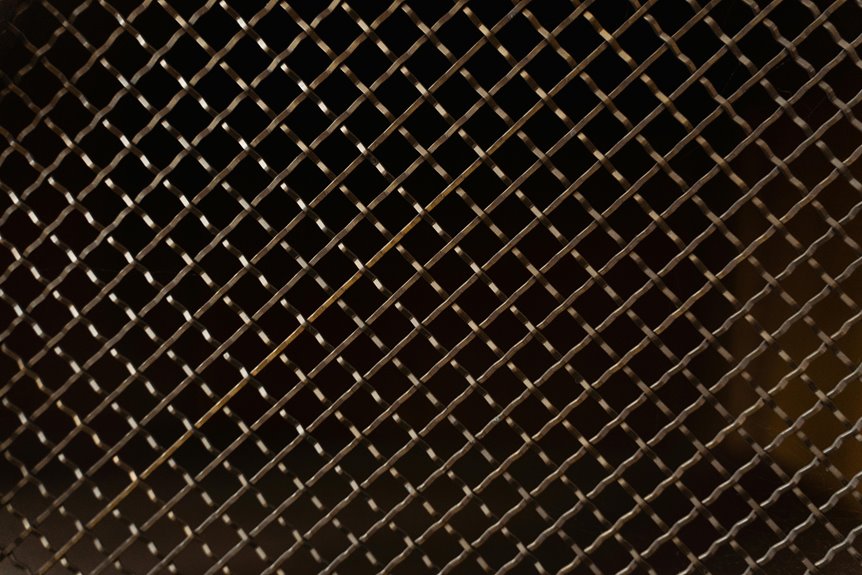
A laid scrim is a lightweight, open-weave fabric designed to reinforce composites and structural materials. You’ll find it made from fibers like polyester or fiberglass, arranged in parallel yarns for strength and flexibility without bulk. Its grid-like structure resists tearing and allows resin to bond easily, making it ideal for automotive, aerospace, and construction use. If you want to understand how different types, materials, and manufacturing processes affect performance, there’s more to explore.
Key Takeaways
- Laid scrims are lightweight, open-weave fabrics designed for reinforcement with parallel yarns in warp and weft directions.
- They provide excellent dimensional stability, flexibility, and strength without bulk, ideal for composite applications.
- Common materials include fiberglass, polyester, and polypropylene, chosen for strength, heat resistance, and chemical durability.
- Manufacturing involves weaving or bonding yarns, with strict quality control to ensure consistency and performance.
- Laid scrims offer superior resin compatibility, easy handling, and enhanced mechanical support compared to other reinforcement fabrics.
Definition and Characteristics of Laid Scrim
Laid scrim is a type of lightweight, open-weave fabric known for its strength and flexibility. When you use laid scrim, you benefit from its grid-like structure, which provides excellent dimensional stability without adding bulk.
It’s designed with parallel yarns laid in both warp and weft directions, held together by a minimal binder, so you get a fabric that’s both strong and adaptable. You’ll find it resists tearing and maintains shape, making it perfect for reinforcement applications where durability matters.
Plus, its openness allows for easy impregnation with resins or adhesives, enhancing bonding in composites. Laid scrim’s characteristics make it a reliable choice when you need a balance of toughness, lightweight performance, and flexibility in your fabric selection.
Materials Commonly Used in Laid Scrims
Choosing the right materials greatly impacts the performance and durability of scrims. When you select materials for laid scrims, you’ll often encounter fiberglass, polyester, and polypropylene.
Fiberglass is popular because it offers excellent strength, heat resistance, and dimensional stability, making it ideal for high-performance applications.
Fiberglass combines strength, heat resistance, and stability, perfect for demanding, high-performance scrim applications.
Polyester provides flexibility and good tensile strength while resisting moisture and chemicals, which suits various industrial uses.
Polypropylene is lightweight, resistant to many chemicals, and cost-effective, perfect when you need an economical option without sacrificing basic durability.
Sometimes, manufacturers combine these fibers to tailor scrims for specific needs. By understanding these common materials, you can make informed choices that match your project’s requirements and guarantee your laid scrim performs reliably in its intended environment.
Manufacturing Process of Laid Scrims
When you start the manufacturing process of laid scrims, you first focus on selecting the right materials to meet strength and flexibility needs.
Then, you apply specific weaving and bonding techniques to create a durable structure.
Finally, you implement quality control measures to guarantee consistency and performance in the finished product.
Material Selection Criteria
Selecting the right materials plays an essential role in the manufacturing process of laid scrims. You want fibers that balance strength, flexibility, and cost to suit your application. Common choices include polyester, fiberglass, and polypropylene, each offering unique benefits. Consider factors like chemical resistance, UV stability, and weight to guarantee durability and performance. Here’s a quick comparison to guide your choice:
| Material | Strength | Resistance |
|---|---|---|
| Polyester | High | UV, Chemical |
| Fiberglass | Very High | Heat, Chemical |
| Polypropylene | Moderate | Chemical, Moisture |
| Nylon | High | Abrasion, Moisture |
| Carbon Fiber | Very High | Heat, Chemical |
Selecting materials by these criteria helps you craft a laid scrim tailored for its intended reinforcement role.
Weaving and Bonding Techniques
Two main techniques dominate the manufacturing of laid scrims: weaving and bonding.
When you choose weaving, you interlace yarns perpendicularly, creating a stable grid that offers excellent strength and dimensional stability. This method suits applications demanding durability and uniformity.
On the other hand, bonding involves securing parallel yarns together using adhesives, heat, or ultrasonic methods without interlacing. You’ll find bonding faster and more cost-effective, ideal for lightweight or flexible scrims.
Both techniques let you tailor the scrim’s properties by adjusting yarn type, density, and bonding strength. Understanding these processes helps you select the right scrim for your composite or reinforcement needs, ensuring peak performance in your project.
Quality Control Measures
Every laid scrim manufacturer implements rigorous quality control measures to ascertain consistent strength and reliability.
You’ll find that each step—from fiber selection to bonding—is closely monitored. They test tensile strength and elongation to ascertain the scrim meets design specifications.
Visual inspections detect defects like misalignment or weak spots. Advanced equipment, such as laser measurement tools, checks uniformity in yarn spacing.
Manufacturers also conduct adhesion tests to confirm the bonding process holds strong under stress. By maintaining strict process controls and documenting results, they help you get a product that performs reliably in your composite or reinforcement applications.
Understanding these quality checks helps you trust the scrim’s durability and ascertains your final product maintains high standards.
Types of Laid Scrims and Their Variations
You’ll find several common types of laid scrims, each designed to meet specific needs.
Materials vary too, affecting strength, flexibility, and durability.
Understanding these differences helps you choose the right scrim for your application.
Common Laid Scrim Types
Laid scrims come in various types, each designed to meet specific needs and applications.
You’ll commonly encounter plain laid scrims, which feature simple, straight fibers laid parallel and perpendicular, offering basic reinforcement.
Then, there are knitted laid scrims that provide enhanced flexibility and conformability, ideal when your project demands adaptability.
You might also see multi-axial scrims, where fibers are laid in multiple directions beyond just 0° and 90°, giving you superior strength in various load conditions.
Additionally, some scrims come with binder fibers or coatings to improve stability and bonding with matrix materials.
Choosing the right type depends on your structural requirements and the environment where the composite will perform.
Understanding these common types helps you pick a laid scrim that fits your exact reinforcement needs.
Material Variations Overview
Understanding the types of laid scrims sets the stage for exploring the materials that make up these fabrics.
You’ll find that laid scrims commonly use fibers like fiberglass, polyester, and polypropylene. Each material offers unique benefits—fiberglass provides excellent strength and heat resistance, while polyester is known for flexibility and chemical resistance.
Polypropylene stands out for its lightweight nature and moisture resistance. Beyond these, some scrims use specialty fibers like aramid for high-performance needs.
The choice of material directly impacts durability, weight, and application potential. When you select a laid scrim, knowing these material variations helps you match the fabric to your project’s demands.
This overview prepares you to understand how different materials influence scrim characteristics without diving into specific use cases just yet.
Application-Specific Scrim Choices
When selecting a scrim for your project, considering the specific application is essential because different types of laid scrims offer tailored properties to meet various demands.
For example, if you need reinforcement in composites exposed to high stress, fiberglass scrims provide excellent tensile strength and durability. Polyester scrims, on the other hand, excel in flexibility and moisture resistance, making them ideal for applications like roofing membranes or geotextiles.
For lightweight yet strong options, carbon fiber scrims offer superior stiffness and are perfect for aerospace or automotive parts. Additionally, some scrims come coated or laminated to enhance bonding with resins or improve chemical resistance.
Applications of Laid Scrims in Composites
Composite manufacturers rely on laid scrims because they enhance strength and stability without adding much weight.
When you work with composites for automotive parts, aerospace components, or sporting goods, laid scrims provide consistent reinforcement that maintains structural integrity under stress. You’ll find them embedded in laminated panels, improving impact resistance and dimensional stability.
In construction, laid scrims reinforce roofing membranes and concrete, preventing cracks and prolonging lifespan. If you’re producing flexible packaging or filtration products, laid scrims add durability without compromising flexibility.
Benefits of Using Laid Scrims for Reinforcement
Laid scrims offer several key benefits that make them a top choice for reinforcement across industries. When you choose laid scrims, you’re investing in a material that boosts strength without adding much weight.
They’re easy to handle and cut, which speeds up your production process. Plus, their open structure guarantees excellent resin flow and bonding, improving the overall durability of your composite.
Here are four benefits you’ll appreciate:
- Enhanced mechanical strength for long-lasting performance.
- Lightweight design that doesn’t compromise reinforcement.
- Superior compatibility with various resin systems.
- Simplified installation thanks to flexible, easy-to-cut sheets.
Using laid scrims for reinforcement means you get reliable, efficient, and versatile support for your composite projects.
Comparing Laid Scrims to Other Reinforcement Fabrics
Although many reinforcement fabrics serve similar purposes, you’ll find that laid scrims stand out regarding flexibility, weight, and resin compatibility.
Unlike woven fabrics, laid scrims have fibers arranged without interlacing, giving you a more open structure. This means they’re lighter and more flexible, making them easier to handle and conform to complex shapes.
Compared to knitted or non-woven options, laid scrims offer superior dimensional stability and precise fiber orientation, which enhances strength where you need it most.
Additionally, their openness allows resin to flow freely, ensuring thorough impregnation and bonding.
Tips for Selecting the Right Laid Scrim for Your Project
When choosing the right laid scrim for your project, you’ll want to contemplate factors like fiber type, weight, and weave openness to match your specific needs.
These elements directly impact strength, flexibility, and compatibility with your materials. To help you decide, consider these tips:
- Identify Your Application Requirements – Understand the mechanical and environmental stresses your scrim will face.
- Select Appropriate Fiber Type – Choose between polyester, fiberglass, or other fibers based on durability and chemical resistance.
- Consider Weight and Thickness – Heavier scrims offer more reinforcement but may add bulk.
- Evaluate Weave Openness – Open weaves allow better resin flow and bonding; tight weaves provide higher strength.
Frequently Asked Questions
How Do Environmental Conditions Affect the Durability of Laid Scrims?
You’ll find that moisture, UV exposure, and temperature swings can weaken laid scrims over time. They can degrade fibers and adhesives, so you’ll want to choose materials and protective coatings suited for your environment to keep them durable.
Can Laid Scrims Be Recycled or Reused After Composite Product Life?
You can sometimes recycle or reuse laid scrims, but it depends on the composite materials and bonding. You’ll often need specialized processes to separate fibers, so check local recycling options and consider repurposing before disposal.
What Safety Precautions Are Needed When Handling Laid Scrim Materials?
You absolutely must protect yourself like you’re handling a ticking time bomb! Wear gloves, goggles, and a mask to avoid irritation or inhaling fibers. Work in a ventilated area and handle materials gently to prevent airborne dust.
How Do Laid Scrims Influence the Weight of Composite Structures?
You’ll find laid scrims add minimal weight to composites while boosting strength and stability. They help you create lighter, more durable structures by evenly distributing loads without considerably increasing overall mass.
Are There Industry Standards Regulating the Quality of Laid Scrims?
Yes, you’ll find industry standards like ASTM and ISO regulating laid scrim quality. These standards guarantee consistent strength, weight, and durability, helping you maintain reliable composite performance and meet safety and manufacturing requirements effectively.