
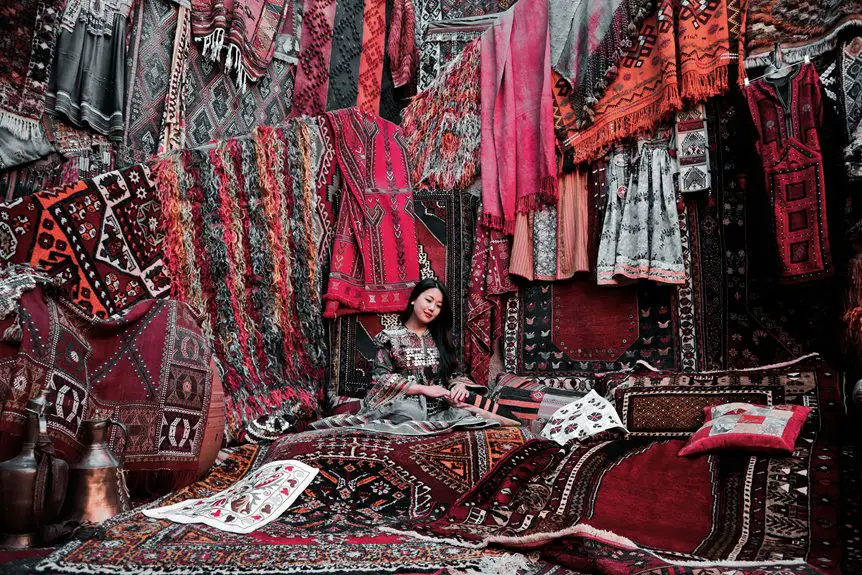
You’ll notice tapestry stands out from other jacquard fabrics by its rich history as handwoven art meant to tell stories or depict scenes, unlike jacquard’s often repetitive, decorative patterns. Tapestries use heavy natural fibers like wool, creating a textured, durable surface, while jacquard fabrics lean toward smoother, lighter blends. Their complex, non-repetitive designs demand skilled craftsmanship. If you want to understand more about these differences, including weaving techniques and uses, keep exploring further insights.
Key Takeaways
- Tapestries tell unique stories or historical scenes, while jacquard fabrics focus on repeating decorative patterns.
- Tapestries use hand-manipulated weaving for texture; jacquard fabrics use automated looms controlling individual warp threads.
- Tapestries feature complex, non-repetitive designs with fine shading; jacquard fabrics often have geometric, repeating motifs.
- Tapestries use heavier natural fibers like wool for a textured surface; jacquard fabrics use finer threads or synthetics for smoothness.
- Tapestries are primarily decorative wall hangings or upholstery; jacquard fabrics are common in clothing, drapery, and flexible textiles.
Historical Origins and Artistic Intent
Although tapestry and other jacquard fabrics share weaving techniques, their historical origins and artistic purposes set them apart.
When you look at tapestries, you’re seeing centuries-old craftsmanship designed to tell stories, depict historical events, or showcase religious themes. They served as portable murals, often commissioned by nobility or the church, emphasizing detailed imagery and narrative depth.
On the other hand, jacquard fabrics emerged later, focusing more on decorative patterns and functional textiles rather than storytelling. You’ll notice jacquard weavings prioritize repeat patterns suitable for clothing or upholstery, reflecting industrial innovation rather than individual artistic expression.
Understanding these distinctions helps you appreciate tapestries as unique art forms rooted in history, while jacquard fabrics lean toward mass-produced elegance and utility.
Weaving Techniques and Loom Usage
When you use a Jacquard loom, you control each warp thread individually, allowing for intricate patterns.
Tapestry weaving, however, often involves hand-manipulating threads, creating images with more texture and variation.
Understanding these differences helps you appreciate how technique shapes the final fabric.
Jacquard Loom Mechanics
If you’ve ever wondered how intricate designs come to life on jacquard fabrics, understanding the jacquard loom mechanics is key. This loom uses a series of punched cards or digital instructions to control each warp thread individually, allowing complex patterns. As you operate the loom, you’ll notice how each thread lifts or lowers precisely, creating detailed motifs.
| Component | Function |
|---|---|
| Warp Threads | Vertical threads, individually controlled |
| Weft Threads | Horizontal threads, woven through warp |
| Jacquard Head | Controls thread lifting mechanism |
| Punch Cards | Encode pattern instructions |
| Harness | Holds and moves warp threads |
This precise control is what sets jacquard fabrics apart in detail and complexity.
Weaving Process Differences
Because jacquard fabrics rely on intricate patterns, their weaving process demands specialized looms and techniques that differ considerably from other jacquard fabrics.
When you work with tapestry weaving, you use hand-operated or semi-automatic looms, allowing you to control each thread individually. This technique lets you create detailed, pictorial designs with precise color changes.
On the other hand, other jacquard fabrics typically rely on fully automated jacquard looms that weave repeating patterns more efficiently but with less manual intervention.
You’ll notice tapestry weaving involves inserting weft threads by hand, which gives you flexibility in color and texture, while standard jacquard fabrics use continuous weft yarns.
Pattern Complexity and Design Styles
You’ll notice tapestry and other Jacquard fabrics differ greatly in pattern complexity, with tapestries often showcasing highly intricate weaves.
As you explore, pay attention to the artistic themes and motifs that give each fabric its unique character.
Don’t forget to contemplate how color variations add depth and richness to the overall design.
Intricacy of Weave Patterns
While tapestry and other jacquard fabrics both showcase detailed weaving, tapestry stands out for its exceptional intricacy in pattern complexity and design styles.
When you examine a tapestry closely, you’ll notice how artisans weave multiple colored threads simultaneously, creating rich, textured surfaces with subtle gradations and depth.
Unlike many jacquard fabrics, which often rely on repeating geometric patterns, tapestries feature highly detailed, non-repetitive designs that demand precise control over each thread.
You’ll see how weavers manipulate warp and weft threads independently, producing complex images with fine shading and nuanced contours.
This level of craftsmanship means tapestries often have a more three-dimensional feel and visual richness that you just don’t find in standard jacquard textiles.
Artistic Themes and Motifs
The intricate weaving techniques of tapestries set the stage for their unique artistic themes and motifs. When you explore tapestries, you’ll notice they often tell stories or depict scenes, which makes them stand out from other Jacquard fabrics.
You get a rich blend of complexity and symbolism that’s rare elsewhere. Here’s what you can expect in tapestry designs:
- Elaborate narrative scenes inspired by history or mythology
- Detailed representations of flora and fauna
- Stylized geometric patterns with cultural significance
- Iconic motifs that reflect artistic movements like Renaissance or Baroque
Unlike many Jacquard fabrics that focus on repetitive or abstract designs, tapestries emphasize depth and storytelling through their patterns.
When you appreciate tapestries, you’re engaging with a form of textile art that’s both visually and culturally immersive.
Color Variations and Depth
Although other Jacquard fabrics often rely on limited color palettes and simpler patterns, tapestries dazzle with rich color variations and intricate depth.
When you examine a tapestry, you’ll notice how countless hues blend seamlessly, creating subtle shading and a three-dimensional effect. This complexity lets you appreciate the artistry in every thread, as colors shift to depict light, shadow, and texture more realistically.
Unlike many Jacquard fabrics that focus on repetitive, flat designs, tapestries use a wide spectrum of colors to tell detailed stories and evoke emotion.
When you choose tapestry, you’re not just selecting fabric—you’re embracing a dynamic, visually rich medium that stands apart through its layered, nuanced color work and remarkable depth.
Material Choices and Texture Differences
When you compare tapestry to other jacquard fabrics, you’ll notice distinct differences in material choices and texture that affect both appearance and feel.
Tapestries often use heavier, natural fibers like wool or cotton, giving them a rich, tactile surface. Other jacquard fabrics might lean toward silk or synthetic blends, resulting in smoother, lighter textures. These material choices influence durability and the overall hand feel.
Tapestries favor heavy natural fibers for texture, while jacquard fabrics use silk or synthetics for smoothness and lightness.
Consider these points:
- Tapestries feature thicker yarns, creating a raised, textured surface.
- Jacquard fabrics usually have finer threads for a sleek finish.
- Natural fibers in tapestries add warmth and weight.
- Synthetic blends in jacquard fabrics enhance sheen and flexibility.
Understanding these differences helps you pick the right fabric for your project.
Common Applications and Functional Uses
Because tapestry and other jacquard fabrics offer different textures and durability, you’ll find they suit distinct applications.
Tapestry’s thick, richly patterned weave makes it ideal for decorative uses like wall hangings, upholstery, and cushions. You’ll often see tapestries adding a historic or artistic touch to interiors.
On the other hand, jacquard fabrics, with their finer, lighter weaves, are perfect for clothing, drapery, and bedding where flexibility and comfort matter. You can also use jacquard for table linens or fashion accessories that require detailed designs without the heavy texture.
Understanding these differences helps you select the fabric that fits your project’s functional needs and aesthetic goals perfectly.
Durability and Maintenance Considerations
Choosing the right fabric isn’t just about appearance or application; you also need to contemplate how well it stands up to wear and how much effort maintenance requires.
Tapestry, with its dense weave and thicker yarns, generally offers superior durability compared to many other Jacquard fabrics. However, its care demands are a bit higher due to the intricate patterns and heavier weight.
When considering durability and maintenance, keep these points in mind:
- Tapestry resists abrasion well, making it ideal for upholstery.
- It’s less prone to pilling but can be susceptible to snags.
- Cleaning often requires gentle vacuuming or professional cleaning to preserve colors.
- Other Jacquard fabrics might be lighter and easier to wash but less durable overall.
This balance helps you pick the fabric that fits your lifestyle.
Frequently Asked Questions
Can Tapestries Be Custom-Made for Modern Interior Design?
You’re in for a delightful surprise—tapestries can indeed be custom-made to suit modern interiors. Designers often embrace their timeless charm, weaving contemporary themes and colors that harmonize beautifully with your unique style and space.
How Do Tapestries Impact Indoor Air Quality?
You’ll find tapestries can help improve indoor air quality by trapping dust and allergens on their fibers, reducing airborne particles. Just remember to clean them regularly, so they don’t become a source of dust themselves.
Are Tapestries More Environmentally Sustainable Than Other Fabrics?
You’ll find tapestries can be more sustainable since they often use natural fibers and traditional weaving, reducing synthetic waste. Plus, their durability means you won’t replace them as often, helping lower overall environmental impact.
What Are the Typical Costs Associated With Commissioning a Tapestry?
Commissioning a tapestry is like planting a rare tree; it demands patience and investment. You’ll typically pay thousands, depending on size, complexity, and artist reputation. Don’t forget to budget for shipping and framing costs too.
Can Tapestries Be Used Effectively in Outdoor Settings?
You can use tapestries outdoors, but they’re not ideal for prolonged exposure to weather. They might fade or deteriorate, so consider protective coatings or placing them in covered areas to keep their beauty intact.