
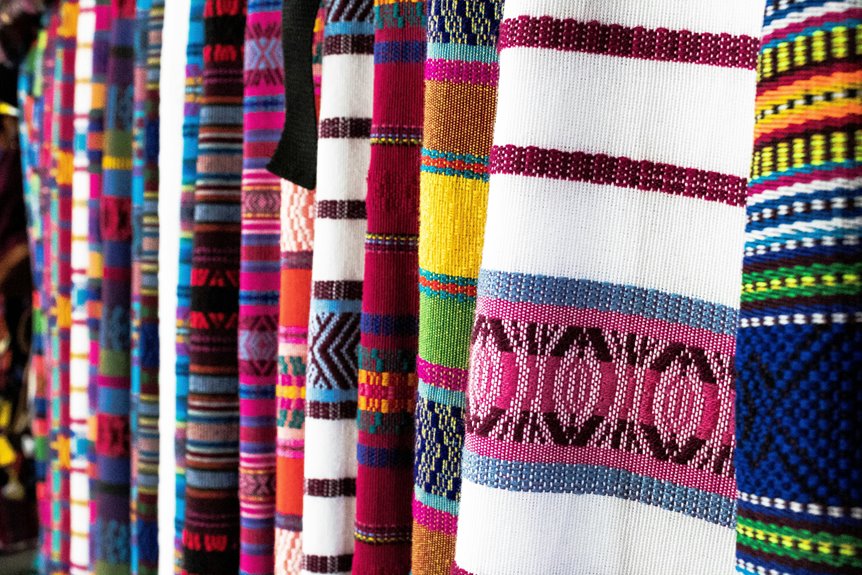
If you’re curious about Warp Ikat vs. Double Ikat, here’s the key: Warp Ikat dyes only the warp threads before weaving, making it simpler and quicker. Double Ikat dyes both warp and weft threads, demanding precise alignment and far more skill, often reserved for special occasions. Warp Ikat reflects local customs, while Double Ikat carries deep cultural meaning and intricate patterns. Understanding these differences will give you a richer appreciation of their unique artistry and heritage.
Key Takeaways
- Warp Ikat dyes only the warp threads before weaving, creating vertical patterns, whereas Double Ikat dyes both warp and weft threads for intricate designs.
- Double Ikat requires higher precision and skill as both threads must align perfectly, making it more complex and time-consuming than Warp Ikat.
- Warp Ikat is quicker to produce, with simpler dyeing and weaving, while Double Ikat involves meticulous tying and dyeing, often taking weeks or months.
- Cultural significance varies: Warp Ikat reflects local and tribal traditions; Double Ikat is often reserved for special ceremonies and celebrations.
- Warp Ikat fabrics are typically used for everyday wear and household items, whereas Double Ikat is mainly used for ceremonial garments and decorative purposes.
What Is Warp Ikat?
Warp Ikat is a dyeing technique where the threads running lengthwise on the loom—the warp—are resist-dyed before weaving.
Warp Ikat involves resist-dyeing the lengthwise warp threads before weaving to create intricate patterns.
You’ll notice that the warp threads are carefully tied and dyed in specific patterns, so when you weave, the design emerges along the fabric’s length.
This method allows for precise control over the pattern on the warp, while the weft threads remain undyed or solid-colored.
As you weave, the pre-dyed warp threads create intricate, often geometric designs that appear on the finished textile.
Because only the warp is dyed, the patterns generally run vertically.
You can appreciate how this technique demands skill in aligning the dyed warp threads, ensuring the final fabric shows clear, sharp motifs without distortion.
Warp Ikat is popular in regions like India and Indonesia.
What Is Double Ikat?
Double Ikat is a complex and rare dyeing technique where both the warp and weft threads are resist-dyed before weaving. This dual resist-dyeing process requires precise alignment of dyed patterns on two separate thread sets, making it highly intricate.
When you work with double ikat, you’ll notice:
- Both warp and weft threads carry the pattern.
- Patterns emerge only after weaving, demanding perfect coordination.
- It’s time-consuming and requires expert skill.
- The finished fabric displays vibrant, symmetrical designs unmatched by single or warp ikat.
You’ll find double ikat fabrics mostly in select regions like India, Japan, and Indonesia.
Because of its difficulty, double ikat is rarer and often more expensive than warp ikat.
When you appreciate double ikat, you value the artistry and precision behind each piece.
The Dyeing Process in Warp Ikat
While double ikat demands aligning patterns on both thread sets, the dyeing process in warp ikat focuses solely on the warp threads.
You begin by tightly binding sections of the warp threads to resist dye in specific areas. This selective binding allows you to create intricate patterns before the threads are dyed.
After dyeing, you remove the bindings and may repeat the process if multiple colors are needed. Because only the warp threads are dyed, you have more control over the design’s lengthwise pattern but less complexity across the width.
Removing bindings after dyeing allows repeating for multiple colors, offering lengthwise pattern control but simpler width complexity.
Once dyed and dried, you stretch the warp threads on the loom and weave the undyed weft threads through them, revealing the characteristic blurred edges of warp ikat patterns.
This method is less time-consuming than double ikat yet still produces stunning textiles.
The Dyeing Process in Double Ikat
When you work with double ikat, you rely on tie-dye precision to align both warp and weft threads perfectly.
This technique demands incredible attention to detail to guarantee the colors meet flawlessly.
You’ll soon see how these challenges make double ikat truly unique.
Tie-Dye Precision Techniques
Although tie-dye might seem simple at first glance, the precision required in double ikat dyeing demands meticulous planning and execution. You have to carefully bind both the warp and weft threads before dyeing, ensuring patterns align perfectly.
Here’s what you need to focus on:
- Accurate Measuring: You must measure threads precisely to match design dimensions.
- Strategic Binding: Tie threads tightly at specific points to resist dye exactly where needed.
- Sequential Dyeing: Dye in stages, from lightest to darkest colors, to maintain clarity.
- Consistent Tension: Keep thread tension uniform during the entire process to avoid distortions.
Color Alignment Challenges
Because double ikat requires aligning patterns on both warp and weft threads, maintaining perfect color registration during dyeing poses serious challenges.
You must carefully tie resist patterns on both sets of threads, anticipating how they’ll intersect once woven. Any slight misalignment in dye application can distort the intended design, making the process painstakingly precise.
Unlike warp ikat, where only one thread set is patterned, double ikat demands that you synchronize two separate dyeing steps flawlessly. You’ll need patience and expert skill to guarantee colors line up exactly, as even minor errors ruin the intricate motifs.
This complexity greatly increases production time and requires meticulous planning, but it’s what gives double ikat its unmatched visual depth and symmetry.
Complexity and Skill Level Comparison
You’ll notice that double ikat demands more precision and patience than warp ikat.
It takes a significant time investment and a higher level of artisan expertise to master.
Let’s explore how these differences affect the overall complexity and skill required for each technique.
Technique Difficulty Levels
When you compare Warp Ikat and Double Ikat, you’ll notice a significant difference in the complexity and skill required.
Double Ikat demands far greater precision because both warp and weft threads are resist-dyed before weaving. This technique challenges even experienced artisans.
Here’s why Double Ikat’s difficulty stands out:
- You must align dyed patterns on both warp and weft perfectly.
- The margin for error is minimal—any misalignment ruins the design.
- It requires advanced planning and expert dyeing skills.
- Weaving demands meticulous attention to detail to maintain pattern integrity.
Warp Ikat, by contrast, involves dyeing only the warp threads, simplifying alignment and reducing technical challenges.
You’ll find it easier to master compared to the intricate coordination needed for Double Ikat.
Time Investment Required
Although both Warp Ikat and Double Ikat demand dedication, Double Ikat takes considerably more time due to its intricate dyeing and weaving processes.
When you work with Warp Ikat, you focus primarily on dyeing the warp threads before weaving, which still requires patience but follows a more straightforward sequence.
In contrast, Double Ikat involves carefully resist-dyeing both warp and weft threads, doubling the complexity and extending the preparation time greatly.
You’ll find that Double Ikat projects can take weeks or even months longer to complete, depending on the pattern’s intricacy.
If you’re pressed for time or new to ikat, Warp Ikat might suit you better.
But if you’re ready to invest extra hours for unparalleled detail, Double Ikat offers that depth.
Your time commitment directly reflects the craft’s complexity.
Artisan Expertise Needed
Because Double Ikat requires aligning patterns on both warp and weft threads, it demands a higher level of skill and precision from artisans compared to Warp Ikat.
When you work with Double Ikat, you must:
- Precisely tie both warp and weft threads to create intricate, symmetrical designs.
- Carefully coordinate dyeing to guarantee colors match perfectly at intersections.
- Maintain tension on threads to avoid distortions during weaving.
- Exhibit advanced patience and experience due to the time-consuming nature of the process.
In contrast, Warp Ikat mainly involves tying and dyeing the warp threads, making it less complex but still requiring substantial expertise.
If you want to master Double Ikat, be ready to invest more in training and practice, as it’s a craft that necessitates exceptional attention to detail and steady hands.
Cultural Significance and Regional Variations
Understanding the cultural significance and regional variations of Warp Ikat and Double Ikat helps you appreciate the rich traditions behind these weaving techniques.
Warp Ikat often reflects local customs, with patterns tied to ceremonies or community identity. For example, in Indonesia, Warp Ikat showcases tribal stories and symbols unique to each island.
Double Ikat, on the other hand, is rarer and usually reserved for special occasions; places like Gujarat and Odisha in India are famous for their intricate double-dyed textiles.
When you explore these regional differences, you see how geography, history, and culture shape the designs and uses of Ikat fabrics. Recognizing these factors deepens your respect for the artisans’ skills and the cultural narratives woven into every piece.
Frequently Asked Questions
Can Ikat Fabrics Be Machine-Washed Without Damage?
You shouldn’t machine-wash ikat fabrics because the dye might bleed or the fibers could weaken. Instead, hand-wash them gently in cold water with mild detergent to keep the colors vibrant and the fabric intact.
What Types of Fibers Are Best for Ikat Weaving?
Oh, because synthetic fibers scream “authentic ikat,” right? Actually, you’ll get the best results using natural fibers like cotton, silk, or wool—they absorb dye beautifully and hold intricate patterns, making your ikat vibrant and lasting.
How Does Climate Affect the Ikat Dyeing Process?
You’ll find that climate impacts ikat dyeing by influencing drying times and color absorption. Humidity slows drying, risking smudges, while heat speeds it up, helping colors set. Adjust your process accordingly for best results.
Are There Modern Fashion Uses for Ikat Textiles?
You’ll find ikat textiles weaving their vibrant patterns into modern fashion, from flowing dresses to sharp blazers. Designers love how the fabric dances with color, turning everyday wear into a bold, artistic statement you’ll cherish.
What Tools Are Essential for Ikat Weaving?
You’ll need essential tools like a loom, resist-dye materials (string or rubber bands), and dye vats for ikat weaving. Precision tools for tying patterns and measuring threads help you create those intricate, beautiful designs.