
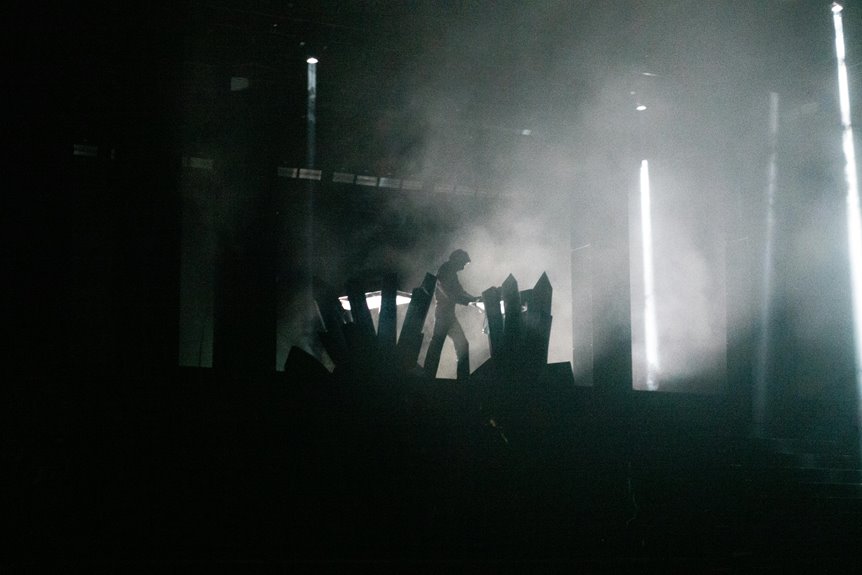
You create the theatrical “bleed-through” effect by using a scrim, a special fabric that looks opaque when lit from the front and transparent when backlit. This happens because light scatters on the scrim’s tiny weave gaps, hiding or revealing what’s behind. Choosing the right scrim type and lighting angles is key. With proper tension and maintenance, you can enhance your scenes dramatically. Keep exploring, and you’ll discover how scrims shape unforgettable theatrical moments.
Key Takeaways
- The bleed-through effect occurs when scrims appear opaque under front lighting and transparent under strong backlighting.
- Scrims are made from loosely woven fabrics like sharkstooth or bobbinet to allow light passage through tiny gaps in the weave.
- Proper lighting contrast, with front light dimmed or off and intense backlight focused behind the scrim, is essential to achieve the effect.
- Stretching the scrim tightly and mounting it flat prevents wrinkles that distort light transmission and visibility.
- Controlling ambient light and audience viewing angles enhances the clarity and impact of the bleed-through effect onstage.
What Is a Theatrical Scrim?
A theatrical scrim is a special type of fabric used in stage productions to create visual effects.
When you use a scrim, it appears opaque when lit from the front but becomes transparent when lit from behind. This unique property allows you to reveal or hide objects, actors, or scenes seamlessly.
By controlling the lighting, you can make the scrim seem solid or ghostly, enhancing the storytelling without changing the set. It’s lightweight and often made from a loosely woven material, so light passes through it easily.
When you experiment with angles and intensity of light, you unleash creative possibilities that add depth and mystery to your production.
Mastering scrim use can transform your stage design dramatically.
Types of Scrims Used in Theater
Though scrims might seem similar at first glance, you’ll find several types designed for different effects and purposes in theater.
Choosing the right scrim lets you control visibility, lighting, and atmosphere perfectly. Here are the main types you’ll encounter:
Selecting the perfect scrim shapes your scene’s mood, light quality, and audience perception with precision.
- Sharkstooth Scrim: Made with a diamond-shaped weave, it offers excellent transparency and is great for subtle fade-ins.
- Sharkskin Scrim: Has a finer weave than sharkstooth, allowing for smoother light diffusion.
- Bobbinet Scrim: Lightweight with a hexagonal mesh, it’s often used for projections and softening backgrounds.
- Drop Scrim: Heavier and less transparent, ideal when you want a solid backdrop but still need some light penetration.
The Science Behind the Bleed-Through Effect
Understanding the different types of scrims helps you appreciate how their unique weaves and weights influence light and visibility.
The bleed-through effect happens because scrims are woven with tiny gaps, allowing light to pass through unevenly. When you light a scrim from the front, it appears opaque since the fabric scatters light, blocking the view behind it.
But when you light it from behind, light travels through those gaps, making the scrim seem transparent. Your eyes perceive this change as a “bleed-through” because the contrast between lighting angles alters how much detail you can see.
This interplay of light transmission and reflection is key to creating dramatic reveals on stage, giving you control over what the audience sees and when.
Materials and Construction of Scrims
When choosing a scrim, you’ll want to take into account common fabrics like sharkstooth or bobbinet, each offering different effects.
The weave density plays an essential role in how light passes through, affecting visibility and opacity.
You’ll also need to stretch and mount the scrim properly to guarantee a smooth, effective surface for your production.
Common Scrim Fabrics
Because scrims serve various visual effects on stage, their fabrics come in different weaves and materials designed to manipulate light and transparency.
When choosing a scrim fabric, you’ll want to take into account how each type interacts with lighting and the desired level of visibility.
Here are some common scrim fabrics you’ll encounter:
- Sharkstooth Scrim: Known for its distinctive diamond pattern, it offers great opacity control.
- Bobbinet: A fine, hexagonal mesh that creates a smooth, semi-transparent surface.
- Leno: Features twisted threads for strength and moderate openness, balancing durability and transparency.
- Netted Polyester: Lightweight and durable, often used for budget-conscious productions without sacrificing effect.
Knowing these options helps you pick the perfect scrim for your theatrical vision.
Weave Density Importance
The choice of fabric is just the start; how tightly or loosely it’s woven makes a big difference in a scrim’s performance. When you select a scrim, consider its weave density carefully—it controls how much light passes through and how visible objects behind it become. A loose weave lets more light and images bleed through, creating that magical ghostly effect. A tight weave blocks more light, making the scrim appear solid when lit from the front.
| Weave Density | Light Transmission | Effect on Visibility |
|---|---|---|
| Very Loose | High | Clear silhouettes |
| Loose | Moderate-High | Faint outlines |
| Medium | Moderate | Subtle shapes |
| Tight | Low | Mostly opaque |
| Very Tight | Very Low | Solid appearance |
Choose the right density to get the exact “bleed-through” effect you want.
Stretching and Mounting
Properly stretching and mounting a scrim guarantees it stays taut and performs as intended on stage.
When you stretch a scrim, you eliminate wrinkles and confirm even light diffusion, which is essential for that classic “bleed-through” effect.
Mounting involves securing the fabric tightly to a frame or battens without damaging it.
Use materials designed for durability and flexibility to maintain tension over time.
Consider:
- Heavy-duty clamps or grommets for secure attachment
- Aluminum or wooden frames for stable support
- Stretching tools like battens or ratchets to achieve tension
- Reinforced edges to prevent fraying and tearing
Lighting Techniques for Scrim Effects
When you shine light directly onto a scrim, it reveals the material’s texture and opacity, creating sharp, defined images or silhouettes.
To achieve the classic “bleed-through” effect, you’ll want to light the scrim from behind, using a strong backlight. This technique makes the scrim appear translucent, allowing shapes and colors to softly glow through.
Adjust the light intensity to control how much detail you want visible—brighter backlighting increases transparency, while dimmer light keeps it more opaque. You can also use colored gels on your lights to add mood or atmosphere.
Avoid front-lighting the scrim during backlighting, as it can wash out the effect. Experiment with angles and distances to find the perfect balance between opacity and translucency for your scene.
Positioning Actors and Props With Scrims
Lighting your scrim effectively sets the stage, but how you position actors and props in relation to it truly shapes the visual impact.
To achieve the “bleed-through” effect, you need to carefully plan placements that enhance depth and mystery. Place actors closer to the scrim for a soft, ghostly silhouette. Keep props slightly behind the scrim to maintain subtle outlines.
Careful placement enhances depth—actors near the scrim create ghostly silhouettes, props behind offer subtle outlines.
Use distance to control focus—objects further back appear more transparent. Also, experiment with angles; positioning elements off-center can create dynamic layers.
- Position actors near but not pressed against the scrim
- Arrange props to avoid clutter and maintain clear silhouettes
- Use varying depths to emphasize or soften outlines
- Adjust angles to add visual interest and dimension
This thoughtful placement guarantees your scrim transforms scenes with powerful, layered imagery.
Common Challenges When Using Scrims
When working with scrims, you’ll often face challenges like controlling visibility and balancing lighting just right.
You might also worry about the material’s durability during long runs or intense setups.
Understanding these common issues will help you use scrims more effectively on stage.
Visibility Control Issues
Although scrims offer unique visual effects, controlling visibility through them can challenge your design intentions. You might find it tricky to decide when the audience should see what’s behind the scrim or when to keep it hidden.
Here are common visibility control issues you could face:
- Uneven visibility caused by scrim tension inconsistencies
- Unintended transparency due to ambient light spill
- Difficulty in achieving sharp silhouettes or clear outlines
- Audience angle affecting how much detail is visible through the scrim
To overcome these, you’ll need to carefully manage scrim placement and tension, and think critically about sightlines.
Mastering this control helps you deliver the desired “bleed-through” effect without losing the element of surprise or clarity.
Lighting Balance Difficulties
Because scrims rely heavily on how light interacts with their surfaces, you’ll often face challenges striking the right balance between illumination and shadow.
If your front lighting is too strong, the scrim becomes almost opaque, hiding whatever’s behind it. Conversely, if your backlighting isn’t bright enough, the image or actor behind the scrim won’t “bleed through” effectively, losing the magical transparency effect.
You’ll need to carefully adjust intensity, angle, and color temperature of lights on both sides to maintain that delicate equilibrium. Even slight shifts can drastically change the scrim’s appearance.
Material Durability Concerns
Scrims demand careful handling since their delicate fabric can wear out quickly under frequent use.
When you’re working with scrims, you need to be aware of common durability issues that can affect their performance and lifespan. Here are some challenges you’ll want to manage:
- Tearing: The lightweight material is prone to rips if caught on sharp edges or rough surfaces.
- Stretching: Over time, tension can distort the fabric, impacting the visual effect.
- Fraying: The edges may unravel without proper finishing or reinforcement.
- Staining: Dirt and makeup can embed easily, making scrims look worn and reducing translucency.
Creative Applications of Bleed-Through in Storytelling
When you use bleed-through creatively in storytelling, you can add layers of meaning and emotion to a scene without relying solely on dialogue or action.
For example, you might reveal a character’s inner turmoil by projecting their shadow behind a scrim while they speak calmly onstage, hinting at hidden conflict. You can also use bleed-through to shift between scenes seamlessly, fading one image into another to suggest a change in time or mood.
This technique encourages your audience to engage actively, interpreting subtle visual cues. Plus, it helps you emphasize themes or foreshadow events without spelling everything out.
Maintenance and Care for Theatrical Scrims
You’ll want to keep your theatrical scrims clean by using gentle cleaning techniques to avoid damage.
Proper storage is essential to prevent wrinkles and tears when the scrim isn’t in use.
Handling and repairing scrims carefully will extend their lifespan and maintain their performance quality.
Cleaning Techniques
Although theatrical scrims are designed to be durable, regular cleaning is essential to maintain their visual clarity and performance quality.
You want to handle them gently to avoid damaging the delicate fabric. Here are some effective cleaning techniques:
- Use a soft brush or lint roller to remove dust and loose debris before washing.
- Spot-clean stains with a mild detergent diluted in water, applying gently with a sponge.
- Avoid harsh chemicals or bleach, as they can weaken the fibers and alter translucency.
- Rinse thoroughly with cool water after cleaning to remove any soap residue.
Storage Best Practices
Since proper storage extends the life of your theatrical scrims, you should take care to keep them in a clean, dry, and cool environment.
Avoid areas with high humidity or direct sunlight, as these can cause fading, mildew, or fabric deterioration.
Always roll your scrims loosely instead of folding them to prevent creases or permanent damage. Use acid-free tissue paper between layers if you need to stack multiple scrims.
Store them in breathable fabric bags or containers rather than plastic, which traps moisture.
Label each scrim clearly so you can find what you need without unnecessary handling.
Regularly inspect your scrims during storage for signs of pests or damage, ensuring they remain in top condition for your next production.
Repair and Handling
Proper storage protects your theatrical scrims, but handling and repair play a big role in keeping them performance-ready.
When you handle scrims, always use clean hands or gloves to avoid dirt and oils that can damage the fabric. Inspect your scrims regularly for tears or loose threads, and repair small holes immediately to prevent them from worsening. Use a gentle sewing technique or fabric adhesive designed for theatrical materials. Avoid harsh chemicals or excessive heat during cleaning to maintain fabric integrity.
- Handle scrims gently, avoiding sharp objects
- Patch small tears promptly with matching fabric
- Clean scrims with mild detergents and cold water
- Store scrims rolled or flat, never folded to prevent creases
Historical Examples of Scrim Usage in Theater
When you explore the history of theater, you’ll find scrims have played an essential role in creating dramatic effects. From Shakespearean plays to modern musicals, scrims have helped directors manipulate light and shadow to convey mystery, transformation, or reveal hidden scenes. For example, in Elizabethan theater, they allowed quick scene alterations, while in 20th-century productions, scrims created ghostly or dreamlike atmospheres.
Here’s a quick look at notable historical scrim uses:
| Era | Usage Example |
|---|---|
| Elizabethan | Scene alterations |
| Victorian | Ghost effects in plays |
| Early 1900s | Shadow plays |
| Mid-1900s | Musicals, atmospheric shifts |
| Contemporary | Multimedia projections |
You can see how scrims evolved, enhancing storytelling through visual surprises.
Tips for Integrating Scrims Into Your Production
Although scrims can transform your production with stunning visual effects, integrating them effectively requires careful planning.
You need to take into account lighting, placement, and timing to maximize their impact without distracting your audience. Here are some tips to help you smoothly incorporate scrims into your show:
- Test lighting angles beforehand to control the “bleed-through” effect precisely.
- Use scrims in scenes where you want to reveal or conceal elements subtly.
- Coordinate actor movements and scrim placement to avoid unintended shadows or distractions.
- Practice cues thoroughly with your technical team to guarantee seamless shifts during performances.
Frequently Asked Questions
Can Scrims Be Used Outdoors in Theater Productions?
You might wonder if scrims can survive outdoors. They can, but you’ll need to take into account weather, lighting, and durability. With proper setup, scrims add mystery and depth, transforming your outdoor theater into a enchanting experience.
Are There Eco-Friendly Materials for Making Scrims?
You can choose eco-friendly scrim materials like organic cotton or recycled polyester. These options reduce environmental impact while maintaining durability and translucency. Look for certified sustainable textiles to keep your productions green and effective.
How Do Scrims Affect Sound Quality on Stage?
Scrims act like a soft whisper between instruments, subtly absorbing sound waves. You’ll notice they slightly muffle or diffuse audio, creating a gentle barrier that changes acoustics without silencing performers—perfect for nuanced stage atmospheres.
Can Scrims Be Customized With Printed Images or Patterns?
Yes, you can customize scrims with printed images or patterns. You’ll want to choose high-quality, translucent fabric and work with a professional printer to guarantee the design looks vibrant and maintains the scrim’s unique light effects.
What Are the Storage Recommendations for Large Theatrical Scrims?
You’ll want to store large scrims rolled and hung or flat to avoid wrinkles, just like you’d carefully fold a treasured map. Keep them in a dry, cool place—moisture and heat can ruin their magic.