
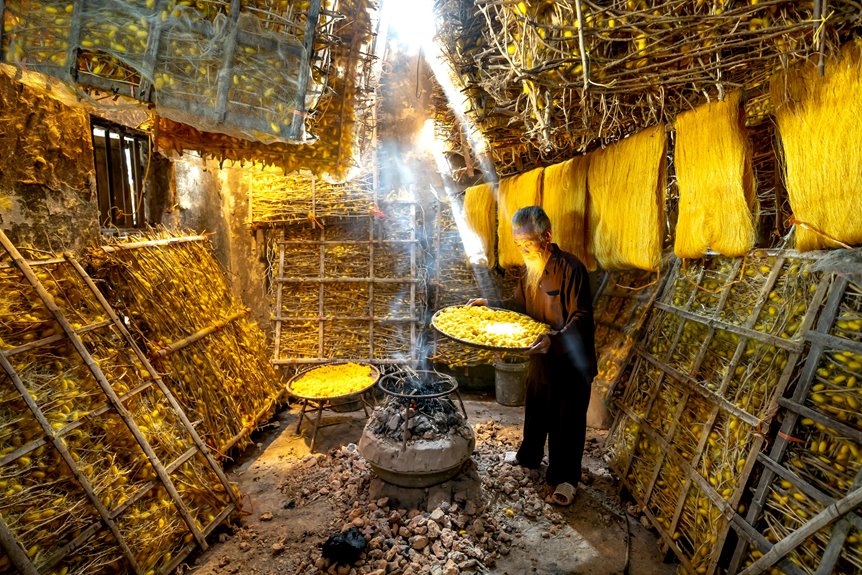
When you explore traditional Katan silk weaving, you start with expertly harvested and boiled silk cocoons to extract smooth threads. These threads are carefully twisted for strength and dyed with natural colors to guarantee vibrancy. Skilled artisans then set up handlooms to weave fabric with precision, producing a durable yet luxurious texture. The final steps involve finishing techniques like calendering and softening to enhance shine and feel. If you want to uncover more about this intricate craft, there’s much more to discover.
Key Takeaways
- Skilled artisans prepare high-quality silk threads by boiling cocoons and unwinding filaments for weaving.
- Threads are carefully twisted to enhance strength, texture, and durability without compromising elasticity.
- Natural dyes are applied through multiple soaking and controlled processes to achieve vibrant, lasting colors.
- The weaving involves precise interlacing of prepared threads to create smooth, dense fabric with traditional patterns.
- Final finishing includes calendering, starching, softening, and buffing to enhance luster, feel, and fabric structure.
Origins and Significance of Katan Silk
Katan silk traces its roots back to ancient India, where skilled artisans crafted this luxurious fabric using finely twisted silk threads.
When you wear or work with Katan silk, you’re connecting to centuries of tradition and mastery. This fabric isn’t just about beauty; it symbolizes elegance and status in Indian culture, often reserved for special occasions like weddings and festivals.
Wearing Katan silk links you to centuries of tradition, symbolizing elegance and cherished cultural moments.
You’ll notice its durability and smooth texture set it apart from other silks, thanks to the precise weaving methods developed over time.
Understanding Katan silk’s origins helps you appreciate the craftsmanship involved and the cultural importance it holds.
It’s more than fabric—it’s a heritage woven into every thread you touch or see.
Harvesting and Preparing Silk Threads
Before the weaving can begin, artisans carefully harvest and prepare the silk threads that form the foundation of the fabric.
You start by collecting cocoons from silkworm farms, guaranteeing they’re intact and of high quality.
Next, you boil the cocoons gently to loosen the sericin, the natural glue holding the fibers together. This step allows you to extract long, continuous silk filaments without breaking them.
As you unwind these filaments, you gather them onto spools, creating raw silk threads. You also sort the threads by thickness and texture to maintain consistency in the final fabric.
This meticulous preparation guarantees the threads are clean, smooth, and ready for the intricate weaving that defines traditional Katan silk.
Twisting and Strengthening the Silk Yarn
Now that you’ve prepared the silk threads, it’s time to twist and strengthen the yarn to guarantee durability and smoothness.
You’ll use specific twisting techniques and tools designed to enhance the silk fibers’ strength without damaging them.
Mastering this step is essential for achieving the fine quality Katan silk is known for.
Yarn Twisting Techniques
Although the raw silk fibers are delicate, twisting them properly gives the yarn the strength and elasticity needed for weaving. You’ll find that the twist direction and tightness directly affect the yarn’s durability and texture. Mastering different twisting techniques lets you create yarns that hold up under tension yet remain soft.
Here’s a quick look at common twisting effects and their emotional impact:
| Twist Style | Emotional Impact |
|---|---|
| S-twist | Gentle, flowing |
| Z-twist | Strong, bold |
| Light twist | Soft, airy |
| Tight twist | Firm, resilient |
| Balanced twist | Harmonious, steady |
Strengthening Silk Fibers
The way you twist silk yarn sets the stage for how strong and durable the fibers will become. By carefully twisting multiple silk filaments together, you increase the yarn’s tensile strength, making it less prone to breakage during weaving.
The tighter and more consistent the twist, the better the fibers hold together, which enhances the fabric’s overall quality. You’ll want to balance the twist to avoid over-tightening, which can cause stiffness or reduce elasticity.
Strengthening the yarn also involves combining strands in a way that distributes tension evenly, ensuring smooth weaving without snags. This deliberate twisting process is essential; it transforms delicate silk filaments into resilient, workable yarns, ready to create exquisite Katan silk textiles known for their durability and sheen.
Tools for Yarn Processing
A variety of specialized tools help you twist and strengthen silk yarn efficiently during processing. You rely on spinning wheels and twisting machines to combine and tighten individual fibers, enhancing the yarn’s durability. These tools guarantee consistent tension and smoothness essential for high-quality Katan silk.
Here’s a quick overview of key tools you’ll use:
| Tool Name | Purpose | Benefit |
|---|---|---|
| Spinning Wheel | Twists silk fibers | Controls tension precisely |
| Twisting Machine | Strengthens yarn by twisting | Increases yarn durability |
| Bobbin | Holds yarn during twisting | Keeps yarn organized |
Using these tools correctly lets you produce strong, uniform yarn ready for weaving exquisite Katan silk fabric.
Dyeing Techniques for Vibrant Colors
When you plunge into the dyeing techniques for Katan silk, you’ll find that artisans use age-old methods to achieve those vibrant, lasting colors.
They start by carefully preparing natural dyes extracted from plants, minerals, and insects, ensuring the hues remain rich and eco-friendly.
You’ll notice the silk yarn is soaked in these dyes multiple times, allowing the fibers to absorb the color deeply.
Artisans skillfully control temperature and timing during dyeing to prevent fading and maintain brilliance.
Precise control of temperature and timing ensures vibrant, lasting colors in Katan silk dyeing.
After dyeing, the yarn undergoes thorough washing and drying under the sun, locking in the colors.
Traditional Loom Setup and Weaving Methods
Setting up a traditional loom for Katan silk weaving involves several precise steps that you’ll need to follow carefully.
Begin by warping the loom, which means stretching the silk threads taut and attaching them to the loom’s frame. Verify the threads are evenly spaced to maintain uniformity in the fabric.
Next, thread the heddles and reed, which control the movement and spacing of the warp threads during weaving.
As you weave, use a shuttle to pass the weft silk thread through the warp threads, beating it firmly into place with the reed. Maintain consistent tension throughout to avoid irregularities.
This methodical approach allows you to create the distinct fine texture and tight weave characteristic of traditional Katan silk, preserving its strength and elegance.
Finishing Touches and Quality Assessment
Now that the weaving is complete, you’ll focus on the final inspection criteria to spot any flaws or inconsistencies.
You’ll also work on enhancing the fabric’s natural luster to make it truly stand out.
These finishing touches guarantee the Katan silk meets the highest quality standards.
Final Inspection Criteria
Although the weaving is complete, you must carefully examine each Katan silk piece to assure flawless quality.
Start by inspecting the fabric for any irregularities like missed threads, knots, or uneven tension. Check the edges to ensure they’re clean and intact, without fraying.
Feel the texture to confirm smoothness and consistent density throughout. Use good lighting to spot color variations or stains that might’ve been overlooked.
Pay close attention to the alignment of intricate patterns; any misalignment can affect the final appeal.
Document any defects and decide if they can be corrected or if the fabric should be rejected.
This thorough inspection assures every Katan silk piece meets the high standards expected in traditional craftsmanship before proceeding to the next step.
Enhancing Fabric Luster
Once the fabric passes inspection, you’ll begin enhancing its natural luster through specialized finishing touches.
These steps bring out the silk’s inherent shine, ensuring the final product looks vibrant and luxurious. You’ll carefully apply each technique to maintain the fabric’s delicate structure while boosting its appeal.
Here are the key steps you’ll follow:
- Calendering – Passing the fabric through heated rollers to create a smooth, glossy surface.
- Starching – Applying natural starch to add stiffness and enhance sheen.
- Softening – Using gentle softeners to improve drape without dulling the shine.
- Buffing – Lightly polishing the fabric with fine brushes to intensify brilliance.
Frequently Asked Questions
How Long Does It Take to Weave One Katan Silk Saree?
You’ll spend about two to three weeks weaving one katan silk saree. It’s a meticulous process that demands patience and skill, ensuring the fabric’s intricate patterns and rich texture come out beautifully every time.
Are There Any Modern Machines Used in Katan Silk Weaving?
Imagine a painter armed with both brushes and a digital tablet; you’ll find some weavers now blend handlooms with modern machines, speeding up Katan silk weaving while preserving its timeless artistry and intricate beauty.
What Is the Average Price Range of Katan Silk Fabrics?
You’ll find katan silk fabrics typically range from $50 to $300 per yard, depending on quality and craftsmanship. Prices can vary widely, so it’s smart to compare sellers before making a purchase.
Can Katan Silk Be Blended With Other Fibers?
You might wonder if Katan silk blends well—and it does! You can mix it with fibers like cotton or polyester, enhancing durability and affordability, while still keeping that luxurious feel you love in your fabrics.
How Do Weavers Protect Themselves From Silk Allergies?
You can protect yourself from silk allergies by wearing gloves and masks while handling silk fibers. Taking breaks, working in well-ventilated areas, and washing hands regularly also help minimize allergic reactions and skin irritation.