
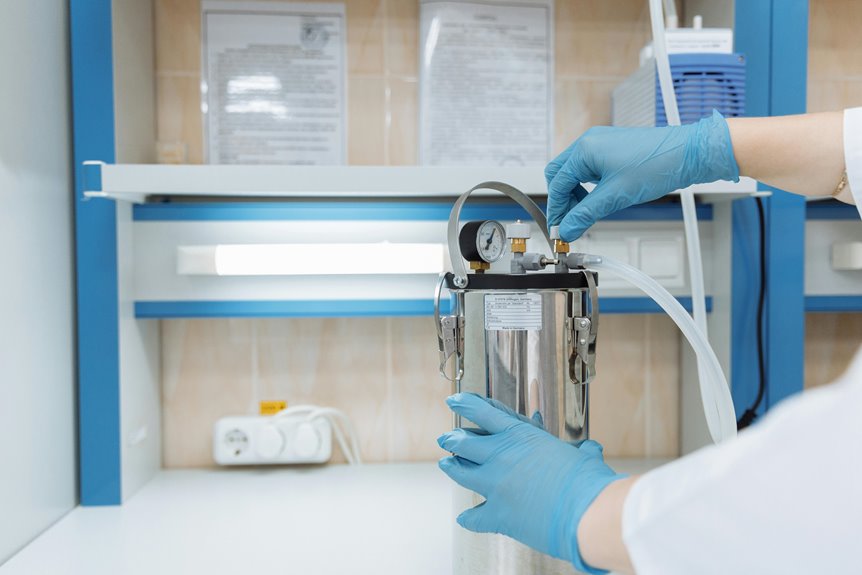
You can separate dyes using chromatography by exploiting their different solubilities and affinities for a stationary phase, like paper, and a mobile solvent. Start by spotting your dye mixture on chromatography paper, then immerse it in a solvent without submerging the spot. As the solvent rises, it carries each dye component at different rates, creating distinct color bands. This technique helps identify dyes and their properties. Keep exploring to discover how to perform and analyze chromatography step-by-step.
Key Takeaways
- Dyes contain chromophores that absorb specific light wavelengths, which chromatography separates based on dye solubility and affinity differences.
- Paper chromatography uses a stationary paper phase and a solvent mobile phase to separate dye mixtures by differential migration rates.
- Applying a dye spot above the solvent line allows solvent to carry dye components upward, separating them into distinct colored spots.
- Measuring distances traveled by dyes and solvent front enables calculation of Rf values for identifying dye components.
- Selecting appropriate solvents and stationary phases optimizes dye separation and resolution during chromatography.
Understanding the Basics of Dye Chemistry
Dye chemistry forms the foundation for understanding how colors interact with various materials. When you immerse yourself in dye chemistry, you’ll find that dyes are molecules designed to bind to specific fibers or surfaces.
Their structures contain chromophores, which absorb certain light wavelengths, giving dye its color. You’ll also notice that different dyes have varying affinities for materials based on molecular interactions like hydrogen bonding or ionic attractions. Understanding these interactions helps you predict how a dye will behave on fabric or paper.
Additionally, the solubility of a dye influences how easily it moves and spreads. By grasping these basics, you prepare yourself to explore how dyes separate or mix, setting the stage for techniques that manipulate color in practical and scientific ways.
What Is Chromatography?
You’ll find chromatography is a technique used to separate mixtures into individual components.
It works by passing a mixture through a medium where different substances move at different rates.
There are several types of chromatography, each suited for specific kinds of analysis.
Chromatography Basics
Although it might seem complex at first, chromatography is simply a technique that separates mixtures into their individual components.
When you use chromatography, you rely on two main phases: a stationary phase and a mobile phase. The stationary phase stays fixed, while the mobile phase moves through it, carrying the mixture.
Different components travel at different speeds because of their varying affinities to these phases. This difference causes the components to separate along the stationary phase. By observing how far each component moves, you can identify and analyze them.
Chromatography is essential for separating dyes because it allows you to see the distinct colors and compounds hidden inside a mixture, making it a powerful tool in dye analysis and other scientific fields.
Types of Chromatography
Chromatography comes in several types, each designed to separate mixtures based on different principles and materials. You’ll often encounter paper chromatography, which uses a paper strip as the stationary phase. It’s perfect for separating dye components because dyes travel at different speeds through the paper.
Another common type is thin-layer chromatography (TLC), where a thin layer of silica gel or alumina acts as the stationary phase on a glass or plastic plate. You might also use column chromatography, which passes the mixture through a column packed with solid adsorbent.
Gas chromatography separates volatile compounds by passing them through a gas stream. Finally, liquid chromatography moves the mixture through a liquid mobile phase, ideal for heat-sensitive dyes. Each type suits specific needs in dye analysis.
Types of Chromatography Used for Dye Separation
You’ll often use paper chromatography to separate dyes because it’s simple and effective for spotting different color components.
Column chromatography is another technique you can apply when you need to handle larger samples or achieve finer separation.
Both methods rely on how dyes interact with the stationary and mobile phases to separate out distinctly.
Paper Chromatography Basics
When you want to separate dyes efficiently, paper chromatography offers a simple yet effective method. You start by spotting a small amount of dye solution near the bottom of a strip of chromatography paper.
Then, you place the paper in a solvent, ensuring the dye spot stays above the solvent level. As the solvent moves up the paper by capillary action, it carries the dye components at different rates. This separation occurs because dyes interact differently with the paper’s cellulose fibers and the solvent.
You’ll see distinct bands or spots forming along the paper, each representing a different dye component. Paper chromatography is inexpensive, easy to set up, and ideal for analyzing plant pigments, ink dyes, and food colorings in a straightforward way.
Column Chromatography Techniques
Although paper chromatography works well for simple separations, column chromatography offers greater control and efficiency for separating complex dye mixtures.
When you use column chromatography, you pack a column with a stationary phase like silica gel or alumina, then pour your dye mixture through it. Different components interact uniquely with the stationary phase, separating as they move at varied speeds.
You’ll encounter several types of column chromatography for dye separation:
- Normal-phase chromatography: Uses polar stationary phases for separating nonpolar dyes.
- Reverse-phase chromatography: Employs nonpolar stationary phases ideal for polar dyes.
- Ion-exchange chromatography: Separates dyes based on charge differences.
- Size-exclusion chromatography: Sorts dyes by molecular size.
This technique gives you precision and scalability beyond paper chromatography.
Materials and Tools Needed for Dye Chromatography
Several essential materials and tools make dye chromatography both effective and manageable. You’ll need chromatography paper or a thin-layer chromatography (TLC) plate as the stationary phase where dyes separate.
Prepare a solvent or solvent mixture as the mobile phase to carry the dyes along the stationary medium. Use a pencil to mark the baseline on the paper or plate since ink can contaminate your results.
Small containers like beakers or jars will hold the solvent during the process. Tweezers help you handle the paper or plates without smudging.
Additionally, have blotting paper or paper towels ready to dry samples or clean spills. Finally, a ruler aids in measuring how far dyes travel, vital for calculating Rf values.
These tools set the stage for clear, precise separation of dyes.
Step-by-Step Guide to Performing Paper Chromatography
With your materials ready, you can now perform paper chromatography to separate dye mixtures.
First, draw a light pencil line near the bottom of the chromatography paper and apply a small dot of dye on it.
Next, place the paper in a container with a shallow solvent, ensuring the dye spot stays above the liquid.
Cover the container to prevent evaporation and let the solvent rise through the paper by capillary action.
As it moves, it will carry the dye components at different rates, separating them.
- Feel the excitement as colors begin to spread.
- Watch the invisible become visible.
- Experience the wonder of science in action.
- Anticipate the colorful patterns revealing secrets.
Analyzing Chromatography Results: Identifying Different Dyes
How can you tell which dyes make up your mixture just by looking at the chromatography results? Start by observing the separated spots on the chromatography paper. Each spot represents a different dye that moved at its own pace.
Note the color and position of each spot relative to the original sample line. Measure the distance each dye traveled and calculate its Rf value by dividing the dye’s distance by the solvent front’s distance.
Compare these Rf values and colors to known standards or reference charts. Matching these helps you identify the specific dyes present.
Common Applications of Dye Separation in Industry and Research
Understanding how to identify dyes through chromatography opens the door to many practical uses in both industry and research.
When you separate dyes accurately, you can guarantee product quality, innovate new materials, and solve complex problems. This technique serves as a critical tool that empowers your work in several impactful ways:
- Guaranteeing consistent color quality in textiles, keeping customers delighted.
- Authenticating art and historical artifacts, preserving cultural heritage.
- Developing eco-friendly dyes, protecting the environment for future generations.
- Investigating chemical compositions in forensic science, aiding justice.
Troubleshooting Tips for Effective Dye Chromatography
Although dye chromatography is a powerful technique, you might encounter challenges that hinder clear separation or accurate identification. If your spots blur or overlap, check your solvent system; tweaking its polarity often improves resolution.
Make certain your sample isn’t overloaded, as too much dye can cause smearing. Also, verify your TLC plate is dry before applying samples to prevent uneven migration.
If spots don’t travel, verify that the solvent front moves properly and your plate is oriented correctly. Contamination can affect results, so use clean tools and fresh solvents.
Finally, control environmental factors like temperature and humidity, as they influence solvent evaporation and dye movement. By addressing these common issues, you’ll achieve more reliable and precise dye separations every time.
Frequently Asked Questions
Can Chromatography Separate Dyes From Natural Fabric Fibers?
You’ll find chromatography cuts through the noise, effectively separating dyes from natural fabric fibers. It works by pulling different dye components apart, letting you see each color’s unique fingerprint clearly and distinctly.
How Long Does a Typical Chromatography Experiment Take to Complete?
A typical chromatography experiment usually takes about 30 minutes to a couple of hours, depending on the method and materials you use. You’ll want to monitor it closely to get accurate separation results.
Is Chromatography Safe for Children to Perform at Home?
Did you know over 70% of kids enjoy hands-on science? You can safely try chromatography at home with adult supervision, using non-toxic materials like water and paper towels—just avoid harmful chemicals to keep it fun and safe.
What Solvents Are Best for Separating Synthetic Versus Natural Dyes?
You’ll find alcohols like ethanol work well for synthetic dyes, while water or vinegar suits natural dyes better. Choosing the right solvent helps you separate the dyes effectively during chromatography experiments.
Can Chromatography Detect Counterfeit Textile Dyes?
You might not think a simple test reveals fakes, but chromatography spots counterfeit textile dyes by comparing their unique chemical fingerprints to authentic samples. It’s your secret weapon in catching imposters hiding in plain sight.