
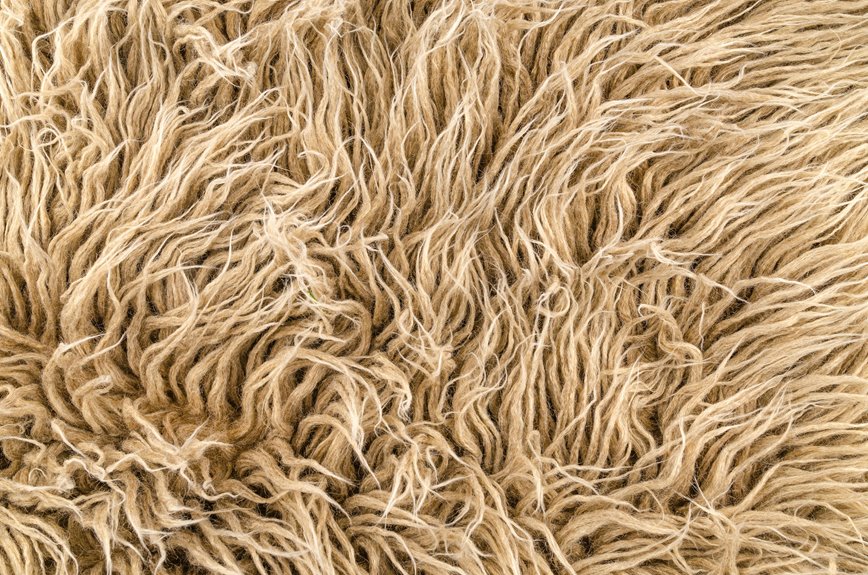
You’ll find that felt is a nonwoven fabric because its fibers bond directly without weaving or knitting. When you apply heat, moisture, and pressure, the fibers, especially wool with scaly surfaces, lock together tightly to form a dense, flexible mat. This interlocking happens randomly, unlike the structured patterns in woven textiles, giving felt unique strength and insulation. Keep exploring, and you’ll uncover how this process shapes felt’s durability and diverse uses.
Key Takeaways
- Felt is formed by interlocking fibers through heat, moisture, and pressure without weaving or knitting.
- The scaly surface of wool fibers enables them to lock together tightly during felting.
- Randomly entangled fibers create a dense, mesh-like structure that characterizes nonwoven fabrics.
- The absence of a woven pattern gives felt unique flexibility and insulating properties.
- Mechanical interlocking and compression produce a cohesive, durable fabric distinct from woven textiles.
Defining Nonwoven Fabrics
Nonwoven fabrics are materials made by bonding or interlocking fibers without weaving or knitting. When you work with nonwoven fabrics, you’ll notice they form through mechanical, chemical, or thermal processes, creating a web of fibers fused together.
Unlike woven textiles, which rely on interlacing yarns, nonwovens provide a more direct method of fabric construction. You can find them in many everyday products like filters, medical masks, and insulation. Their strength and durability depend on the fiber type and bonding method used.
Since they skip traditional weaving, nonwoven fabrics often offer unique properties like enhanced thickness, softness, and resistance to tearing. Understanding these basics helps you appreciate why felt, a classic example, fits perfectly into the nonwoven category.
Historical Origins of Felt
Although felt’s exact beginnings are hard to trace, people have been making it for thousands of years across various cultures.
You can find early evidence of felt in Central Asia, where nomadic tribes used it for clothing, rugs, and tents due to its durability and insulation. Felt was practical because it didn’t require weaving; instead, fibers were compressed and matted together, making it easier to produce with limited tools.
Early Central Asian nomads valued felt for durable, insulating clothing and tents, crafted without weaving using simple tools.
As you explore history, you’ll see felt’s importance in ancient Egypt, Scandinavia, and Mongolia, each adapting the material for their needs. This widespread, independent development shows felt’s fundamental value.
Understanding its origins helps you appreciate how felt evolved into the versatile nonwoven fabric it’s today, valued both for tradition and modern applications.
Fiber Composition in Felt
You’ll find that felt can be made from natural fibers like wool or synthetic ones, each affecting its feel and durability.
The length and texture of these fibers play a big role in how the felt forms and performs.
Blending different fibers lets you customize the fabric’s strength and softness for your needs.
Natural Vs Synthetic Fibers
When choosing felt, you’ll encounter two main fiber types: natural and synthetic.
Natural fibers, like wool, come from animals and offer warmth, breathability, and eco-friendliness.
Synthetic fibers, such as acrylic or polyester, are man-made and provide durability, resistance to moisture, and often cost less.
To understand their differences, consider these points:
- Source: Natural fibers originate from sheep or other animals; synthetics are chemically produced.
- Performance: Natural felt excels in insulation and moisture absorption; synthetic felt resists water and dries quickly.
- Environmental Impact: Natural fibers biodegrade easily, while synthetics can persist in landfills longer.
Fiber Length and Texture
Understanding the types of fibers in felt leads naturally to examining their length and texture, which play a big role in the fabric’s characteristics.
When you look at fiber length, shorter fibers tend to mat together more tightly, creating a denser, firmer felt. Longer fibers, on the other hand, offer more flexibility and softness but may not felt as compactly.
Texture also influences the fabric’s feel and durability—coarser fibers add strength and resilience, while finer fibers provide a smoother, softer surface.
As you handle felt, you’ll notice how these variations affect its appearance and performance. By choosing fibers with specific lengths and textures, manufacturers control how the felt behaves, from stiffness to warmth, making these factors essential to understanding felt’s unique nonwoven structure.
Blending Techniques in Felt
Blending techniques play an essential role in determining the final qualities of felt by combining different fibers to achieve specific textures, strengths, and appearances.
When you blend fibers, you tailor the felt’s performance and look precisely. Here’s how different blending methods impact felt:
- Carding: You mix fibers mechanically, aligning them loosely, which creates a soft, airy texture ideal for lightweight felt.
- Combing: By removing shorter fibers, you get a smoother, stronger felt perfect for durable applications.
- Needle-punching: This interlocks fibers tightly, enhancing density and resilience for industrial-grade felt.
The Felting Process Explained
Although felting might seem like a simple craft, the process involves a fascinating interplay of heat, moisture, and pressure that causes fibers to intertwine tightly.
When you apply these elements to loose wool fibers, the scales on each fiber open up. As you press and rub the fibers together, they begin to hook and lock into one another, transforming loose strands into a dense, cohesive fabric.
You can initiate this process through wet felting, where warm water and soap help relax and bind the fibers, or through needle felting, using barbed needles to mechanically tangle fibers.
Microscopic Structure of Felt
When you look closely at felt, you’ll see fibers locked together without any clear pattern.
Unlike woven fabrics, felt’s fibers arrange randomly, creating a dense mat. This unique structure comes from fibers interlocking tightly, giving felt its strength and flexibility.
Fiber Interlocking Mechanism
The strength and durability of felt come from how its fibers lock together at a microscopic level. You can imagine this interlocking process as a natural hook-and-loop system where fibers grip each other tightly.
Here’s what happens:
- Scaly fiber surfaces: Each fiber has tiny scales that catch onto neighboring fibers.
- Pressure and friction: When you press or rub the fibers, they push closer, increasing contact and grip.
- Entanglement: Fibers twist and bend, creating a dense network that resists pulling apart.
This mechanism forms a sturdy, cohesive fabric without weaving or knitting.
You’re fundamentally witnessing millions of microscopic hooks catching and holding, making felt uniquely durable among nonwoven fabrics.
Random Fiber Arrangement
Millions of fibers randomly overlap and intertwine to create felt’s unique microscopic structure.
When you examine felt under a microscope, you won’t see neat rows or patterns like woven fabrics. Instead, you’ll notice a chaotic mesh where fibers cross over and under each other in unpredictable ways.
This randomness allows the fibers to bond firmly through entanglement rather than relying on a set pattern. As you handle felt, this disordered network gives it strength and flexibility, making it resistant to tearing and stretching.
The irregular fiber arrangement also traps air, contributing to felt’s insulating properties.
Absence of Weaving Pattern
You won’t find any repeating patterns or orderly sequences in felt’s microscopic structure.
Unlike woven fabrics, felt lacks the interlacing threads that create uniform grids. Instead, its fibers intertwine randomly, forming a dense, matted network.
When you look closer, you’ll notice:
- Fibers oriented in multiple directions without alignment
- Overlapping layers that bond through friction and pressure
- No clear warp or weft threads crossing at right angles
This absence of a weaving pattern means felt doesn’t have the rigid structure typical of woven textiles.
Its strength and texture come from fiber entanglement rather than thread interlacing.
Comparing Felt to Woven Fabrics
Although both felt and woven fabrics serve essential roles in textiles, they differ considerably in structure and production methods.
When you look at woven fabrics, you’ll notice their distinct crisscross pattern created by interlacing warp and weft yarns tightly. This method gives woven fabrics strength, flexibility, and a predictable texture.
Felt, on the other hand, forms without weaving or knitting. You create felt by matting and compressing fibers together using heat, moisture, and pressure. This process produces a dense, uniform fabric without any visible pattern or grain.
Because of these differences, felt behaves differently from woven fabrics—it’s less prone to fraying and offers unique insulation properties.
Understanding these contrasts helps you appreciate why felt occupies a special niche separate from traditional woven textiles.
Mechanical Properties of Felt
When you apply pressure or force to felt, its unique structure responds differently than woven fabrics do.
Felt’s fibers are entangled and compressed, allowing it to deform without unraveling. This gives felt several mechanical properties you’ll notice:
Felt’s entangled, compressed fibers let it deform smoothly without unraveling, offering unique mechanical strength.
- Resilience: Felt springs back after being compressed, making it durable under repeated stress.
- Flexibility: Unlike woven fabrics, felt bends easily without fraying or breaking due to the random fiber matrix.
- Density Variability: You can feel areas of varied thickness and firmness depending on fiber arrangement and compression during manufacturing.
These properties mean felt absorbs shocks and distributes force evenly, which you won’t get with traditional woven textiles.
Applications of Felt in Industry
Felt serves countless roles across various industries, thanks to its unique combination of durability, flexibility, and shock absorption. When you choose felt, you’re tapping into a material that excels in cushioning, insulation, and soundproofing. You’ll find it in automotive parts, musical instruments, and even in fashion. Its nonwoven structure allows it to absorb impacts and reduce vibrations effectively.
Here’s a quick overview of felt’s key industrial applications:
| Industry | Application | Benefit |
|---|---|---|
| Automotive | Gaskets, padding | Shock absorption |
| Construction | Insulation panels | Thermal and acoustic |
| Fashion | Hats, accessories | Flexibility, texture |
| Manufacturing | Polishing, filtration | Durability, filtration |
Using felt can improve performance and longevity in your projects.
Environmental Impact and Sustainability of Felt
Because you care about the planet, understanding the environmental impact and sustainability of felt is essential.
Felt, often made from natural fibers like wool, offers eco-friendly advantages compared to synthetic fabrics. When you choose felt, you support renewable resources and biodegradable materials. However, the production process and fiber sourcing play significant roles in its sustainability.
Consider these key points:
- Renewable Fibers – Wool and other natural fibers in felt come from renewable sources, reducing dependency on petrochemicals.
- Biodegradability – Felt decomposes naturally, minimizing landfill waste and environmental pollution.
- Energy Use – Felt production requires less energy than weaving or knitting, lowering its carbon footprint.
Frequently Asked Questions
Can Felt Be Made From Synthetic Fibers Only?
Yes, you can make felt entirely from synthetic fibers. Manufacturers often use materials like polyester or acrylic to create synthetic felt, which offers durability and water resistance, making it suitable for various crafts and industrial applications.
How Does Moisture Affect the Durability of Felt?
Moisture might make your felt weaker, warping its weave and worsening wear. When wet, fibers swell and soften, so you’ll want to wisely wipe and warm your felt to ward off water’s wear and tear.
What Are the Best Cleaning Methods for Felt Products?
You should gently spot clean felt with cold water and mild detergent, avoiding soaking. Use a soft brush for stains and air dry flat to maintain shape. Avoid heat, as it can shrink or damage felt.
Does Felt Have Insulating Properties Against Heat and Sound?
Feeling for fantastic features? Felt fights heat and filters sound effectively. You’ll find felt’s fibrous form traps temperature and tones, making it a smart, sustainable solution for insulation in your home or workspace.
Can Felt Be Recycled or Repurposed After Use?
You can recycle or repurpose felt, especially if it’s made from natural fibers like wool. While industrial recycling options are limited, you’ll find creative ways to reuse felt in crafts, insulation, or padding around your home.