
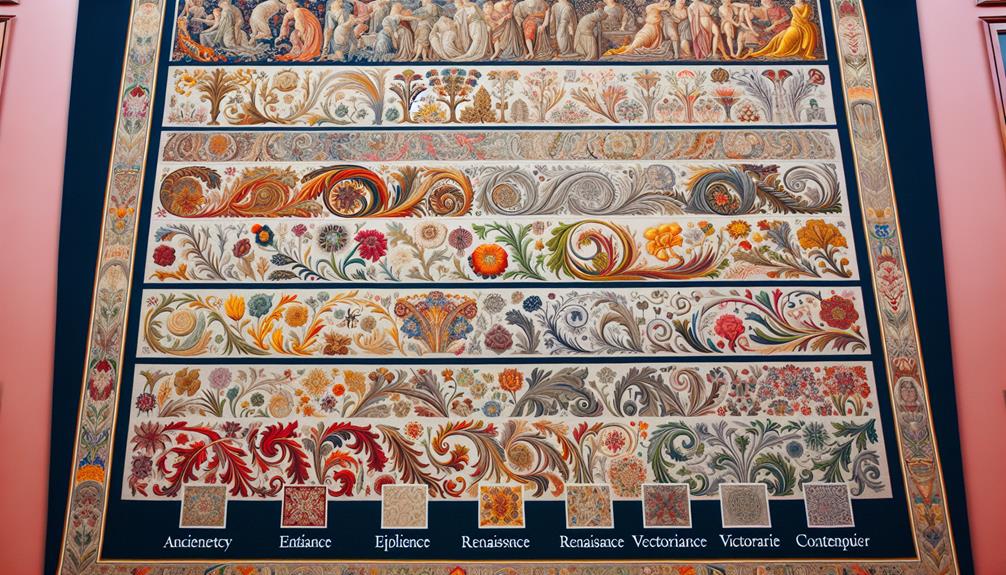
Imagine the intricate handwoven patterns of ancient Mesopotamia juxtaposed with the sleek, digital prints of today. You can trace a fascinating journey from these early symbolic weaves, rich with mythology and daily life, to medieval tapestries that held deeper, often secret meanings. As you explore further, you'll uncover the Renaissance's vibrant dyes and elaborate embroideries that set the stage for the Industrial Revolution's mechanized marvels. Now, contemporary digital innovations offer customizable designs that marry tradition with cutting-edge technology. Isn't it intriguing to see how each era's advancements reflect its cultural and technological shifts?
Key Takeaways
- Ancient textiles used motifs that reflected cultural mythology and daily life, such as Egyptian hieroglyphs and Mesopotamian scenes.
- Medieval weaves featured symbolic geometric motifs and colors like reds and golds to represent power, wealth, and protection.
- The Renaissance introduced intricate embroidery, elaborate motifs, and innovations like the Jacquard loom, setting the stage for complex patterns.
- The Industrial Revolution mechanized loom and spinning technologies, leading to mass production and making textiles more affordable.
- Contemporary digital prints enable customizable, intricate designs with reduced waste, promoting sustainability and reflecting current fashion trends.
Ancient Textile Patterns
Ancient textile patterns, rich in history and symbolism, often reveal the cultural narratives of civilizations long gone. If you explore Mesopotamian designs, you'll find intricate weaves that depict scenes of daily life and mythology, reflecting a society deeply connected to its environment and deities. These designs weren't mere decoration; they were a form of storytelling and a display of status.
Egyptian motifs, on the other hand, offer a window into a civilization obsessed with the afterlife and the divine. You'll notice the prevalence of lotus flowers, scarabs, and hieroglyphs, each symbol packed with meaning and intention. The precision and artistry involved in these patterns speak volumes about their advanced techniques and the importance of textiles in their culture.
Moving west, Greek tapestries often illustrated epic tales and gods, woven with a skill that showcased their mastery in both art and literature. These pieces weren't just for practical use but were also significant cultural artifacts.
Roman textiles adopted and adapted many of these influences, creating luxurious fabrics that displayed the empire's wealth and power. By exploring these ancient patterns, you gain a profound understanding of how textiles functioned as both utilitarian objects and cultural expressions.
Medieval Weaves and Motifs
As you move from the opulence of ancient civilizations, the medieval period introduces weaves and motifs that reflect a burgeoning blend of practicality and evolving artistic expression. You'll discover that medieval tapestries aren't just decorative pieces but also storytelling canvases. These tapestries often feature intricate designs, depicting scenes from everyday life, religious narratives, and mythological tales.
Mastering the weaving techniques of this era requires understanding the symbolic meanings embedded in each piece. For instance, fleur-de-lis patterns symbolize purity and nobility, while geometric motifs often represent protection and eternity. The warp and weft techniques used in medieval weaving are more than just methods; they're the very foundation of these artistic expressions.
You'll notice that the use of color in medieval weaves is deliberate and meaningful. Reds and golds often signify power and wealth, while blues and greens denote peace and prosperity. The complexity of these designs demands an appreciation for the skilled artisans who painstakingly created them.
Renaissance Textile Innovations
Renaissance textile innovations bring a blend of artistic sophistication and technological advancements that redefine fabric creation. You'll find that this era transformed the textile landscape, introducing methods and designs that still inspire today.
Renaissance embroidery techniques were nothing short of revolutionary. Artisans began experimenting with intricate stitches, employing silk threads and gold filigree to create elaborate motifs, often depicting nature, mythology, and religious iconography. These techniques elevated textiles to an art form, making garments not just clothing but statements of wealth and taste.
Moreover, textile design innovations flourished during this period. The introduction of new weaving practices and the use of richer, more vibrant dyes resulted in fabrics that were more durable and visually stunning. The Jacquard loom, though fully realized later, found its conceptual roots in Renaissance ingenuity, setting the stage for complex patterns that were previously impossible.
Industrial Revolution Changes
The Industrial Revolution transformed textile production with the advent of mechanized looms and spinning machines, making fabrics cheaper and more accessible. You witnessed a seismic shift from artisanal handcrafting to factory production, where mechanized looms and spinning jennies dominated the scene. This change didn't just boost output; it revolutionized the very fabric of society by making textiles affordable for the masses.
In factories, the emphasis was on increased efficiency and mass production. By mechanizing the process, you could produce textiles at unprecedented speeds and volumes. This not only met the growing demand but also allowed for consistent quality, something that was harder to achieve with manual labor.
Here's a quick comparison to illustrate the impact:
| Aspect | Pre-Industrial Revolution | Post-Industrial Revolution |
|---|---|---|
| Production Method | Handcrafted | Factory Production |
| Time Consumption | High | Low |
| Cost of Fabrics | Expensive | Affordable |
As you can see, the shift to factory production and mechanized looms brought about significant changes. The increased efficiency allowed for mass production, ensuring that textiles became a staple in everyday life. This industrial boom laid the groundwork for the modern textile industry, setting the stage for future innovations.
Contemporary Digital Prints
With the foundation laid by the Industrial Revolution, today's textile industry embraces contemporary digital prints to create intricate and customizable designs at unprecedented speeds.
You can now leverage digital design software to craft patterns that resonate with current fashion trends, ensuring your creations are both relevant and striking. This software allows for unparalleled precision and versatility, enabling you to experiment with colors, shapes, and textures effortlessly.
Digital printing isn't just about aesthetics; it's a pivotal element in sustainable production. Traditional printing methods often involve wasteful practices and harmful chemicals, but digital printing minimizes waste and reduces environmental impact. By using this technology, you can create eco-friendly garments without sacrificing quality or artistic expression.
Moreover, digital prints empower you to express your creativity in ways that were previously unimaginable. You can produce complex, detailed patterns quickly, allowing for a more dynamic response to evolving fashion trends. Whether you're designing for haute couture or ready-to-wear collections, digital prints enable a higher level of customization and innovation.
Embrace this modern tool, and you'll find it revolutionizes how you approach textile design, merging sustainability with boundless creative potential.
Frequently Asked Questions
How Have Environmental Factors Influenced Textile Pattern Designs Over the Centuries?
You'll find climate influences and cultural adaptations have greatly shaped textile pattern designs. Harsh climates required practical designs, while cultural elements added symbolic patterns, showcasing both functionality and artistic expression through changing environmental conditions.
Which Cultures Have Had the Most Enduring Influence on Global Textile Patterns?
Imagine you're weaving a tapestry; you'll notice Indian motifs, Indonesian batik, Chinese silk patterns, and African inspirations. These cultures have had the most enduring influence on global textile patterns through their rich traditions and unique techniques.
How Do Traditional Textile Patterns Differ Between Rural and Urban Settings?
You'll notice traditional textile patterns in rural settings often reflect local cultural differences and historical significance. Urban designs, however, are influenced by diverse design influences and prioritize artistic expression, blending various styles and modern aesthetics.
What Role Do Textile Patterns Play in Modern Fashion Trends?
While you might think textile patterns are old-fashioned, they actually drive creativity and innovation in modern fashion. These patterns add cultural significance, making your wardrobe not just stylish but also deeply meaningful.
Are There Any Notable Collaborations Between Artists and Textile Designers?
You'll find numerous notable collaborations between artists and textile designers. These artistic partnerships and innovative collaborations often draw on historical influences, resulting in creative partnerships that push the boundaries of both art and textile design.