
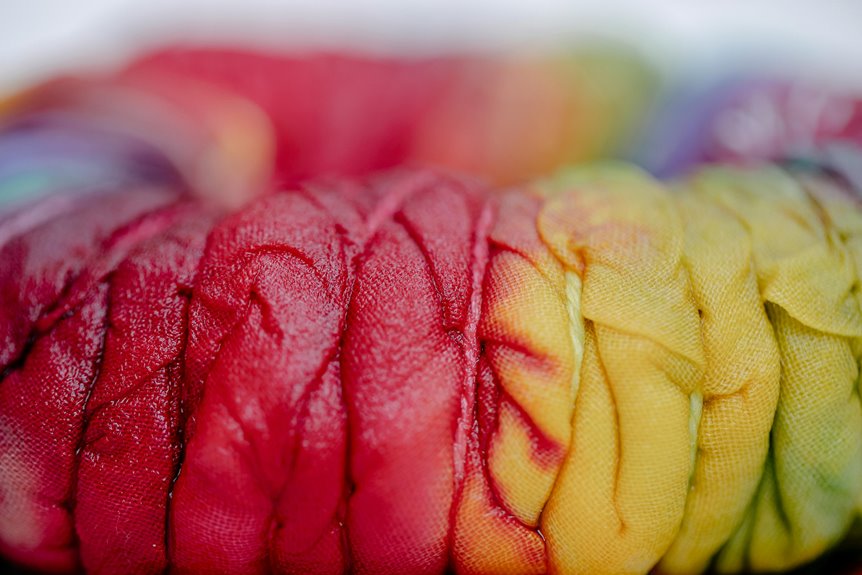
You’ll notice that ikat and tie-dye differ mainly in how their patterns form. Ikat dyes yarns before weaving, creating soft, blurred designs with a watercolor look. Tie-dye dyes the finished fabric after binding, producing bold, vibrant, and often unpredictable patterns like spirals and circles. Ikat feels more deliberate and traditional, while tie-dye is playful and freeform. If you want to understand their unique histories, processes, and cultural meanings, there’s plenty more to discover.
Key Takeaways
- Ikat dyes yarns before weaving, creating blurred patterns; tie-dye dyes finished fabric with bold, vibrant, and unpredictable designs.
- Ikat uses natural fibers like silk or cotton, while tie-dye commonly uses cotton, silk, and rayon for dye absorption.
- Ikat patterns have soft, feathered edges and repetitive motifs; tie-dye features sharp, distinct shapes like spirals and bullseyes.
- Ikat reflects cultural heritage with precise, planned designs; tie-dye emphasizes individual expression through spontaneous, unique patterns.
- Ikat requires complex yarn-resist dyeing before weaving; tie-dye applies dye directly to bound fabric sections after weaving.
History and Origins of Ikat
Although you might recognize Ikat by its distinct blurred patterns, you may not know that this ancient dyeing technique dates back thousands of years. You’ll find Ikat’s origins in multiple cultures across Asia, Central and South America, and parts of Africa.
It’s unique because you dye the threads before weaving, unlike other methods that dye finished fabrics. This pre-dyeing process creates those signature blurry designs once woven.
When you explore Ikat, you’re tapping into a tradition that’s been passed down through generations. It wasn’t just about aesthetics; many communities used Ikat to signify social status, cultural identity, or spiritual beliefs.
History and Origins of Tie-Dye
When you look at tie-dye, you’re seeing a vibrant technique that has roots stretching back thousands of years across various cultures.
This method of resist dyeing has evolved independently around the world, making it a truly global art form.
You’ll find evidence of tie-dye in:
- Ancient China, where it appeared as early as the 6th century CE
- Japan’s shibori, a sophisticated tie-dye variation with intricate patterns
- West African cultures, using bold colors and symbolic designs
- 1960s America, when tie-dye became a symbol of counterculture and self-expression
Materials Used in Ikat
While tie-dye relies on binding and folding techniques to create its patterns, ikat achieves its distinct look through a unique method of dyeing the threads before weaving.
You’ll mainly work with natural fibers like cotton, silk, or wool in ikat, as they absorb dyes beautifully and provide durability. The yarns are carefully bundled and tied to resist certain dye areas, creating the pattern once woven.
Depending on the region, silk is prized for its sheen and softness, while cotton offers a more rustic texture. You’ll notice that synthetic fibers are rarely used because they don’t hold dye as well during the multiple dyeing and tying stages ikat requires.
Choosing the right material is key to achieving ikat’s crisp, blurred-edge motifs.
Materials Used in Tie-Dye
You’ll find that cotton, silk, and rayon are some of the most popular fabrics for tie-dye because they absorb dye well.
The types of dyes used usually include fiber-reactive and acid dyes, depending on the fabric.
Understanding these materials helps you get the vibrant, lasting colors tie-dye is known for.
Common Fabrics Used
Fabrics play an essential role in achieving vibrant and lasting tie-dye designs. When you pick the right material, your colors will pop and hold up well after washing.
Natural fibers absorb dye better, making them ideal for tie-dye projects.
Here are some common fabrics used for tie-dye:
- Cotton: The most popular choice due to its softness and excellent dye absorption.
- Rayon: Offers a smooth texture and vibrant color results.
- Silk: Provides a luxurious feel with rich, bright dye patterns.
- Linen: A bit rougher but still takes dye nicely, creating unique textures.
Choosing any of these fabrics guarantees your tie-dye work looks vivid and lasts through countless washes.
Avoid synthetic fabrics, as they don’t absorb dye well.
Dye Types Employed
Since the type of dye you choose directly affects the vibrancy and durability of your designs, understanding dye options is crucial for successful tie-dye projects. You’ll mostly encounter fiber-reactive dyes, which bond well with cotton and produce bright, long-lasting colors. Alternatively, you might use acid dyes for protein fibers like silk or wool. Each dye type requires specific techniques and materials to achieve the best results.
Here’s a quick comparison of popular dye types for tie-dye:
| Dye Type | Best For | Durability |
|---|---|---|
| Fiber-Reactive | Cotton, Rayon | Very High |
| Acid Dye | Silk, Wool | High |
| All-Purpose | Mixed Fabrics | Moderate |
Choosing the right dye guarantees your tie-dye looks vibrant and lasts through many washes.
The Ikat Dyeing Process
Although the Ikat dyeing process can seem complex at first, understanding its basic steps will help you appreciate the skill involved. You start by carefully tying sections of yarn to resist dye before weaving. This technique requires precise planning because the pattern is dyed onto the threads, not the fabric.
Here’s how it works:
- Tie bundles of yarn tightly to prevent dye penetration in selected areas
- Dip the yarn into dye baths, sometimes multiple times for layered colors
- Untie the yarn and align it on a loom to weave the fabric
- Weave carefully to guarantee the dyed patterns match the intended design
The Tie-Dye Technique Explained
You’ll start by binding sections of the fabric using various tying methods to create patterns.
Then, you apply colors directly onto the cloth, letting the dye seep into the exposed areas.
This process gives tie-dye its signature bold, unpredictable designs.
Binding Methods Overview
When you start exploring tie-dye, understanding the binding methods is essential because they control how the dye interacts with the fabric.
By folding, twisting, or bunching the cloth and securing it tightly, you create areas that resist dye, resulting in unique patterns.
Here are common binding techniques you’ll want to try:
- Spiral: Twist the fabric into a coil and bind sections to form a circular pattern.
- Accordion Fold: Fold fabric back and forth like a fan, then bind to create stripes.
- Bullseye: Pinch the fabric at one point and bind rings around it for concentric circles.
- Scrunch: Crumple the fabric randomly and tie loosely for a mottled effect.
Mastering these methods lets you control pattern shapes and dye penetration effectively.
Color Application Process
Since the binding methods set the stage, applying color is where your tie-dye design truly comes to life. You’ll use fabric dyes, often in vibrant shades, and apply them directly to the bound sections of your fabric.
How you apply the dye—whether by squirting, brushing, or soaking—affects the final look. The tied parts resist the dye, creating those signature patterns. You can mix colors or keep them separate for bold contrasts.
After dyeing, you’ll let the fabric sit to absorb the colors fully, usually for several hours. Once fixed and rinsed, the ties come off to reveal unique, kaleidoscopic designs.
This hands-on color application distinguishes tie-dye from ikat, where dyeing happens before weaving, making tie-dye’s vibrant patterns all about your personal touch and timing.
Visual Characteristics of Ikat Patterns
Ikat patterns captivate with their blurred, feathered edges that result from the unique dyeing process applied to the threads before weaving.
Ikat patterns enchant with their distinctive blurred, feathered edges from dyeing threads before weaving.
When you look closely, you’ll notice these distinct visual traits:
- Soft, hazy outlines rather than sharp, defined shapes
- A subtle blending of colors creating a watercolor effect
- Repetitive geometric or abstract motifs that often appear slightly offset
- An overall sense of depth and texture thanks to the hand-dyed threads
These characteristics give Ikat fabrics a dynamic and organic feel.
Unlike patterns printed or tied after weaving, Ikat’s design emerges during the weaving itself, making each piece unique.
When you wear or use Ikat, you’re embracing the artistry of this ancient technique visible through these signature visual traits.
Visual Characteristics of Tie-Dye Patterns
While Ikat patterns emerge from the weaving process with their soft, blurred edges, tie-dye creates its visual magic through a different approach—manipulating fabric after it’s woven. You twist, fold, or tie the fabric, then apply dye selectively, resulting in vibrant, often unpredictable patterns. These patterns typically feature bold colors, circular shapes, and organic lines.
| Characteristic | Description |
|---|---|
| Color Palette | Bright, saturated hues |
| Pattern Edges | Sharp or irregular, not blurred |
| Shapes | Circles, spirals, stripes |
| Texture | Smooth with dye variations |
| Uniqueness | Each piece is one-of-a-kind |
When you wear tie-dye, you showcase lively, spontaneous designs that contrast Ikat’s controlled, woven look.
Cultural Significance of Ikat
You’ll find that ikat has deep historical roots spanning several cultures around the world.
Each region has its own unique traditions that shape the patterns and techniques used.
Understanding these origins helps you appreciate the rich cultural meaning behind every ikat design.
Historical Origins
Because it has been practiced for centuries across various cultures, understanding the historical origins of Ikat reveals its deep cultural significance.
When you explore Ikat’s past, you’ll notice how it:
- Dates back to ancient civilizations in Southeast Asia, Central Asia, and South America.
- Reflects skilled craftsmanship where artisans resist-dye threads before weaving.
- Symbolizes social status, identity, and spiritual beliefs in many communities.
- Demonstrates early global trade influences, spreading techniques and patterns worldwide.
Regional Traditions
The rich history of Ikat sets the stage for exploring how various regions have made this textile art uniquely their own.
When you look at Ikat from Indonesia, you’ll notice intricate patterns reflecting local myths and ceremonies, often reserved for important events.
In India, Ikat carries symbolic meanings tied to religious rituals, and the designs can signify social status or community identity.
Central Asia’s Ikat tends to feature bold, geometric shapes, showing a blend of nomadic traditions and cultural storytelling.
As you explore these regional traditions, you see how Ikat isn’t just fabric; it’s a living expression of cultural values and history.
Understanding these nuances helps you appreciate the deep significance woven into every thread.
Cultural Significance of Tie-Dye
Although tie-dye patterns may appear purely decorative, they carry deep cultural meanings across various societies. When you wear or create tie-dye, you’re connecting with traditions that symbolize more than just color.
Tie-dye often represents:
- Spirituality and protection, where certain patterns ward off evil spirits.
- Social status or community identity, distinguishing groups within a culture.
- Celebration and ritual, marking important events or ceremonies.
- Individual expression, allowing creativity within traditional frameworks.
Understanding these meanings helps you appreciate tie-dye beyond its vibrant look. It’s a living art form that tells stories, preserves heritage, and connects people across time.
Tie-dye is more than color—it’s storytelling, heritage, and connection woven through time.
When you choose tie-dye, you embrace a rich cultural tapestry woven with intention and significance.
Modern Applications of Ikat
When you spot ikat patterns in contemporary fashion and home decor, you’re seeing a centuries-old technique reimagined for today’s tastes. You’ll find ikat in sleek dresses, scarves, and jackets, where its blurred, geometric motifs add a unique, artisanal flair.
Designers appreciate ikat for its intricate patterns and rich cultural roots, giving their collections depth and authenticity. In your living space, ikat appears on throw pillows, rugs, and curtains, infusing rooms with vibrant texture and global appeal.
Unlike mass-produced prints, ikat’s handcrafted look sets your style apart. By incorporating ikat, you connect with a tradition that honors craftsmanship while embracing modern aesthetics. This blend of heritage and innovation makes ikat a versatile choice for anyone wanting timeless yet fresh design elements.
Modern Applications of Tie-Dye
If you’ve noticed tie-dye making a comeback in fashion and home decor, you’re not alone. This vibrant technique has evolved beyond its 60s roots, showing up in new, creative ways today.
You can easily spot tie-dye in:
- Trendy clothing like hoodies, dresses, and sneakers.
- Home accents such as throw pillows and curtains.
- Art projects and DIY crafts for personalized style.
- Tech accessories, including phone cases and laptop sleeves.
When you use tie-dye, you’re adding a splash of individuality and color to everyday items.
Its versatility lets you experiment with patterns and hues, making your pieces truly unique. Whether you’re revamping your wardrobe or brightening your living space, tie-dye offers a fun, dynamic way to express yourself.
Frequently Asked Questions
How Do Ikat and Tie-Dye Affect Fabric Durability?
You’ll find ikat’s weaving process strengthens fabric durability since the threads are dyed before weaving. Tie-dye’s surface dyeing can weaken fibers over time, so you’ll need to handle those pieces more gently to keep them lasting.
Can Ikat and Tie-Dye Be Combined in One Garment?
You can definitely combine ikat and tie-dye in one garment to create a unique look. Just make sure to plan the design carefully, as each technique requires different preparation and dyeing methods to avoid color bleeding.
Which Technique Is More Environmentally Friendly?
Oh sure, just pick the “greener” dye technique and save the planet while looking fabulous! Honestly, Ikat uses less water and chemicals than tie-dye, so if you care, Ikat’s your eco-friendly winner.
How Long Does Each Dyeing Process Typically Take?
You’ll find Ikat takes longer, often several days, because of its precise tying and dyeing steps. Tie-dye is quicker, usually done in a few hours, since it involves simpler folding and dye application.
Are Ikat and Tie-Dye Patterns Reversible on Fabric?
Imagine flipping a patterned page—you’re curious if ikat and tie-dye designs reveal new images when reversed. They don’t; the patterns stay fixed, so you won’t see a mirror image on the fabric’s back side.