
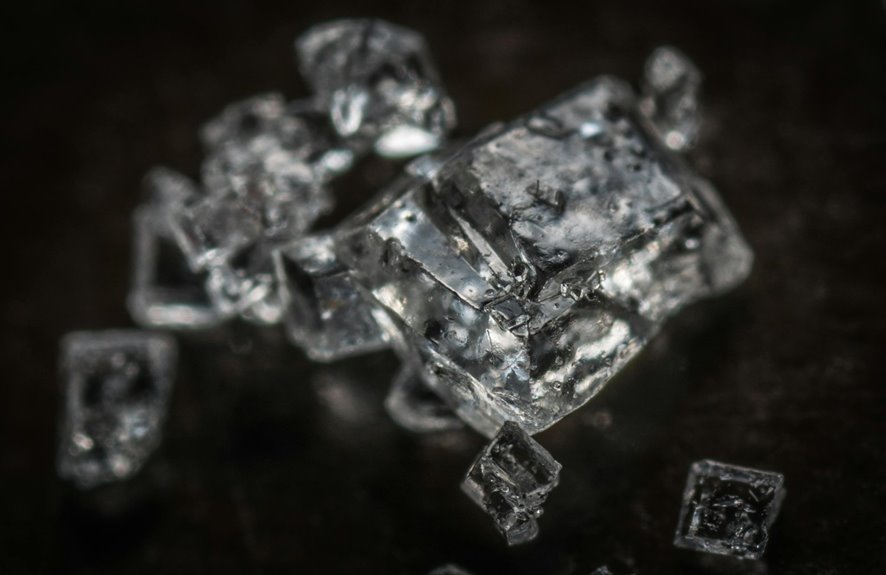
Polyamide structures actually contain both amorphous and crystalline regions, each influencing its properties differently. You’ll find the amorphous parts offer flexibility and higher moisture absorption, while the crystalline regions provide strength, rigidity, and thermal stability. The balance between these areas shapes the material’s performance in applications from textiles to automotive parts. If you want to understand how this dual nature affects everything from mechanical strength to heat resistance, there’s more to explore ahead.
Key Takeaways
- Polyamides have both amorphous and crystalline regions within their molecular structure.
- Crystalline regions feature highly ordered molecular chains with strong hydrogen bonding.
- Amorphous regions consist of disordered, flexible chains with higher moisture absorption.
- The degree of crystallinity affects polyamide’s mechanical strength and thermal stability.
- Processing conditions and molecular structure determine the balance between amorphous and crystalline phases.
Definition and Overview of Polyamides
Polyamides are a group of polymers characterized by repeating amide linkages in their backbone. When you work with polyamides, you’ll find they’re versatile materials commonly used in textiles, automotive parts, and packaging.
These polymers form through condensation reactions between diamines and dicarboxylic acids or their derivatives. You’ll often hear about Nylon, a well-known polyamide, which showcases the material’s strength and durability.
Polyamides offer excellent mechanical properties, chemical resistance, and thermal stability, making them ideal for many applications. As you explore polyamides, you’ll notice how their structure influences these properties without diving into molecular details just yet.
Understanding their definition and general characteristics sets a solid foundation before moving into how their structure affects crystallinity and amorphous behavior.
Molecular Structure of Polyamides
You’ll notice that polyamides have specific chain arrangement patterns that affect their properties.
The hydrogen bonding between chains plays a key role in strengthening the material.
Let’s explore how these molecular features shape polyamide behavior.
Chain Arrangement Patterns
Although the molecular structure of polyamides varies, their chain arrangement patterns play an essential role in determining their physical properties.
You’ll find that the chains can organize themselves in different ways, influencing strength, flexibility, and thermal resistance. Understanding these patterns helps you predict how the material behaves under stress or heat.
Key chain arrangement patterns include:
- Amorphous regions: Chains are randomly oriented, providing flexibility but less strength.
- Crystalline regions: Chains align in a regular, ordered fashion, enhancing rigidity and durability.
- Semi-crystalline structure: A mix of ordered and disordered regions, balancing toughness and flexibility.
Hydrogen Bonding Influence
When you examine the molecular structure of polyamides, you’ll notice that hydrogen bonding plays a crucial role in their behavior.
These bonds form between the amide groups’ hydrogen and oxygen atoms, creating strong intermolecular attractions. This interaction greatly influences whether the polymer chains align into ordered, crystalline regions or remain disordered in amorphous areas.
Hydrogen bonding stabilizes the crystalline phase by holding chains tightly together, enhancing mechanical strength and thermal resistance. Without these bonds, polyamides would lack structural integrity and perform poorly.
Characteristics of Amorphous Regions in Polyamides
Since polyamides consist of both crystalline and amorphous regions, understanding the characteristics of the amorphous areas is essential for grasping their overall behavior.
These amorphous regions lack the ordered, tightly packed molecular arrangement found in crystalline parts. Instead, they feature random, disordered chains, which greatly influence flexibility and impact resistance.
When you examine these areas, you’ll notice they absorb moisture more readily, affecting mechanical properties. Also, they exhibit lower density and reduced thermal stability compared to crystalline zones.
Key characteristics include:
- Random, disordered molecular chains without long-range order
- Greater free volume allowing chain mobility and flexibility
- Higher moisture absorption leading to plasticization effects
Recognizing these traits helps you understand how amorphous regions contribute to the unique performance of polyamide materials.
Characteristics of Crystalline Regions in Polyamides
Now, you’ll see how crystalline regions in polyamides show tightly aligned molecular patterns that boost mechanical strength.
You’ll notice distinct thermal behaviors that help identify these ordered areas.
Understanding these traits lets you grasp how polyamides perform under different conditions.
Molecular Alignment Patterns
Although polyamides can appear amorphous at a glance, their crystalline regions reveal highly ordered molecular alignment patterns.
You’ll notice that polymer chains in these regions line up in a regular, repeating arrangement, creating a stable and tightly packed structure. This alignment is vital because it influences the material’s mechanical strength and durability.
When you examine these patterns, you’ll find:
- Chains arranged in lamellae, forming plate-like crystals
- Strong hydrogen bonding between amide groups, enhancing order
- Chain folding that contributes to dense packing and rigidity
Thermal Behavior Indicators
The ordered molecular alignment in polyamide’s crystalline regions directly impacts how the material responds to temperature changes. You’ll notice sharp melting points during thermal analysis, indicating well-defined crystalline structures.
These regions exhibit a distinct melting temperature (Tm), where the material shifts from a solid to a more fluid state. Additionally, you can detect a glass shift temperature (Tg) associated with the amorphous parts, but the crystalline zones influence overall thermal stability.
When you heat polyamides, crystalline areas require more energy to disrupt, showing higher heat resistance. Techniques like Differential Scanning Calorimetry (DSC) help you observe these shifts clearly.
Understanding these thermal behavior indicators lets you predict performance under heat and tailor polyamide applications effectively without mixing mechanical strength details.
Mechanical Strength Contributions
Crystalline regions in polyamides play an essential role in boosting mechanical strength by providing structural rigidity and resistance to deformation. When you examine these regions, you’ll notice they create ordered molecular chains that act like a tough backbone, enhancing durability.
This structure helps polyamides withstand stress and retain shape under load, making them ideal for demanding applications.
You’ll find these key contributions to mechanical strength:
- Increased tensile strength due to tightly packed polymer chains
- Improved resistance to wear and abrasion from stable crystal lattices
- Higher stiffness and dimensional stability because of restricted molecular mobility
Understanding these crystalline features helps you appreciate why polyamides perform so well in engineering and consumer products.
Factors Influencing Crystallinity in Polyamides
When you examine polyamides, you’ll find that their crystallinity depends on several key factors, including molecular structure, processing conditions, and thermal history.
The chemical makeup, such as chain length and symmetry, influences how easily polymer chains align into ordered regions. For example, regular, linear chains tend to crystallize better than branched ones.
Processing methods like cooling rate also play a role—slow cooling allows chains time to organize, increasing crystallinity, while rapid cooling traps chains in an amorphous state.
Additionally, thermal history matters; repeated heating and cooling cycles can alter crystalline content by promoting or disrupting crystal growth.
Impact of Crystallinity on Mechanical Properties
Although you mightn’t always notice it, the degree of crystallinity in polyamides greatly affects their mechanical properties. Higher crystallinity means stronger, stiffer materials because the ordered regions resist deformation better.
On the other hand, less crystalline polyamides tend to be more flexible and impact-resistant due to their amorphous, less organized structure. Understanding this balance helps you choose the right polyamide for your application.
Key mechanical impacts of crystallinity include:
- Tensile strength: Increases with crystallinity, making the material tougher.
- Elastic modulus: Higher crystallinity results in a stiffer, less stretchable polymer.
- Impact resistance: Lower crystallinity enhances toughness and energy absorption.
Thermal Behavior Related to Polyamide Crystallinity
Because the degree of crystallinity directly influences how polyamides respond to heat, you’ll notice significant differences in their thermal behavior. Higher crystallinity typically raises melting points and enhances thermal stability, while lower crystallinity results in lower melting points and more flexibility. You can rely on these traits when selecting polyamides for heat-sensitive applications.
| Crystallinity Level | Melting Point (°C) | Thermal Stability |
|---|---|---|
| Low | 180–210 | Moderate, softens easily |
| Medium | 210–230 | Balanced stability/flexibility |
| High | 230–265 | High, resists deformation |
Understanding these patterns helps you predict polyamide performance under thermal stress effectively.
Methods to Analyze Polyamide Crystallinity
Understanding how crystallinity affects polyamide’s thermal properties naturally leads to the question of how to measure it accurately.
Accurately measuring crystallinity is key to understanding its impact on polyamide’s thermal properties.
You can analyze polyamide crystallinity using several key methods, each offering unique insights into its structure. Here are three essential techniques you should consider:
- X-ray Diffraction (XRD): This method reveals the degree of crystallinity by detecting the crystalline regions through diffraction patterns.
- Differential Scanning Calorimetry (DSC): DSC measures the heat flow associated with melting and crystallization, helping you quantify the crystalline fraction.
- Fourier Transform Infrared Spectroscopy (FTIR): FTIR identifies molecular bonding and can differentiate between amorphous and crystalline phases by analyzing specific absorption bands.
Applications Based on Polyamide Structural Properties
The unique structural properties of polyamides open the door to a wide range of practical applications. You’ll find these materials in everything from automotive parts to textiles because their crystalline and amorphous regions provide strength and flexibility. Understanding these properties helps you choose the right polyamide for your needs, whether it’s durability or elasticity.
| Application | Relevant Structural Property |
|---|---|
| Automotive Parts | High crystallinity for strength |
| Textiles | Balanced amorphous regions for flexibility |
| Electrical Insulation | Amorphous regions for dielectric properties |
| Packaging Films | Semi-crystalline for barrier performance |
Frequently Asked Questions
How Do Polyamides Biodegrade in the Environment?
You’ll find polyamides biodegrade slowly as microbes break their bonds, especially under warm, moist conditions. You can speed this up by exposing them to enzymes or composting environments that encourage microbial activity.
What Are Common Additives Used With Polyamides?
You might think polyamides don’t need additives, but they do. You’ll often find plasticizers, stabilizers, flame retardants, and fillers added to improve flexibility, durability, heat resistance, and reduce costs during production and use.
How Do Processing Conditions Affect Polyamide Color?
You’ll notice polyamide color changes with processing conditions like temperature and time; overheating causes yellowing, while moisture levels affect clarity. Controlling these factors helps you maintain consistent, desired color in your final product.
What Is the Cost Comparison of Polyamides Versus Other Polymers?
Back in the days of knights, you’d find polyamides pricier than common polymers like polyethylene but cheaper than high-performance ones like PEEK. You’ll balance cost with strength and durability when choosing your polymer today.
Are Polyamides Safe for Food Contact Applications?
You can safely use polyamides for food contact since they meet regulatory standards like FDA approval. Just guarantee the specific grade is certified, as formulations vary. Always check compliance for your intended application.