
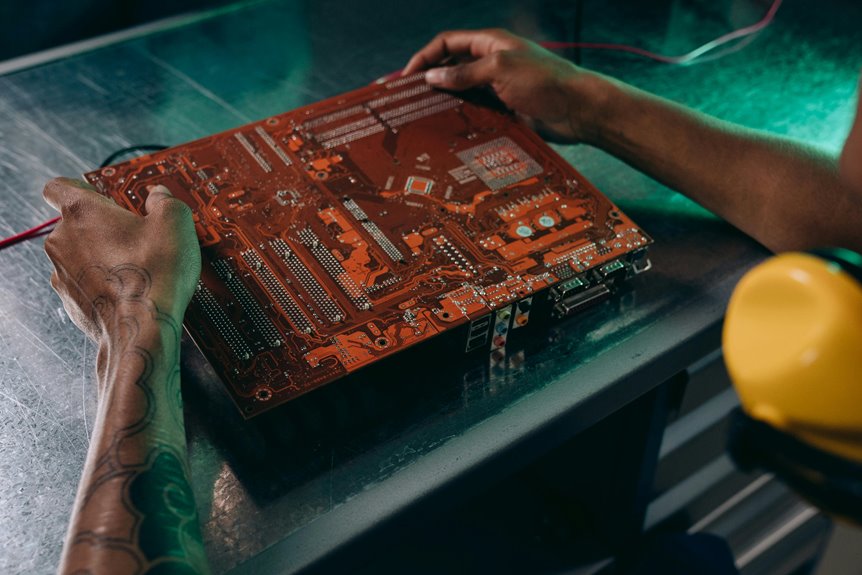
When fabricating PCBs in China, start by selecting a reputable manufacturer with strong certifications and clear communication. Design your boards using standard materials like FR4 and guarantee manufacturability for smooth production. Prototype first to test quality and fit, then scale up for cost-efficient mass production. Implement rigorous quality control and plan logistics carefully to navigate shipping and customs smoothly. Keep these steps in mind, and you’ll be ready to optimize your entire PCB fabrication journey effectively.
Key Takeaways
- China offers vast PCB manufacturing scale, advanced technology, and cost-effective production from prototypes to complex multilayer boards.
- Select manufacturers by verifying certifications, testing prototypes, and assessing communication, lead times, and quality control processes.
- Use suitable materials like FR4 or Rogers and design for manufacturability with standard hole sizes, spacing, and layer counts to ensure smooth fabrication.
- Implement strict quality control, verify ISO 9001, IPC, UL, and RoHS certifications, and conduct automated inspections and sampling during production.
- For mass production, optimize order size, choose cost-effective shipping, handle import duties carefully, and collaborate with experienced freight forwarders.
Understanding the PCB Manufacturing Landscape in China
Although you might be familiar with global electronics production, understanding the PCB manufacturing landscape in China reveals why it dominates this industry.
When you look closely, you’ll see China offers an unmatched combination of scale, advanced technology, and cost efficiency. Thousands of factories across regions like Shenzhen and Dongguan specialize in everything from simple single-layer PCBs to complex multilayer boards.
You’ll find these manufacturers equipped with the latest machinery, allowing rapid turnaround and high-quality outputs. Plus, the local supply chain is tightly integrated, reducing delays and costs.
This ecosystem supports both startups needing prototypes and large companies launching mass production runs. By grasping these factors, you’ll appreciate why China remains the go-to hub for PCB fabrication worldwide, balancing innovation, speed, and affordability with ease.
Choosing the Right PCB Manufacturer
How do you pick the right PCB manufacturer amid so many options in China? Focus on quality, lead time, and communication. Quality guarantees your design works flawlessly. Lead time affects your project schedule. Clear communication prevents costly misunderstandings.
Here’s a quick comparison to help you decide:
| Criteria | What to Check |
|---|---|
| Quality | Certifications, sample tests |
| Lead Time | Production speed, flexibility |
| Communication | Responsiveness, language skills |
Before committing, request prototypes and verify certifications. A reliable manufacturer will be transparent and open to questions. Prioritize factories that match your project’s scale and complexity. By carefully weighing these factors, you’ll find a partner that helps your PCB project succeed from prototype to production.
Key Materials and Technologies Used in PCB Fabrication
Once you’ve chosen the right manufacturer, understanding the materials and technologies they use becomes key to ensuring your PCB meets performance and durability requirements.
Key materials like FR4, Rogers, and aluminum substrates influence thermal management and signal integrity. Advanced techniques such as controlled impedance, laser drilling, and surface finish options like ENIG or HASL also impact quality and reliability. Knowing these lets you tailor your PCB specs for ideal results.
Here are essential elements to take into account:
- Substrate Materials: FR4 for general use, Rogers for high-frequency.
- Copper Thickness: Affects current capacity and heat dissipation.
- Surface Finishes: ENIG, HASL, or OSP for solderability and protection.
- Fabrication Technologies: Laser drilling and controlled impedance for precision.
This knowledge helps you get the best from your PCB fabrication in China.
Designing Your PCB for Manufacturing in China
When designing your PCB for manufacturing in China, focus on design for manufacturability to guarantee smooth production.
You’ll also want to choose materials that meet both performance and cost requirements.
Optimizing your PCB layout can help reduce errors and speed up the fabrication process.
Design for Manufacturability
Efficiency plays an essential role in designing your PCB for manufacturing in China. To guarantee smooth production and reduce costs, focus on creating a design that’s easy to fabricate and assemble.
Keep in mind that complex layouts or tight tolerances can lead to delays or increased expenses. Simplify your design by adhering to manufacturer guidelines and standard practices.
Consider these key points to improve manufacturability:
- Use standard hole sizes and pad dimensions to avoid custom tooling
- Maintain adequate spacing between traces to prevent shorts or defects
- Opt for common PCB layer counts to reduce complexity
- Design for testability by including test points and accessible components
Material Selection Considerations
Choosing the right materials is essential for guaranteeing your PCB meets performance and cost requirements during fabrication in China.
Start by evaluating the base substrate; FR-4 is standard for most applications due to its balance of durability and affordability. However, if you need high-frequency performance, consider materials like Rogers or PTFE.
Copper thickness also impacts your board’s current-carrying capability and thermal management—select it based on your design’s electrical demands.
Don’t overlook surface finishes; options like HASL, ENIG, or OSP affect solderability and lifespan.
Additionally, factor in the material’s thermal properties, especially if your design involves heat-sensitive components.
PCB Layout Optimization
Material choices set the foundation, but how you arrange your PCB components and traces can make or break the manufacturing process in China.
Optimizing your layout guarantees smooth production, reduces errors, and lowers costs. You should place components logically to minimize trace lengths and avoid complex routing. Make certain to respect manufacturer design rules regarding spacing and drill sizes to prevent fabrication issues.
Additionally, keep thermal management in mind to maintain board reliability.
Focus on these key layout optimization tips:
- Group related components to simplify routing
- Use standard trace widths and spacing compliant with Chinese manufacturers
- Avoid placing vias in critical signal paths to reduce interference
- Incorporate adequate clearance for automated assembly and testing
These steps help you create a manufacturable, high-quality PCB ready for China’s production capabilities.
Prototype Development and Testing
Before moving to full-scale production, you’ll want to focus on prototype development and testing to confirm your PCB design performs as expected. Creating prototypes allows you to identify design flaws early and make necessary adjustments. Testing these prototypes involves checking electrical functionality, signal integrity, and mechanical fit. By collaborating closely with your Chinese fabricator, you can expedite revisions and improve quality.
| Step | Purpose | Tools/Methods |
|---|---|---|
| Prototype Fabrication | Build initial PCB samples | Quick-turn PCB shops |
| Functional Testing | Verify circuit operation | Multimeter, Oscilloscope |
| Signal Integrity Test | Validate signal quality | TDR, Network Analyzer |
| Mechanical Check | Confirm fit and assembly | 3D Models, Fixtures |
| Design Revision | Implement improvements | CAD Software |
Scaling Up to Mass Production
When you scale up to mass production, you’ll need to focus on volume and cost efficiency to keep your project profitable.
You’ll also want to implement strict quality control measures to maintain consistency across large batches.
Balancing these factors guarantees your PCBs meet standards without breaking the budget.
Volume and Cost Efficiency
Although scaling up PCB production in China can seem challenging, you’ll find that volume manufacturing considerably drives down costs. When you increase order size, fixed costs like setup fees spread out, making each board cheaper.
Plus, suppliers often offer bulk discounts and prioritize large orders, speeding up turnaround times. To maximize cost efficiency, focus on:
- Ordering standardized board sizes to reduce material waste
- Consolidating multiple PCB designs into one production batch
- Negotiating long-term contracts for better pricing
- Choosing local manufacturers to cut shipping and logistics expenses
Quality Control Measures
Since maintaining high quality becomes more complex as you scale up PCB production in China, implementing rigorous quality control measures is vital.
You need to establish standardized inspection protocols at every stage—from raw material sourcing to final assembly. Using automated optical inspection (AOI) and electrical testing guarantees defects are caught early, reducing costly rework.
Collaborate closely with your manufacturer to set clear quality benchmarks and request regular progress reports. Don’t skip on sampling inspection during mass production runs to verify consistency.
Additionally, insist on certifications like ISO 9001 to ensure adherence to international quality standards.
Quality Control and Certification Standards
Guaranteeing stringent quality control and meeting certification standards are essential steps you must consider when choosing PCB fabrication in China.
Ensuring strict quality control and certification compliance is crucial when selecting PCB fabrication services in China.
These standards guarantee your boards meet safety, reliability, and performance expectations, reducing risks during production and end-use. You should verify that your manufacturer complies with internationally recognized certifications to guarantee product quality and regulatory adherence.
Key certifications and standards to look for include:
- ISO 9001: Quality management system guaranteeing consistent product quality.
- IPC Standards: Industry benchmarks for PCB design and manufacturing.
- UL Certification: Safety certification for electronic components.
- RoHS Compliance: Restricts hazardous substances in electronics.
Managing Costs and Lead Times
When you work with PCB manufacturers in China, managing costs and lead times becomes essential for keeping your project on schedule and within budget.
Start by clearly specifying your design requirements to avoid costly revisions. Choose the right manufacturing process and materials that balance quality and price. Request quotes from multiple suppliers to compare pricing and turnaround times.
Be aware that prototype runs are usually faster but more expensive per unit, while larger production orders reduce cost per board but take longer to complete.
Communicate regularly with your manufacturer to track progress and address potential delays early. Planning ahead and consolidating orders can help reduce shipping frequency and associated costs.
Shipping, Customs, and Import Considerations
After managing costs and lead times, you’ll need to focus on shipping, customs, and import requirements to get your PCBs from China to your doorstep smoothly.
Choosing the right shipping method—air or sea—depends on your budget and urgency. Make sure your manufacturer provides accurate documentation, like the commercial invoice and packing list, to avoid customs delays.
You’ll also want to be aware of import duties and taxes that might apply. Working with a reliable freight forwarder can simplify the process and help you navigate regulations.
Key considerations include:
- Selecting cost-effective shipping options
- Ensuring complete and accurate customs paperwork
- Understanding import tariffs and taxes
- Partnering with experienced freight forwarders for smooth delivery
Frequently Asked Questions
How Do Environmental Regulations Impact PCB Waste Disposal in China?
When it comes to PCB waste disposal in China, you can’t cut corners. Environmental regulations force you to follow strict guidelines, ensuring hazardous materials are handled safely, protecting the environment while keeping your operations compliant and responsible.
What Are Common Intellectual Property Concerns With Chinese PCB Manufacturers?
You’ll often worry about IP theft, unauthorized copying, and weak enforcement when working with Chinese PCB manufacturers. Protect your designs with NDAs, patents, and choose partners carefully to minimize risks and safeguard your intellectual property.
How Can I Verify a PCB Manufacturer’S Factory Audit Reports?
You know what they say, “Trust, but verify.” You can cross-check factory audit reports by requesting third-party verification, comparing certifications, and even visiting the factory yourself or hiring a local agent to guarantee accuracy and authenticity.
Are There Specific Labor Laws Affecting PCB Production Timelines in China?
Yes, you should know China’s labor laws set limits on working hours and mandatory breaks, which can impact PCB production timelines. Make sure your manufacturer complies to avoid delays caused by labor disputes or overtime restrictions.
What Post-Production Support Services Do Chinese PCB Manufacturers Typically Offer?
You’ll typically get testing, inspection, and quality assurance services. Many manufacturers also offer technical support, rework, and repair services. Some provide logistics assistance and customization advice to guarantee your PCBs meet your exact needs after production.