
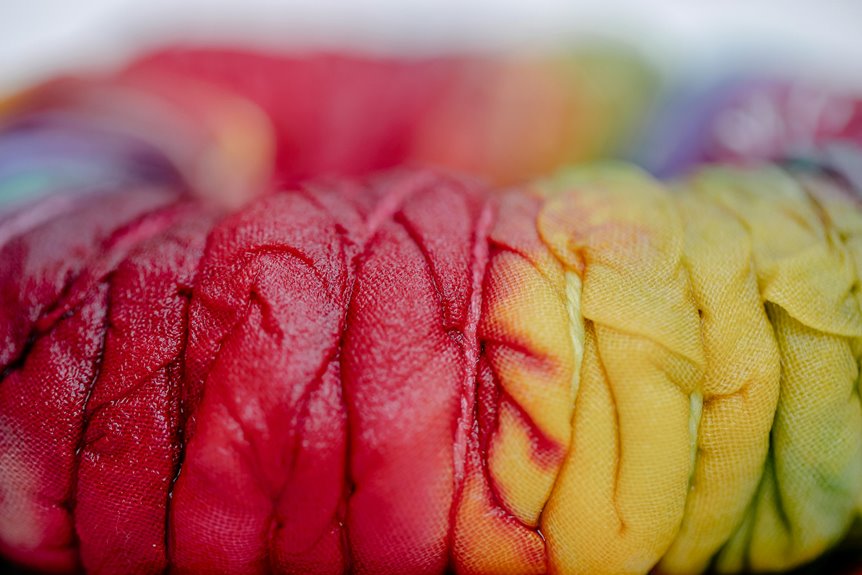
If you want to master the hardest tie-dye technique, focus on perfecting complex folds like accordion, origami, and pleating. You’ll need to prep your fabric properly—cotton works best—and fold precisely with tight, even creases secured by strong rubber bands. Controlling dye absorption and leaving intentional negative space adds contrast and depth. Though challenging, mastering these steps leads to sharp, vibrant designs that stand out. Keep exploring to reveal tips for troubleshooting and advanced effects.
Key Takeaways
- Mastering complex folds requires precise fabric alignment and consistent fold widths for uniform dye patterns.
- Use strong rubber bands and secure ties tightly on natural creases to maintain sharp design edges during dyeing.
- Employ advanced folding methods like origami and pleating with careful pressure and symmetry for intricate geometric effects.
- Control dye absorption by selectively tying and layering folds to create vibrant contrasts and negative space.
- Troubleshoot common issues by ensuring fabric is pre-washed, folds are tight, and dye is applied sparingly to prevent bleeding.
Understanding Fabric Behavior for Advanced Folding
Before you plunge into complex tie-dye folds, you need to understand how different fabrics behave.
Cotton, for instance, absorbs dye quickly and evenly, making it ideal for sharp, vibrant patterns. Polyester, however, resists dye, so it’s less suitable for traditional tie-dye techniques.
Cotton soaks up dye fast for vivid patterns, while polyester resists, making it tricky for classic tie-dye.
Linen and rayon offer unique textures but absorb dye inconsistently, which can add dimension or cause blotches. Stretchy fabrics like spandex don’t hold folds well, leading to less defined designs.
When you choose your fabric, consider its weave and weight; tighter weaves hold folds better, resulting in cleaner lines. Pre-washing your fabric removes sizing and improves dye absorption.
Knowing these factors lets you predict how your fabric will take dye, helping you tailor your folding technique for the best results.
Accordion Fold Techniques for Sharp Patterns
To create sharp accordion fold patterns, you’ll need to align your fabric precisely and keep each fold the same width.
Make sure to press firmly so the folds hold their shape throughout the dyeing process.
These steps are key to achieving clean, crisp designs every time.
Precise Fabric Alignment
Mastering precise fabric alignment is essential when using accordion fold techniques to create sharp tie-dye patterns. You need to lay your fabric flat and smooth out any wrinkles before folding.
Then, carefully fold the fabric back and forth like an accordion, making sure each fold lines up exactly with the previous one. If your edges aren’t perfectly aligned, your pattern will blur and lose its crispness.
Use clips or pins to hold the fabric in place as you work to prevent shifting. Checking your alignment from different angles helps catch any misplacements early.
The more precise you’re during this step, the more defined your final design will be. Take your time; perfect alignment is the foundation of striking, sharp accordion fold tie-dye.
Consistent Fold Widths
Consistently folding your fabric to the same width guarantees your accordion folds produce sharp, uniform patterns. Start by measuring a small section of fabric to determine your fold width, then use that as a guide throughout. You can mark the edges lightly with a washable fabric marker or pin to keep each fold even.
As you fold, keep the fabric taut but not stretched to maintain consistent tension. Folding irregularly will cause uneven dye distribution, blurring your design. Pay close attention to edges and corners, folding them as precisely as the rest of the fabric.
The goal is to create crisp, repeating lines that reveal themselves once dyed. Mastering this step sets the foundation for complex, eye-catching tie-dye patterns.
Securing Folds Firmly
When you secure your accordion folds firmly, you guarantee the dye only reaches the intended sections, creating sharp, defined patterns.
To do this, pinch the fabric tightly at each fold, then use strong rubber bands or string to hold everything in place. Make sure the bands are evenly spaced and snug to prevent dye from seeping into unwanted areas.
Avoid loose ties, as they blur the design and ruin the crisp lines you want. Also, double-check that the folds don’t shift while you apply dye; any movement can distort the pattern.
Using clips or additional ties can help keep folds stable. By mastering this step, you’ll elevate your tie-dye game and produce striking, professional-looking results every time.
The Origami Fold: Creating Geometric Designs
You’ll want to focus on precise folding methods to get the clean lines that make geometric designs pop.
Sharp creases are key, so take your time pressing each fold firmly. This attention to detail will transform your fabric into striking, well-defined patterns.
Precise Folding Methods
Although precise folding might seem intimidating at first, mastering the origami fold lets you create striking geometric designs that stand out in your tie-dye projects.
To nail the technique, focus on accuracy and consistency with these steps:
- Lay your fabric flat and smooth out wrinkles before folding.
- Pinch a corner and carefully fold the fabric into even, sharp triangles.
- Align edges carefully at each fold to maintain symmetry.
- Use light pressure to hold folds in place without stretching the fabric.
Achieving Sharp Creases
Mastering precise folding sets the stage for achieving sharp creases that define your geometric tie-dye patterns. To get those crisp lines, start with damp fabric—it’s more pliable and holds folds better.
Use your fingertips to press down firmly along each fold, then run the edge of a ruler or a bone folder to reinforce the crease sharply. Don’t rush this step; taking your time guarantees each fold stays put during dyeing.
After folding, secure the fabric tightly with rubber bands or string to maintain pressure on the creases. Remember, sharp creases control dye penetration, so your geometric shapes come out clean and distinct.
With consistent practice, you’ll turn complex folds into striking, precise tie-dye designs.
Using Pleats for Intricate Color Transitions
When you fold fabric into pleats, you create narrow, repeated layers that guide dye in precise patterns. This technique lets you achieve intricate color shifts with sharp definition.
To master pleating:
- Start by ironing the fabric flat to remove wrinkles.
- Fold the fabric into tight, even pleats along the desired direction.
- Secure the pleats firmly with rubber bands or string.
- Apply dye carefully, targeting different pleat edges to create gradual color changes.
Combining Multiple Folds for Layered Effects
Combining multiple folds lets you create layered effects that add depth and complexity to your tie-dye designs. By merging different folding techniques, like accordion pleats with spirals or triangles, you can achieve patterns that pop with dimension. Start by folding one section, then layer another fold on top before dyeing. This method allows colors to overlap and interact in unique ways, making your design stand out.
| Fold Type | Effect | Tips |
|---|---|---|
| Accordion Pleat | Sharp, linear patterns | Keep pleats even |
| Spiral | Circular, dynamic look | Center fold precisely |
| Triangle | Geometric shapes | Use consistent angles |
| Layered Combo | Multi-dimensional | Fold carefully layer by layer |
Experiment with folding sequences to reveal endless creative possibilities.
Precision Tying: Securing Complex Folds
Although creating intricate folds sets the stage, fastening them with precise tying guarantees your design holds its shape during dyeing.
Crafting detailed folds lays the groundwork, but secure tying ensures your pattern stays crisp through dyeing.
You need to secure every fold tightly to prevent dye bleeding and maintain sharp patterns. Here’s how to tie your complex folds effectively:
- Use strong, thin rubber bands to wrap each fold firmly without damaging the fabric.
- Double knot each band to verify it doesn’t slip during the dyeing process.
- Adjust tension evenly across the folds so no areas are loose or overly tight.
- Position ties strategically on natural fold creases to reinforce the pattern’s edges.
Experimenting With Negative Space in Folding
Securing your folds tightly sets a solid foundation, but exploring negative space within those folds can elevate your tie-dye designs to a new level.
Negative space refers to the areas left undyed or minimally colored, creating contrast and visual interest. When folding, intentionally leave certain sections exposed or loosely bound to preserve these blank zones.
This technique allows you to craft bold patterns where color and fabric interplay dynamically. Experiment by folding asymmetrically or layering folds unevenly, then selectively tying parts to control dye absorption.
You’ll notice how the untouched fabric highlights surrounding colors, adding depth and complexity. Don’t be afraid to test different fold placements to see how negative space transforms your design.
Embracing this approach sharpens your control and creativity in complex tie-dye folding.
Troubleshooting Common Issues in Advanced Folding
When you plunge into advanced folding techniques, you’ll encounter challenges like uneven dye penetration, unwanted creases, or fabric shifting.
To troubleshoot these issues effectively:
Effective troubleshooting ensures your folding technique produces vibrant, clean, and precise tie-dye patterns every time.
- Uneven Dye Penetration: Make sure your folds are tight and consistent. Use rubber bands to secure the fabric so dye reaches all areas evenly.
- Unwanted Creases: Avoid overly sharp folds that create harsh lines. Try softer, rounded folds to keep the pattern smooth.
- Fabric Shifting: Anchor your fabric firmly on a flat surface before folding. Work slowly to maintain the layers’ alignment.
- Color Bleeding: Use quality dyes and apply sparingly. Let the fabric rest between colors to prevent bleeding.
Frequently Asked Questions
What Types of Dyes Work Best With Complex Tie-Dye Folds?
You’ll want fiber-reactive dyes for vibrant, lasting colors that soak well into complex folds. They bond with cotton fibers, ensuring sharp patterns and bright hues. Avoid basic dyes—they won’t give you the depth you need.
How Long Should Dyed Fabric Be Left to Cure for Vibrant Colors?
You should let your dyed fabric cure for at least 6 to 24 hours to get vibrant colors. Wrapping it in plastic helps keep moisture in, allowing the dye to fully set and intensify.
Can These Folding Techniques Be Applied to Synthetic Fabrics?
You might think synthetic fabrics resist folding techniques, but you’re in luck—they can handle them! Just remember synthetics absorb dye differently, so you’ll need to adjust your process for vibrant, lasting colors.
What Safety Precautions Are Recommended When Using Multiple Dyes?
You should wear gloves and work in a well-ventilated area to avoid inhaling fumes. Don’t mix dyes directly, and protect surfaces with plastic. Always follow dye instructions carefully to keep yourself safe and dye colors vibrant.
How Do Washing Instructions Vary for Complex Tie-Dye Garments?
Like a delicate dance, washing complex tie-dye garments requires you to use cold water, gentle cycles, and mild detergent to preserve vibrant colors and intricate patterns. Don’t mix with heavy fabrics to avoid color bleeding or damage.