
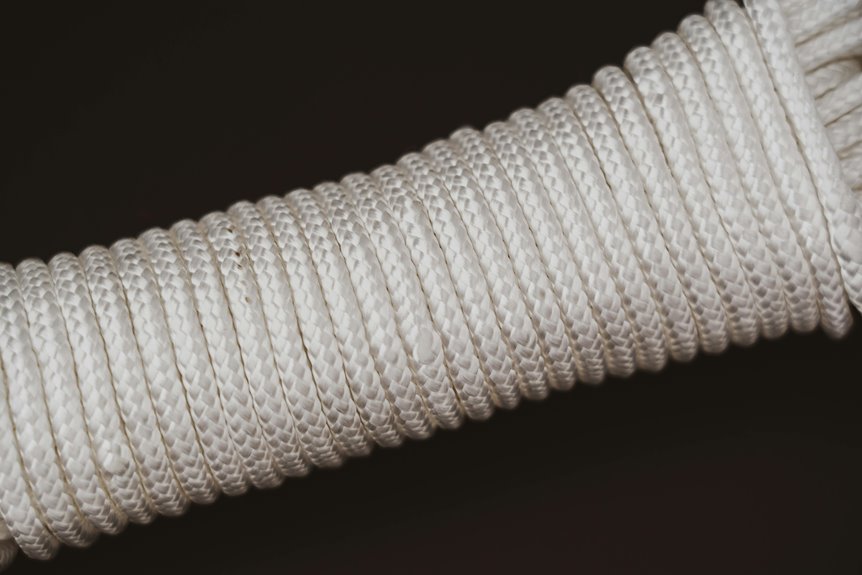
Kevlar fabric owes its strength to aramid fibers made from rigid, aromatic polyamide chains packed with benzene rings. You get tightly bonded polymer chains aligned parallel, maximizing strong hydrogen bonds that resist stretching and breaking. This molecular orientation creates stiff, crystalline regions balanced by flexible amorphous areas, giving you exceptional toughness and tensile strength. The manufacturing process further enhances this by stretching fibers for ideal alignment. If you want to understand how these elements come together to create Kevlar’s unmatched durability, keep exploring its details.
Key Takeaways
- Kevlar’s aramid fibers consist of rigid aromatic polyamide chains with benzene rings linked by strong amide bonds.
- Strong hydrogen bonding between polymer chains enhances intermolecular strength and resists stretching.
- High molecular orientation aligns fibers parallel, creating crystalline domains that maximize stiffness and strength.
- The balance of crystalline and amorphous regions provides both toughness and flexibility in the fiber.
- Manufacturing processes stretch and align fibers, increasing molecular order and resulting in exceptional tensile strength.
Chemical Structure of Aramid Fibers
Although you mightn’t see it, Kevlar’s strength comes from its unique chemical structure. You’re dealing with aramid fibers, which are long chains of aromatic polyamides.
These chains contain repeating units with benzene rings connected by amide linkages. This structure gives Kevlar both rigidity and stability. The benzene rings provide stiffness, while the amide groups form strong hydrogen bonds between polymer chains.
You’ll find that these hydrogen bonds act like molecular glue, holding the chains tightly together. This tight bonding resists stretching and breaking under stress.
Molecular Orientation and Crystallinity
When you look closer at Kevlar’s structure, you’ll see that its molecular orientation plays an essential role in its strength. The polymer chains align parallel to each other, creating highly ordered regions called crystalline domains. This alignment allows the chains to pack tightly, maximizing intermolecular hydrogen bonding and enhancing load transfer along the fiber’s length.
You’ll also find less ordered, amorphous regions that provide flexibility without compromising toughness. The balance between crystalline and amorphous areas determines Kevlar’s overall performance. High crystallinity means better stiffness and resistance to deformation while maintaining durability.
This precise molecular arrangement is why Kevlar fibers don’t just rely on chemical composition but also on how the molecules are organized to achieve exceptional strength and resilience.
Mechanical Properties and Tensile Strength
Kevlar fibers boast an impressive tensile strength that often exceeds 3,000 MPa, making them five times stronger than steel on an equal weight basis.
Kevlar fibers deliver tensile strength over 3,000 MPa, making them five times stronger than steel by weight.
When you handle Kevlar fabric, you’re working with a material designed to resist stretching and breaking under extreme stress. Its high modulus means it maintains shape under tension, giving you reliable durability.
The fiber’s molecular structure allows load distribution evenly across chains, minimizing weak points. You’ll notice Kevlar’s exceptional toughness — it absorbs energy efficiently, making it ideal for impact-resistant applications.
Despite being lightweight, it offers remarkable stiffness and resilience. By choosing Kevlar, you get a fabric that balances strength and flexibility, allowing you to trust it in demanding environments without sacrificing performance or safety.
Manufacturing Process of Kevlar Fabric
Since producing Kevlar fabric involves precise chemical and mechanical steps, understanding its manufacturing process helps you appreciate its unique properties.
You start with a polymer solution made by reacting para-phenylenediamine with terephthaloyl chloride, forming long aramid chains. This solution undergoes spinning, where it’s extruded through tiny holes into a coagulation bath, solidifying the fibers.
Next, you carefully stretch these fibers to align the molecules, increasing strength and rigidity. The fibers then dry and wind onto spools.
Finally, the yarns are woven into fabric using specialized looms. Throughout, strict control of temperature, tension, and chemical conditions guarantees the fibers’ exceptional tensile strength and durability.
Applications Leveraging Kevlar’s Strength
Exceptional strength and lightweight properties make Kevlar fabric a go-to choice in many high-performance applications. When you need materials that can withstand extreme conditions without adding bulk, Kevlar stands out.
You often find it in gear designed to protect and perform under pressure. For instance, law enforcement and military personnel rely on Kevlar vests for ballistic protection. You’ll also see it in sports equipment where durability and weight matter, such as racing sails and bicycle tires.
Additionally, Kevlar’s resistance to heat and abrasion makes it ideal for industrial uses.
- Body armor and protective gear for personal safety
- High-performance sports equipment requiring durability
- Industrial applications demanding heat and abrasion resistance
Frequently Asked Questions
How Does Kevlar Compare in Weight to Other Synthetic Fibers?
You’ll find Kevlar is lighter than many synthetic fibers like fiberglass or steel but slightly heavier than ultra-light options like Dyneema. Its excellent strength-to-weight ratio makes it ideal for protective gear without adding bulk.
What Are the Environmental Impacts of Producing Kevlar?
You should know producing Kevlar consumes significant energy and uses toxic chemicals, which can harm the environment if not managed properly. However, its durability means less waste over time, balancing some environmental concerns.
Can Kevlar Degrade Under Prolonged UV Exposure?
Yes, Kevlar can degrade under prolonged UV exposure. You’ll notice its strength and flexibility diminish over time if it’s not protected, so it’s best to shield it from direct sunlight to maintain its durability and performance.
How Recyclable Is Kevlar Fabric After Use?
You’ll find Kevlar fabric isn’t very recyclable because its strong, heat-resistant fibers resist breakdown. While some specialized processes exist, recycling is limited and costly, so reusing or repurposing Kevlar is often a better choice.
What Safety Precautions Are Needed When Handling Kevlar Fibers?
Since Kevlar fibers can irritate your skin and eyes, you should always wear gloves and protective eyewear. You’ll also want to handle them in a well-ventilated area to avoid inhaling any airborne particles.