
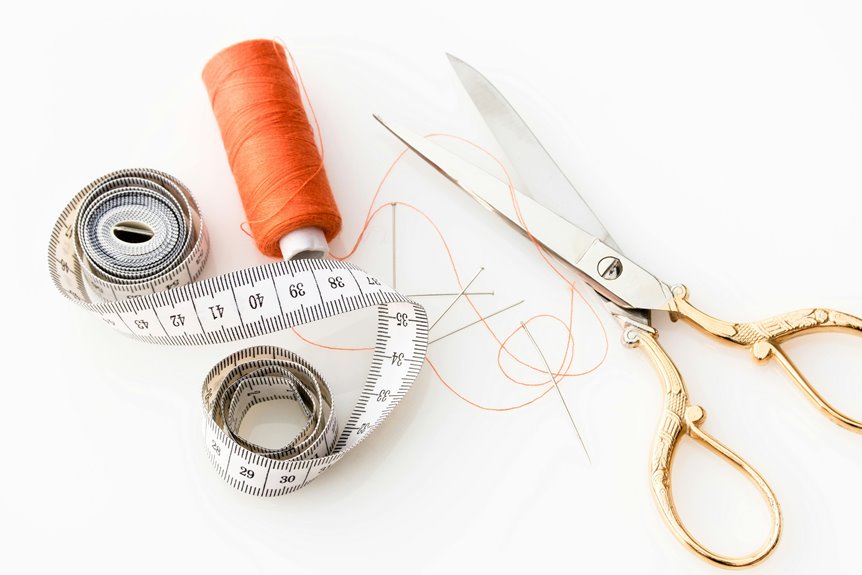
When sewing with nonwoven interfacing, first choose the right weight for your fabric—light for delicate, medium for cotton, heavy for denim. Pre-wash and press both fabric and interfacing to avoid shrinkage. Cut accurately using sharp tools, then fuse with a pressing cloth at the recommended heat, applying firm, even pressure. Trim interfacing seam allowances to reduce bulk and adjust stitch length for smooth seams. Ready to enhance your garment’s structure and learn expert tips to perfect your work?
Key Takeaways
- Choose lightweight interfacing for delicate fabrics to minimize bulk and maintain fabric drape.
- Pre-wash and press fabric and interfacing before cutting to prevent shrinkage and distortion.
- Use sharp scissors or rotary cutters and stabilize fabric to cut interfacing accurately.
- Fuse interfacing with proper heat settings, using a pressing cloth and applying firm, even pressure.
- Trim interfacing seam allowances and adjust stitch length and tension to manage bulk and ensure smooth sewing.
Understanding Nonwoven Interfacing Types
When you work with nonwoven interfacing, you’ll encounter several types designed for different fabric weights and project needs.
You’ll notice fusible and sew-in options; fusible has adhesive on one side, so you just press it onto your fabric with an iron. Sew-in interfacing doesn’t have adhesive, so you stitch it directly into your project.
Nonwoven interfacing is made from fibers bonded together, giving it a smooth, consistent texture without any grain. It comes in varying weights—light, medium, and heavy—so you can add the right amount of structure.
Nonwoven interfacing features smooth, grain-free fibers and comes in light, medium, and heavy weights for tailored support.
The weight affects stiffness and durability, and you’ll find that lighter interfacing is ideal for delicate fabrics, while heavier types provide more support for sturdy textiles.
Understanding these types helps you handle your fabric confidently.
Choosing the Right Interfacing for Your Fabric
Since each fabric behaves differently, you’ll need to select interfacing that complements its weight and texture.
For lightweight fabrics like silk or chiffon, choose a lightweight nonwoven interfacing to avoid adding bulk or stiffness.
Medium-weight fabrics such as cotton or linen pair well with a medium-weight interfacing, providing structure without overwhelming the fabric.
For heavier fabrics like denim or wool, opt for a heavy-duty nonwoven interfacing to guarantee durability and support.
Also, consider the fabric’s drape; if it’s fluid, pick an interfacing that maintains softness.
Always test a small fabric piece with your chosen interfacing to check compatibility.
Matching the right interfacing keeps your project looking polished and professional, preventing unwanted stiffness or distortion in your final garment.
Preparing Your Fabric and Interfacing
Before you start sewing, make certain to pre-wash and press both your fabric and interfacing to prevent any shrinkage or distortion later. This step helps maintain the shape and fit of your finished project. Lay your fabric and interfacing flat on a clean surface, smoothing out wrinkles. Use a dry iron to press them, avoiding steam which can affect the adhesive on some nonwoven interfacings.
| Step | Tip | Why It Matters |
|---|---|---|
| Pre-wash | Use gentle detergent | Removes sizing and dirt |
| Press | Use dry heat, low to medium | Prevents adhesive damage |
| Smooth fabric | Lay flat, avoid stretching | Keeps fabric shape intact |
Following these preparation steps guarantees your interfacing bonds properly and your sewing project looks professional.
How to Cut Nonwoven Interfacing Accurately
To cut nonwoven interfacing accurately, you’ll need the right tools like sharp scissors or a rotary cutter.
Mark your fabric carefully with tailor’s chalk or washable pens to keep your lines precise.
Make certain to stabilize your fabric before cutting to prevent shifting and guarantee clean edges.
Choosing the Right Tools
Selecting the right tools makes cutting nonwoven interfacing precise and hassle-free.
To get clean, accurate cuts, you’ll want to equip yourself properly. Here’s what you should consider:
- Sharp Fabric Scissors – Use scissors dedicated to fabric to avoid frayed edges and uneven cuts.
- Rotary Cutter and Cutting Mat – Ideal for straight lines and multiple layers, ensuring smooth, consistent cuts.
- Measuring Tools – A clear ruler or a measuring tape helps you stay exact with dimensions.
- Weights or Pins – Keep your interfacing steady while cutting to prevent slipping and mistakes.
Marking Techniques for Precision
Accurate marking plays an essential role in cutting nonwoven interfacing cleanly and correctly. To guarantee precision, use a fine-tip fabric marker or tailor’s chalk that contrasts well with your interfacing’s color. Avoid heavy or permanent markers, as they might bleed through or stain your fabric.
Lay the interfacing flat on a smooth surface, then transfer your pattern outlines carefully. Pin or weigh down your pattern pieces to prevent shifting while marking. When tracing, use light, even pressure to avoid distorting the interfacing fibers.
For curved edges or complex shapes, mark multiple points and connect them smoothly. Taking time with these marking techniques will help you cut accurately, guaranteeing your interfacing fits perfectly and supports your project as intended.
Stabilizing Fabric Before Cutting
Keep your fabric steady before cutting nonwoven interfacing to guarantee clean, precise edges. Unstable fabric leads to uneven cuts, which can affect your sewing project’s finish.
To stabilize your fabric effectively, try these steps:
- Use a cutting mat: Place your fabric on a non-slip cutting mat to prevent shifting.
- Pin or weigh down: Secure your fabric and interfacing with pins or fabric weights.
- Press flat: Iron your fabric and interfacing to remove wrinkles, ensuring smooth cutting.
- Cut slowly and steadily: Use a sharp rotary cutter or scissors, moving carefully along your marked lines.
Following these tips will help you cut interfacing accurately, improving your garment’s structure and appearance.
Tips for Fusing Nonwoven Interfacing Properly
When you fuse nonwoven interfacing, ensuring the right temperature and pressure is key to achieving a smooth, secure bond.
Always check the manufacturer’s recommended heat setting and test on a scrap piece first. Use a pressing cloth to protect your fabric from direct heat and avoid shiny marks.
Apply firm, even pressure with your iron, holding it steady for about 10-15 seconds per section without sliding, which can cause shifting. Let the fused fabric cool completely before moving it; this helps the adhesive set properly.
If you notice any bubbling or peeling, reduce the temperature slightly and press again. Taking these steps will give you a professional finish and a durable bond that holds up through sewing and wear.
Sewing Techniques for Nonwoven Interfacing
Before you start sewing, make sure to properly prepare your nonwoven interfacing by cutting it accurately and aligning it with your fabric.
Use a sharp needle and adjust your stitch length to prevent puckering or damage.
These simple stitching tips will help you achieve clean, professional results every time.
Preparing Nonwoven Interfacing
To prepare nonwoven interfacing effectively, you’ll need to start by selecting the right type for your fabric and project.
Once chosen, follow these steps to guarantee a smooth application:
- Pre-shrink the interfacing by gently pressing it with a warm iron to prevent future distortion.
- Cut it precisely, matching the pattern pieces to avoid bulk or gaps.
- Test adhesion on a fabric scrap to confirm compatibility and heat settings.
- Align the interfacing carefully with the wrong side of your fabric, guaranteeing smooth, bubble-free placement before fusing or sewing.
Stitching Tips and Tricks
Once you’ve properly prepared and applied your nonwoven interfacing, stitching it requires some specific techniques to maintain fabric integrity and achieve a clean finish.
Use a sharp needle, like a universal or microtex, to prevent snagging or damaging the interfacing. Choose a shorter stitch length, around 2 to 2.5 mm, for stronger seams and less puckering.
Sew slowly and steadily, ensuring the fabric and interfacing feed evenly through the machine. Avoid backstitching over the same spot repeatedly, as this can cause bulk or weaken the interfacing’s bond.
If your project allows, consider using a walking foot to manage layers smoothly.
Finally, always test on a scrap piece before beginning your actual work to fine-tune your settings and avoid surprises.
Handling Bulk and Thickness in Sewing Projects
Although nonwoven interfacing adds valuable structure, it can also increase bulk and thickness, which may affect your sewing machine’s performance and the final garment’s comfort.
To handle this, you need to adjust your approach:
- Choose a lightweight interfacing for delicate fabrics to reduce bulk.
- Trim seam allowances of interfacing before sewing to prevent thick seams.
- Use a longer stitch length to ease fabric through your machine smoothly.
- Consider pressing seams open or to one side to flatten bulky areas.
Preventing Wrinkles and Puckering
To prevent wrinkles and puckering when using nonwoven interfacing, make sure you place the interfacing correctly on your fabric.
Adjust your sewing machine’s tension to match the thickness for smooth stitches.
Also, stabilize the fabric edges to keep everything aligned and neat as you sew.
Proper Interfacing Placement
When you place nonwoven interfacing incorrectly, wrinkles and puckering can easily ruin your project. To guarantee smooth results, you need to position the interfacing properly before fusing or sewing.
Follow these key steps:
- Align grainlines – Match the interfacing grain with your fabric for consistent stretch and drape.
- Cut accurately – Use the same pattern piece to cut interfacing, avoiding size mismatches.
- Fuse gently – Apply heat evenly with a pressing cloth to prevent shifting or bubbles.
- Secure edges – Pin or baste the interfacing in place to keep it from moving during stitching.
Optimal Sewing Tension
Because sewing tension directly affects fabric handling, getting it right is essential to prevent wrinkles and puckering when working with nonwoven interfacing.
Start by adjusting your machine’s tension dial to a moderate setting; too tight will gather the fabric, while too loose causes loose stitches. Test on a scrap piece layered with the interfacing to find balance.
Pay attention to both the upper thread and bobbin tension—both must work harmoniously. Use a fine needle to minimize fabric distortion.
Sew slowly and evenly, guiding the fabric without pulling. If puckering appears, slightly loosen the tension or try a longer stitch length.
With careful tension control, your seams will lie flat, maintaining the crisp structure interfacing provides and ensuring a professional finish.
Stabilizing Fabric Edges
Three key steps help you stabilize fabric edges and prevent wrinkles or puckering when sewing with nonwoven interfacing.
First, always choose the right weight of interfacing for your fabric to maintain balance.
Second, carefully fuse the interfacing using a consistent, medium heat to avoid bubbles or shifting.
Third, trim interfacing edges precisely to match your fabric pieces for even support.
To further stabilize fabric edges:
- Use a sharp rotary cutter or scissors for clean cuts.
- Apply a gentle pressing technique without stretching the fabric.
- Stitch slowly and steadily to maintain smooth seams.
- Consider using stay stitching along curves before assembling.
Following these tips guarantees your project looks polished and professional every time.
Using Nonwoven Interfacing in Garment Construction
Although nonwoven interfacing might seem simple, it plays an essential role in garment construction by adding structure and stability to fabrics. When you apply it to collars, cuffs, and facings, it helps maintain crisp shapes and prevents stretching.
You’ll want to choose the right weight and type based on your fabric and the garment’s purpose. Fuse the interfacing carefully with an iron, following the manufacturer’s instructions to avoid damaging your fabric. Pin or baste it in place before stitching to keep everything aligned.
Using nonwoven interfacing also improves the durability of your garment, ensuring it holds its form through wear and washing. By mastering its application, you’ll create professional-looking pieces that feel as good as they look.
Caring for Garments With Nonwoven Interfacing
Once you’ve mastered applying nonwoven interfacing to give your garments structure, you’ll want to know how to keep them looking sharp over time.
Proper care guarantees your clothing maintains its shape and durability. Here are four key tips:
Proper care ensures your garments keep their shape and last longer.
- Follow Fabric Care Labels: Always check and adhere to the garment’s washing instructions to avoid damaging the interfacing.
- Use Gentle Washing Methods: Opt for hand washing or delicate machine cycles to protect the interfacing’s integrity.
- Avoid High Heat: High temperatures in washing, drying, or ironing can weaken or warp the interfacing. Use low heat settings instead.
- Store Properly: Hang or fold garments carefully to prevent creasing or crushing the interfacing, preserving the garment’s structure longer.
Creative Uses for Nonwoven Interfacing Beyond Clothing
Nonwoven interfacing isn’t just for clothing—it’s a versatile material that can enhance many craft and home projects. You can use it to stabilize fabric in quilting, giving your pieces more structure without bulk.
It’s perfect for making stiffened fabric bookmarks or coasters that hold their shape over time. When creating home décor items like fabric lampshades or wall art, interfacing adds durability and form.
You can also reinforce fabric baskets or storage bins, ensuring they stand up to daily use. Plus, it’s great for DIY book covers or fabric-covered boxes, adding a professional finish.
Troubleshooting Common Issues When Sewing Interfacing
When sewing interfacing, you might encounter issues like puckering, bubbling, or uneven adhesion that can affect your project’s finish. Don’t worry—these problems are common, and you can fix them with a few adjustments.
- Puckering: Reduce your stitch length or adjust the tension on your sewing machine. Also, make sure you’re not stretching the fabric while sewing.
- Bubbling: Check that the interfacing is fused properly. Use the right heat and pressure settings for your fabric type.
- Uneven Adhesion: Reapply heat with a pressing cloth, making sure to cover the entire area evenly.
- Fabric Damage: Always test on a scrap piece first to avoid burning or melting.
With these tips, you’ll get smooth, professional results every time.
Frequently Asked Questions
Can Nonwoven Interfacing Be Used in Quilting Projects?
You can definitely use nonwoven interfacing in quilting projects to add stability and structure. It’s great for supporting fabric layers, but make sure you choose the right weight so it doesn’t make your quilt too stiff or bulky.
What Is the Environmental Impact of Nonwoven Interfacing?
Think of nonwoven interfacing as a quick fix with a hidden cost—it’s often made from synthetic fibers that don’t break down easily, so you’ll want to choose eco-friendly options or recycle to lessen your environmental footprint.
How Long Does Nonwoven Interfacing Typically Last in Garments?
You can expect nonwoven interfacing to last several years in garments, but its durability depends on fabric quality and care. Over time, it may weaken or lose stiffness, especially after frequent washing or heavy use.
Are There Nonwoven Interfacings Suitable for Machine Washable Items?
Think of nonwoven interfacing as armor for your fabric. You’ll find machine-washable options designed to stay strong through cycles. Just check labels carefully, so your garment keeps its shape without shrinking or warping after washing.
Can Nonwoven Interfacing Be Recycled or Reused After Sewing?
You can’t easily recycle nonwoven interfacing due to its synthetic fibers and adhesives. However, you can reuse scraps for small projects or reinforce areas in other garments, reducing waste and extending its usefulness creatively.