
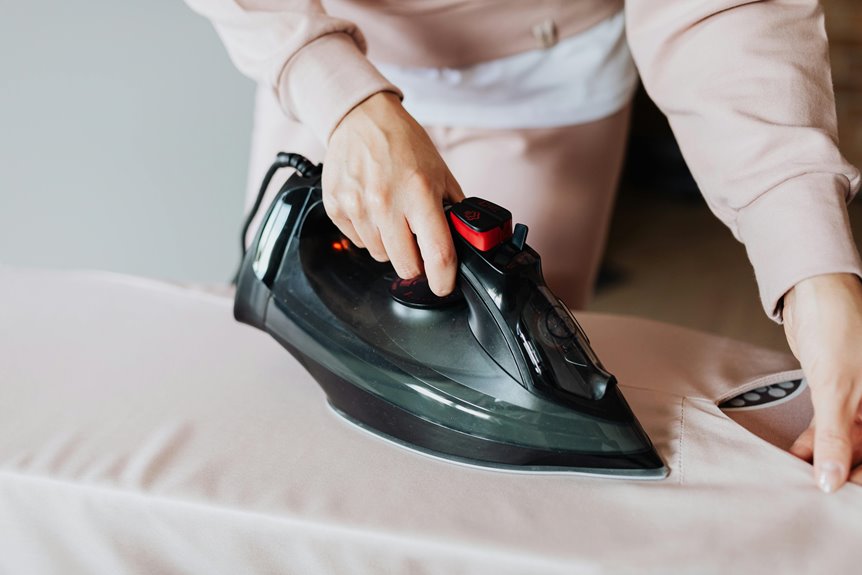
To press scuba fabric, set your iron to low or medium heat (250°F–300°F) and avoid steam to prevent damage. Always use a pressing cloth to protect the smooth surface and keep the iron moving to avoid melting or shiny marks. Press gently without sliding to maintain the fabric’s shape. Work on a clean, flat surface with good lighting for best results. Keep handling soft and steady—there’s more to learn about perfecting your technique and caring for your finished garment.
Key Takeaways
- Use a low to medium heat setting (250°F to 300°F) on the iron to avoid melting or warping the scuba fabric.
- Always place a pressing cloth between the iron and fabric to protect the smooth texture and sheen.
- Avoid using steam and keep the iron moving gently without sliding to prevent stretching or damage.
- Press seams briefly with gentle, downward pressure, using a tailor’s ham for curved areas when needed.
- Prepare a clean, flat workspace with good lighting and avoid heavy pressure or prolonged heat exposure.
Understanding the Properties of Scuba Fabric
Before you press scuba fabric, you need to understand its unique properties.
Scuba fabric is a thick, stretchy knit made from a blend of polyester and spandex, giving it a smooth texture and a slight sheen. Its thickness provides structure, but that same quality makes it sensitive to heat. If you apply too much heat, you risk melting or warping the fabric.
Scuba fabric’s thick, stretchy blend offers structure and sheen but requires careful low-heat handling to avoid damage.
Unlike cotton or linen, scuba fabric doesn’t respond well to high-temperature pressing or steam. You’ll also notice it resists creasing, so heavy pressing isn’t usually necessary.
Knowing these traits helps you avoid damaging your material and guarantees you maintain its sleek finish. Keep in mind, gentle handling and low heat settings are key when working with scuba fabric.
Essential Tools for Pressing Scuba Fabric
You’ll need the right iron, like a steam or dry iron with adjustable temperature settings, to press scuba fabric effectively.
Using protective pressing materials, such as a pressing cloth, helps prevent damage and shine.
Let’s go over the best temperature settings to keep your fabric looking perfect.
Recommended Iron Types
Although scuba fabric requires careful handling, choosing the right iron makes pressing much easier and prevents damage.
You’ll want an iron with adjustable temperature settings so you can start low and increase heat cautiously. Steam irons work well because the moisture helps relax the fabric fibers, but avoid excessive steam that might cause stretching. A dry iron can also be effective if you control the temperature carefully.
Non-stick or ceramic soleplates are recommended since they glide smoothly and reduce the risk of sticking or scorching the fabric. Avoid heavy irons or those with rough soleplates, as they can leave marks or permanently alter the fabric’s texture.
Selecting the right iron guarantees your scuba fabric stays smooth and maintains its shape during pressing.
Protective Pressing Materials
When pressing scuba fabric, using protective materials is essential to prevent shine, scorch marks, or fabric distortion.
These tools create a barrier between the iron and the fabric, ensuring a smooth and safe pressing experience. You’ll want to have these on hand:
- Pressing cloth: A lightweight cotton or muslin cloth to shield the fabric from direct heat.
- Teflon sheet: A non-stick cover that prevents sticking and protects delicate surfaces.
- Silicone ironing mat: Heat-resistant and ideal for placing hot irons safely.
- Parchment paper: An alternative protective layer when you don’t have a pressing cloth.
- Clean towel: To cushion and absorb excess moisture during pressing.
Utilizing these materials helps maintain the scuba fabric’s texture and appearance while you press.
Temperature Settings Guide
Because scuba fabric is sensitive to heat, setting your iron to the correct temperature is crucial to avoid damaging the material. You should always use a low to medium heat setting, typically between 250°F to 300°F (120°C to 150°C).
Avoid using the steam function, as moisture combined with heat can cause the fabric to lose its shape. Before pressing, test your iron on a small, hidden area to verify the temperature won’t scorch or melt the fabric.
Remember to keep the iron moving and avoid applying direct heat for too long. Using a pressing cloth between the iron and the fabric adds an extra layer of protection.
Following these temperature guidelines will help you achieve crisp seams without ruining your scuba fabric.
Preparing Your Workspace for Pressing
A clean, organized workspace sets the foundation for successfully pressing scuba fabric. Before you begin, clear your ironing area and gather everything you need to avoid interruptions.
Start with a clean, organized workspace to ensure smooth, uninterrupted pressing of your scuba fabric.
Having a dedicated spot helps you focus and prevents accidental fabric damage. Make sure the surface is flat and sturdy to support even pressing.
Here’s what you should prepare:
- A clean ironing board or flat surface covered with a soft cloth
- A pressing cloth to protect the fabric
- Your iron placed within easy reach
- A spray bottle with water for steam if needed
- Good lighting to spot wrinkles and fabric details
With these ready, you’ll create a safe, efficient environment for perfect pressing results.
Setting the Iron Temperature Correctly
You’ll want to set your iron to a low to medium heat to protect the scuba fabric’s texture.
Using too high a temperature can easily cause melting or unwanted marks.
Always test on a scrap piece first to avoid damage.
Ideal Heat Settings
Three key temperature settings help you press scuba fabric without damage: low, medium, and high. You’ll want to start with a low heat to test how the fabric reacts. If it holds up well, you can cautiously move to medium. Avoid going straight to high, as it risks melting or warping the material.
Here’s how to adjust your iron settings for the best results:
- Set your iron to the synthetic or low heat setting initially
- Use medium heat only if the fabric tolerates low heat without alteration
- Avoid steam to prevent watermarks or distortion
- Always press with a protective cloth between the iron and fabric
- Test on a small, hidden area before the full press
Following these guidelines guarantees your scuba fabric stays smooth and intact.
Avoiding Fabric Damage
When setting your iron temperature, make certain to avoid overheating scuba fabric, as excessive heat can cause melting or permanent distortion.
Always use the lowest heat setting possible, typically a synthetic or low-temperature option, to protect the fabric’s integrity.
Before pressing the entire piece, test your iron on a small, inconspicuous area to verify it doesn’t damage the material.
Never apply the iron directly; instead, place a thin pressing cloth between the iron and scuba fabric to provide a protective barrier.
Keep the iron moving constantly to prevent heat buildup in one spot.
If your iron has a steam function, avoid using it, as moisture combined with heat can alter the fabric’s texture.
Proper temperature control is key to preserving your scuba fabric’s shape and appearance.
Using a Pressing Cloth for Protection
One essential step to protect scuba fabric while pressing is using a pressing cloth. This simple barrier prevents direct heat contact, reducing the risk of shine, scorch marks, or melted fibers.
When you use a pressing cloth, it cushions the fabric, distributes heat evenly, and helps maintain scuba’s smooth texture.
Keep these tips in mind when choosing and using a pressing cloth:
- Use a clean, lightweight cotton or muslin cloth
- Avoid synthetic fabrics that can melt
- Place the cloth flat over the area to be pressed
- Don’t apply excessive pressure through the cloth
- Replace or wash the cloth regularly to prevent dirt transfer
Techniques for Pressing Seams on Scuba Fabric
When pressing seams on scuba fabric, set your iron to a low heat to prevent damage.
Always use a pressing cloth to protect the fabric’s smooth surface and avoid shine.
To keep seams crisp, stabilize them with gentle steam and avoid stretching while pressing.
Ideal Iron Settings
Setting your iron to the right temperature is essential for pressing seams on scuba fabric without damaging it. Scuba fabric is synthetic and thick, so too much heat can melt or distort it. Here’s how to set your iron perfectly:
- Use a low to medium heat setting, usually between 200°F and 300°F (around polyester or nylon settings).
- Avoid steam; dry heat prevents watermarks and puckering.
- Test on a fabric scrap to guarantee no shine or melting occurs.
- Press gently without sliding the iron to avoid stretching the fabric.
- Use a short pressing time—just a few seconds per seam—to maintain fabric integrity.
Following these settings will help you achieve smooth, crisp seams without ruining your scuba fabric.
Using Pressing Cloth
Using a pressing cloth is crucial for protecting scuba fabric during ironing. You’ll want to place a thin, damp cotton cloth between the iron and the fabric to prevent direct heat contact, which can cause melting or shine.
When pressing seams, position the fabric flat, cover with the cloth, and press gently—don’t slide the iron back and forth, as this can stretch or distort the material. Use a light touch and short pressing bursts, lifting the iron frequently to avoid overheating.
The pressing cloth acts as a heat buffer, allowing you to shape seams neatly without damaging the scuba fabric’s texture or thickness. Always test on a scrap piece first to verify the right heat and technique before working on your project.
Seam Stabilization Tips
Although scuba fabric can be tricky to press, stabilizing seams properly guarantees your garment keeps its shape and durability.
To handle seams on scuba fabric effectively, follow these essential tips:
- Use a low to medium heat setting on your iron to avoid melting the fabric.
- Press seams gently with a pressing cloth to protect the surface.
- Avoid stretching the fabric while pressing to maintain seam alignment.
- Consider using a tailor’s ham to press curved seams smoothly.
- Clip seam allowances carefully to reduce bulk without damaging the fabric.
How to Avoid Shiny Marks and Scorching
Because scuba fabric is sensitive to heat, you’ll need to take extra care to prevent shiny marks and scorching when pressing.
Always use a low heat setting on your iron, ideally the synthetic or silk setting, and test on a scrap piece first.
Place a pressing cloth—a clean cotton towel or muslin—between the iron and the fabric to protect the surface.
Avoid applying direct, prolonged pressure; instead, press briefly and lift the iron frequently to prevent heat buildup.
Steam can help relax the fabric without direct contact, but keep the iron slightly above the fabric to avoid moisture damage.
Taking these precautions guarantees your scuba fabric stays smooth and vibrant without unwanted shiny patches or burn marks.
Pressing Curved and Detailed Areas
Anyone who’s worked with scuba fabric knows that pressing curved and detailed areas requires extra patience and care.
You can’t just press flat like you do with regular fabric; these areas need a gentler, more precise approach to avoid distortion or shine.
Here’s how you can handle it:
- Use a tailor’s ham or pressing cushion to support curves.
- Set your iron to a low heat with no steam.
- Press with a cloth between the iron and fabric to protect the surface.
- Use short, gentle presses instead of sliding the iron.
- Let the fabric cool completely before moving it to set the shape.
Best Practices for Storing Pressed Scuba Garments
After carefully pressing curved and detailed areas, you’ll want to guarantee your scuba garments stay crisp and wrinkle-free. Store them properly by hanging on wide, padded hangers to maintain shape and avoid creases. Keep garments in a cool, dry place, away from direct sunlight to prevent fabric damage. Use breathable garment bags to protect from dust while allowing airflow. Avoid overcrowding your closet to prevent crushing the fabric.
| Storage Tip | Why It Matters | Quick Reminder |
|---|---|---|
| Use padded hangers | Maintains garment shape | No wire hangers! |
| Cool, dry storage | Prevents mildew and fading | Avoid damp areas |
| Breathable garment bag | Protects without trapping moisture | Avoid plastic covers |
| Avoid overcrowding | Stops wrinkles and creases | Space is key |
| Fold carefully if needed | Prevents permanent creases | Use tissue paper |
Troubleshooting Common Pressing Issues With Scuba Fabric
When pressing scuba fabric, you might encounter issues like unwanted shine, puckering, or stubborn wrinkles. Don’t worry—these problems are common but fixable. Here’s how you can troubleshoot effectively:
- Use a pressing cloth to prevent shine caused by direct heat.
- Adjust your iron to a low or medium setting; too much heat damages the fabric.
- Avoid stretching the fabric while pressing to prevent puckering.
- Apply gentle, even pressure and keep the iron moving to smooth wrinkles.
- If wrinkles persist, try steaming instead of ironing to relax the fibers.
Frequently Asked Questions
Can Scuba Fabric Be Machine Washed Without Damaging Its Texture?
You can machine wash scuba fabric, but be gentle. Use cold water, a delicate cycle, and avoid harsh detergents. Don’t tumble dry—air dry instead to keep its texture smooth and prevent damage.
Is Scuba Fabric Suitable for Outdoor Clothing?
Isn’t durability key for outdoor gear? You’ll find scuba fabric’s thick, stretchy nature makes it water-resistant and windproof, perfect for mild outdoor activities. Just remember, it’s not ideal for extreme weather conditions or heavy abrasion.
How Does Scuba Fabric Compare to Neoprene in Durability?
You’ll find scuba fabric less durable than neoprene since neoprene’s thicker and more resistant to wear. However, scuba offers better stretch and comfort for everyday wear, while neoprene’s built for heavy-duty, water-resistant use.
Can You Dye Scuba Fabric at Home?
You can dye scuba fabric at home, but it’s tricky since it’s synthetic. Use fabric dye designed for polyester or nylon, follow instructions carefully, and test a small piece first to guarantee good color absorption.
What Types of Garments Are Best Made From Scuba Fabric?
You might expect delicate blouses, but scuba fabric shines in structured garments like bodycon dresses and sleek jackets. Its thickness offers stretch and shape, so you’ll create bold, modern pieces that stand out effortlessly in your wardrobe.