
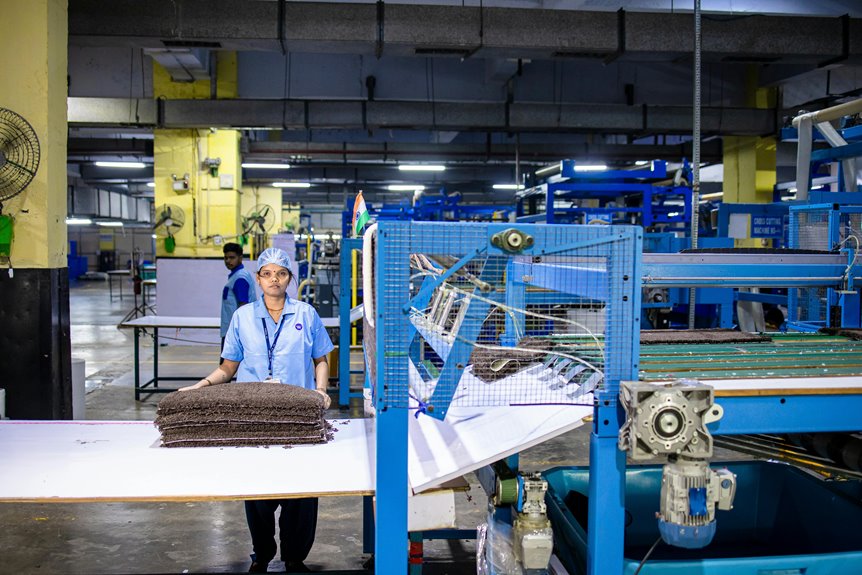
You create nonwoven fabrics by bonding fibers without weaving or knitting, using natural or synthetic fibers chosen for strength and texture. You first prepare fibers and form a web through drylaid, wetlaid, or spunbond methods. Then, you bond the fibers thermally, chemically, or mechanically. Finishing processes improve performance, and quality control guarantees durability. If you want to understand the detailed techniques and see where nonwovens fit in today’s industries, there’s more to explore.
Key Takeaways
- Nonwoven fabrics are made by bonding fibers mechanically, chemically, or thermally without weaving or knitting.
- Fiber selection, including natural or synthetic types, influences fabric strength, texture, and function.
- Web formation uses methods like drylaid, wetlaid, or spunbond to arrange fibers into a fabric web.
- Bonding techniques such as thermal, chemical, or mechanical bonding fuse fibers to create the fabric structure.
- Finishing processes and quality control ensure fabric performance, appearance, and compliance with industry standards.
Understanding the Basics of Nonwoven Fabrics
Although you mightn’t realize it, nonwoven fabrics play an essential role in many everyday products.
These materials differ from traditional woven or knitted fabrics because they’re made by bonding fibers together without weaving or knitting. Instead, fibers are mechanically, chemically, or thermally bonded to create a fabric with specific properties.
You’ll find nonwovens in items like medical masks, wipes, filters, and even insulation. Their versatility comes from how fibers are arranged and bonded, giving you fabrics that can be soft, strong, porous, or absorbent.
Understanding these basics explains why nonwoven fabrics are often chosen for applications where disposability, hygiene, or specialized performance is critical.
Once you grasp this, you’re ready to explore how these fabrics are actually produced.
Fiber Selection and Preparation
You’ll start by choosing the right fiber types, whether natural, synthetic, or a blend, based on your fabric’s intended use.
Then, you’ll prepare these fibers through processes like cleaning, carding, or blending to guarantee consistent quality.
Getting this step right sets the foundation for strong, reliable nonwoven fabrics.
Fiber Types Overview
Choosing the right fiber is essential when making nonwoven fabrics, as it directly affects the fabric’s strength, texture, and function.
You’ll typically work with natural fibers like cotton or wool, synthetic fibers such as polyester, polypropylene, and nylon, or a blend of both. Natural fibers offer breathability and softness, ideal for hygiene products, while synthetic fibers provide durability and resistance to moisture, perfect for industrial uses.
Your choice depends on the end product’s requirements, whether it’s absorbency, strength, or elasticity. Additionally, fiber length and fineness influence the fabric’s feel and performance.
Preprocessing Techniques
Before you start forming the nonwoven fabric, you need to prepare the fibers properly to guarantee consistent quality and performance.
First, select fibers based on your product’s requirements—consider strength, absorbency, and texture. Natural, synthetic, or blended fibers each bring unique properties.
Once chosen, you’ll clean and separate the fibers to remove impurities and clumps. Processes like carding or opening help align and loosen the fibers, ensuring even distribution later.
You might also blend fibers at this stage to achieve specific traits. Proper fiber preparation prevents defects and improves bonding in the final fabric.
Web Formation Techniques
Now that you’ve prepared your fibers, it’s time to form them into a web.
You’ll encounter key techniques like drylaid, wetlaid, and the spunbond method, each shaping fibers differently.
Understanding these will help you see how the fabric starts to take shape.
Drylaid Web Formation
Drylaid web formation uses mechanical methods to arrange fibers into a loose web before bonding. You’ll typically work with dry fibers that are opened and aligned using equipment like carding machines or airlay systems.
These machines help distribute fibers evenly, ensuring the web’s uniformity and strength. When you handle drylaid webs, you’re focusing on fiber orientation and web density without involving water.
Key points about drylaid web formation include:
- Carding aligns fibers in a mostly parallel arrangement.
- Airlay uses air currents to disperse fibers randomly.
- This method suits both natural and synthetic fibers.
- It produces webs with varied thickness and texture depending on fiber distribution.
Understanding these basics sets you up for exploring bonding techniques next.
Wetlaid Web Process
Wetlaid web formation involves suspending fibers in water to create a uniform slurry, which is then deposited onto a moving screen to form a continuous web.
As you work with this process, you’ll notice it resembles traditional papermaking, using water to evenly distribute short fibers.
Once the slurry hits the screen, water drains away, leaving a wet mat of fibers. This mat is then pressed and dried to create a strong, even fabric.
Wetlaid webs are great for producing lightweight, soft materials with fine fiber distribution. You’ll often find this technique used for wipes, medical fabrics, and filtration materials.
Since the fibers are suspended in water, you can mix different types easily, giving you flexibility in fabric properties without the need for complex machinery.
Spunbond Technique Overview
While wetlaid processes rely on water to arrange fibers, spunbond techniques take a different approach by forming webs directly from continuous filaments.
In spunbonding, thermoplastic polymers melt and extrude through spinnerets to create fine, strong filaments. These filaments are then cooled, stretched, and laid randomly onto a moving conveyor, forming a web without the need for water.
You’ll find spunbond fabrics lightweight yet durable, making them ideal for many applications.
Key advantages of spunbond technique include:
- Continuous filaments provide strength and uniformity
- No water use reduces drying time and energy costs
- Produces lightweight, breathable materials
- Suitable for medical, hygiene, and industrial products
This method’s efficiency and versatility make it a cornerstone in nonwoven fabric production.
Bonding Methods in Nonwoven Production
Bonding methods play an essential role in turning loose fibers into durable nonwoven fabrics. When you produce nonwovens, you need to bind the fibers together so the fabric holds its shape and strength.
You can choose from several bonding techniques, including thermal, chemical, and mechanical bonding. Thermal bonding uses heat to melt fibers slightly, fusing them as they cool. Chemical bonding involves applying adhesives that glue fibers together. Mechanical bonding, like needle punching or hydroentangling, physically entangles fibers for strength without additives.
Each method affects fabric properties like softness, durability, and breathability. By selecting the right bonding process, you guarantee your nonwoven fabric meets the performance requirements for its intended use, whether it’s for hygiene products, filters, or geotextiles.
Finishing Processes for Enhanced Properties
After bonding the fibers, you’ll want to apply finishing processes to enhance the fabric’s performance and appearance.
These steps tailor the nonwoven to specific applications, improving durability, texture, and functionality. Depending on your needs, you might choose chemical treatments, mechanical finishing, or coatings.
Key finishing processes include:
- Calendering: Uses heated rollers to smooth and compact the fabric, increasing strength and surface uniformity.
- Coating and Laminating: Adds protective or functional layers, such as waterproofing or flame retardancy.
- Surface Treatments: Impart properties like hydrophilicity, repellency, or antistatic behavior through chemical application.
- Heat Setting: Stabilizes the fabric’s dimensions and improves resistance to shrinkage and deformation.
These enhancements guarantee the nonwoven fabric meets your exact performance requirements.
Quality Control and Testing Standards
Applying finishing processes improves the fabric’s performance, but ensuring consistent quality requires thorough inspection. You need to test nonwoven fabrics for strength, thickness, and uniformity to meet industry standards.
Common tests include tensile strength to check durability, basis weight to confirm fabric density, and permeability to assess breathability. Visual inspections help identify defects like holes or uneven textures. You’ll also perform chemical tests to verify treatments like flame retardancy or water repellency.
Adhering to standards set by organizations such as ASTM or ISO guarantees your fabric meets safety and performance criteria. By integrating these quality control steps into production, you catch issues early, reduce waste, and deliver reliable, high-quality nonwoven fabrics every time.
Applications and Industry Trends
While nonwoven fabrics might seem simple, their applications span a wide range of industries, from healthcare and hygiene products to automotive and construction.
You’ll find these fabrics in disposable medical masks, wipes, filters, insulation materials, and even geotextiles. The industry is quickly evolving, driven by sustainability trends and demand for biodegradable materials.
You’ll also notice innovations focusing on enhanced strength, breathability, and antimicrobial properties. If you work with or rely on nonwovens, staying updated is vital.
Key applications and trends include:
- Eco-friendly and recyclable nonwovens
- Lightweight composites in automotive parts
- Advanced filtration for air and water purification
- Medical disposables with improved barrier performance
These developments guarantee nonwoven fabrics stay versatile and relevant.
Frequently Asked Questions
What Are the Environmental Impacts of Nonwoven Fabric Production?
You’ll notice nonwoven fabric production uses lots of energy and chemicals, which can pollute air and water. You should also consider waste generation, especially since many nonwovens aren’t biodegradable or easily recycled, impacting the environment.
How Do Nonwoven Fabrics Compare in Cost to Woven Fabrics?
Did you know nonwoven fabrics can be up to 30% cheaper than woven ones? You’ll find they cost less because they require less labor and time to produce, making them a budget-friendly choice for many applications.
Can Nonwoven Fabrics Be Recycled or Reused?
You can recycle or reuse some nonwoven fabrics, but it depends on their material and contamination. Many are made from plastics, making recycling tricky, but reusing for cleaning or insulation is common and eco-friendly.
What Safety Precautions Are Needed During Manufacturing?
You’ll wear your armor—gloves, goggles, masks—to shield against flying fibers and chemicals. You’ll keep machines humming safely with regular checks, ensuring sparks don’t ignite. Safety’s your silent guardian in every thread you create.
How Long Does It Take to Produce a Batch of Nonwoven Fabric?
You’ll find that producing a batch of nonwoven fabric usually takes a few hours to a day, depending on the fabric type, machinery speed, and batch size. Efficiency and quality control also affect production time.