
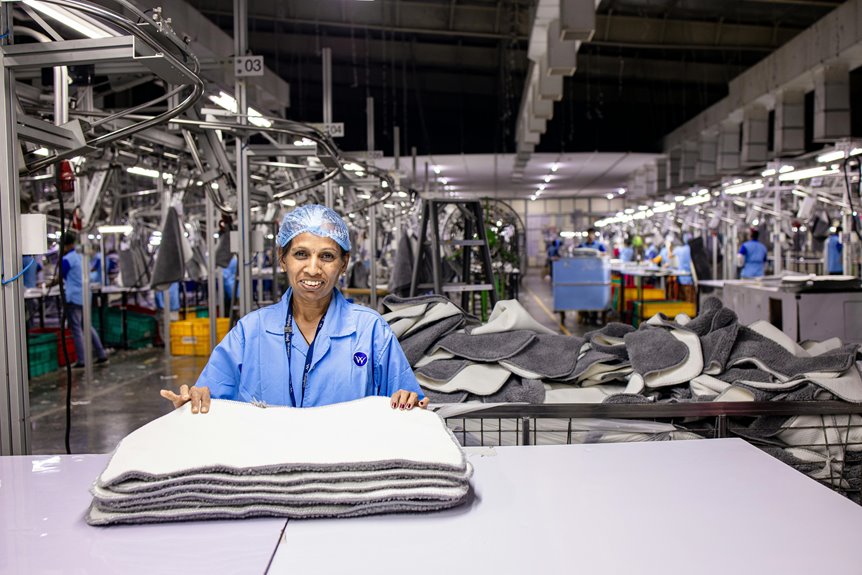
When you see how Chinese factories produce melt-blown non-woven fabric, you’ll find they start with high-quality polypropylene resin, ensuring it’s pure and dry. They melt the resin and extrude it through tiny nozzles, using high-speed hot air to form ultrafine fibers that become a uniform, strong fabric. Advanced machinery and strict quality tests guarantee top filtration performance. If you want to understand the full process and the latest innovations behind these fabrics, there’s a lot more to explore.
Key Takeaways
- Chinese factories select high-purity polypropylene resin with optimal melt flow for consistent melt-blown fabric quality.
- Molten polymer is extruded through specialized dies and stretched by high-velocity hot air to create ultrafine fibers.
- Advanced extruders, die heads, and air compressors control fiber formation and bonding into uniform non-woven fabric.
- Quality control includes filtration efficiency testing, tensile strength measurement, and microscopic fiber distribution inspection.
- Innovations like electrostatic charging and AI-driven monitoring improve filtration performance and manufacturing consistency.
Raw Materials Selection and Preparation
Before production begins, Chinese factories carefully select and prepare raw materials to guarantee the melt-blown fabric meets strict quality standards.
You’ll find that polypropylene resin is the primary raw material, chosen for its excellent melt flow and filtration properties. The resin must be pure and consistent in quality; otherwise, the final fabric won’t perform well.
Polypropylene resin is essential, prized for its superior melt flow and filtration, ensuring consistent fabric performance.
You’ll also notice that factories test the resin’s melting point and viscosity to verify it suits the melt-blowing process. Once the raw material passes inspection, it’s dried thoroughly to remove moisture, which could affect fiber formation.
By controlling these factors upfront, you can trust the factory produces fabric that’s reliable, efficient, and meets industry standards without compromise.
This careful preparation sets the foundation for high-quality melt-blown fabric production.
The Melt-Blowing Process Explained
Although the raw materials set the stage, the melt-blowing process itself transforms polypropylene resin into the fine fabric you rely on. You start by melting the resin until it reaches a fluid state.
Then, the molten polymer is extruded through tiny nozzles. High-velocity hot air blows these fine streams, stretching them into ultrafine fibers that cool and solidify instantly.
Here’s how it unfolds:
- Melting and Extrusion: You heat the resin and push it through a die with multiple tiny holes.
- Fiber Attenuation: Hot air jets stretch the polymer streams into thin fibers.
- Web Formation: These fibers deposit on a moving mesh belt, bonding into a uniform fabric.
This precise process creates the essential non-woven fabric’s unique filtration properties.
Key Machinery and Equipment in Production
Several specialized machines work together to turn molten polymer into melt-blown fabric. You’ll find the extruder first, heating and melting polymer pellets into a liquid state.
Next, the melt-blown die extrudes the molten polymer through tiny nozzles, creating fine fibers. High-velocity hot air jets stretch these fibers as they exit the die, forming a web.
You’ll then see the collection drum, which rapidly spins to gather and bond the fibers into a uniform non-woven fabric. To maintain precision, the winder rolls up the finished fabric onto spools for easy handling.
Throughout production, you’ll also rely on auxiliary equipment like temperature controllers, air compressors, and filtration systems. Each piece plays an essential role in ensuring consistent fabric quality and efficient operation.
Quality Control and Testing Procedures
To guarantee melt-blown fabric meets strict industry standards, you need rigorous quality control and testing procedures throughout production. This confirms the fabric’s filtration efficiency, strength, and consistency are always exceptional.
Rigorous quality control ensures melt-blown fabric consistently meets high standards of filtration, strength, and uniformity.
You’ll regularly check the fabric at different stages to catch any defects early.
Here’s what you should focus on:
- Filtration Efficiency Testing – Measure how well the fabric filters particles, often using automated particle counters.
- Physical Strength Tests – Assess tensile strength and elongation to confirm durability.
- Microscopic Inspection – Examine fiber distribution and uniformity under a microscope for consistency.
Innovations and Advancements in Melt-Blown Fabric Manufacturing
Beyond maintaining strict quality control, Chinese factories are constantly pushing the boundaries of melt-blown fabric production through innovations and technological advancements.
You’ll find they’re adopting cutting-edge polymer blends that enhance filtration efficiency while keeping breathability high. Automated machinery with real-time monitoring helps you track fiber diameter and web uniformity, ensuring consistent quality.
Some factories use electrostatic charging techniques to boost the fabric’s ability to capture tiny particles without increasing thickness. Additionally, energy-efficient processes reduce waste and lower production costs, making high-quality melt-blown fabric more accessible.
By integrating AI-driven predictive maintenance, factories minimize downtime, so you get faster delivery times.
These advancements mean when you source melt-blown fabric from China, you’re accessing not only quantity but also state-of-the-art quality and innovation.
Frequently Asked Questions
How Long Does It Take to Produce a Batch of Melt-Blown Fabric?
You’ll find that producing a batch of melt-blown fabric typically takes several hours, depending on the machine’s speed and batch size. With efficient setups, you can expect completion within 4 to 8 hours on average.
What Are the Environmental Impacts of Melt-Blown Fabric Production?
You’ll find melt-blown fabric production uses significant energy and releases pollutants. It generates plastic waste and consumes non-renewable resources, impacting air quality and contributing to environmental pollution unless you adopt sustainable practices and proper waste management.
How Do Chinese Factories Handle Labor and Worker Safety?
You’ll find Chinese factories tackling labor and safety seriously, with strict protocols and protective gear—almost like guarding a treasure trove. They’re committed to minimizing risks and ensuring workers’ well-being throughout every production stage.
What Is the Global Market Demand for Melt-Blown Fabric?
You’ll find the global market demand for melt-blown fabric has surged, especially due to increased mask and protective gear needs. It’s booming in healthcare, filtration, and industrial sectors, and the growth trend’s expected to continue steadily.
How Do Export Regulations Affect Melt-Blown Fabric Shipments?
Export regulations can delay your melt-blown fabric shipments, increase costs, and restrict quantities. You’ll need to navigate customs approvals carefully and stay updated on changing rules to avoid disruptions and guarantee smooth international trade.