
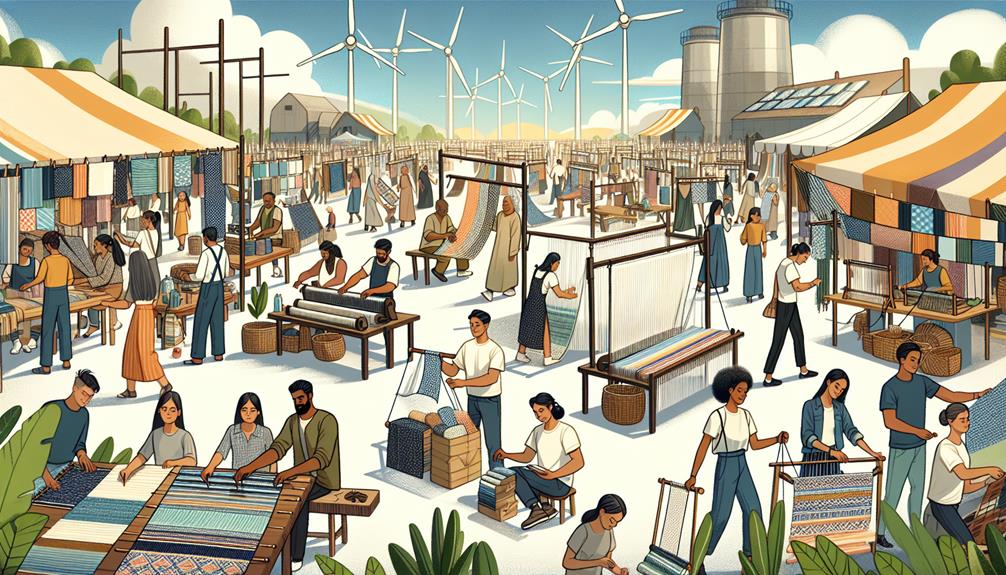
Just as Midas turned everything to gold, the shift towards sustainable textiles is transforming the economic landscape. You might wonder how eco-friendly materials can lead to significant financial gains for businesses. These gains aren't just limited to market growth but also include cost savings through resource efficiency and waste reduction. Additionally, sustainable textiles spur job creation and innovation, bolstering local economies. Companies adopting these practices are poised for long-term success, attracting both consumers and investors. Curious about the full extent of these economic benefits and how they shape the future of the textile industry?
Key Takeaways
- Sustainable textiles drive significant market growth and create new revenue streams.
- Reduced operational costs through efficient resource utilization and minimized waste.
- Job creation boosts local economies and supports community employment.
- Enhanced consumer demand for eco-friendly products reshapes the textile industry.
- Innovations in sustainable materials and production processes lead to economic opportunities.
Market Growth Potential
The market for sustainable textiles is poised for significant growth as consumers increasingly prioritize eco-friendly products. You'll find that this trend isn't just a fleeting fad; it's a fundamental shift that's reshaping the textile industry.
With global expansion on the horizon, companies are increasingly tapping into new markets where demand for sustainable options is rising. This not only opens up new revenue streams but also solidifies a brand's reputation as an industry leader in sustainability.
To truly capitalize on this potential, you need to focus on supply chain efficiencies. By optimizing every step of the supply chain—from sourcing raw materials to final delivery—you can reduce waste, lower costs, and improve overall sustainability.
Implementing advanced technologies like blockchain for transparent tracking or AI for predictive analytics can streamline operations, making your supply chain more agile and responsive to market demands.
Moreover, sustainable practices often lead to stronger partnerships with suppliers who share your commitment to eco-friendly methods. This alignment can result in better quality materials and more reliable supply chains, further driving your market position.
In a rapidly evolving landscape, mastering these elements will place you at the forefront of sustainable textile growth.
Cost Savings
Implementing sustainable textile practices can greatly reduce operational costs and improve your bottom line. By optimizing your supply chain and focusing on production efficiency, you can minimize waste and enhance resource utilization. Sustainable practices often lead to lower energy and water usage, which directly translates to cost savings. For example, using eco-friendly dyes and recycled materials not only benefits the environment but also reduces material costs.
Here's a breakdown of how sustainable textile practices impact cost savings:
| Area | Potential Savings |
|---|---|
| Energy Consumption | Reduced energy bills by 20-30% |
| Water Usage | Decreased water costs by 15-25% |
| Waste Management | Lower disposal fees |
| Raw Materials | Savings from using recycled materials |
| Production Efficiency | Enhanced speed and reduced defects |
Job Creation
When you invest in sustainable textiles, you're supporting local employment opportunities that can boost community economies. These initiatives often include skill development programs that help workers gain valuable expertise.
Local Employment Opportunities
Sustainable textile initiatives can create numerous local jobs, revitalizing communities and fostering economic growth. As a stakeholder in this industry, you'll find that engaging in community partnerships is a powerful way to drive local employment. By collaborating with local organizations, you can tap into existing networks and resources, ensuring that job opportunities are both accessible and inclusive.
One of the most effective ways to generate jobs is through specialized training programs. These programs allow you to equip local workers with the skills needed to thrive in the sustainable textiles sector. You're not just offering employment; you're empowering community members with valuable expertise that can lead to long-term career growth.
Additionally, sustainable textile projects often require a diverse range of roles, from production to logistics and marketing. This diversity means you can offer a variety of job types, catering to different skill sets and interests within the community. By doing so, you'll help create a more resilient and adaptable local workforce.
In essence, your investment in sustainable textiles doesn't just benefit the environment; it also brings tangible economic advantages to local communities, making them more sustainable and prosperous in the long run.
Skill Development Initiatives
By investing in extensive skill development initiatives, you're not just creating jobs but also fostering a workforce that's prepared for the future of sustainable textiles. Training programs tailored to sustainable practices equip workers with the specialized knowledge and skills needed to thrive in this evolving industry. These programs can range from advanced textile manufacturing techniques to eco-friendly dyeing processes, guaranteeing that your team is both versatile and adept.
When you focus on workforce development, you're building a foundation for long-term growth. Skilled workers are more productive, innovative, and capable of propelling the industry forward. By prioritizing education and practical experience, you secure that the workforce remains competitive and adaptable to new technologies and methodologies. This not only enhances job satisfaction but also reduces turnover rates, saving costs in the long run.
Moreover, the ripple effects of such initiatives extend beyond the immediate workforce. As employees gain expertise, they can train others, creating a culture of continuous improvement. This cycle of knowledge transfer ensures that sustainable practices become deeply embedded in the industry's fabric.
Consumer Demand
As more consumers prioritize eco-friendly products, the demand for sustainable textiles has surged dramatically. Your heightened environmental awareness has led you to seek out materials that not only look good but also align with your values. Ethical sourcing is now a critical factor in your purchasing decisions. You're no longer just buying a product; you're investing in a future that respects both people and the planet.
This shift in consumer behavior has compelled companies to reevaluate their supply chains. Brands that fail to adapt are quickly losing favor, while those that embrace sustainability are seeing substantial growth. You've likely noticed more transparency in the production process, with companies proudly showcasing their ethical practices and sustainable certifications.
Your demand for sustainable textiles extends beyond just clothing; it impacts home goods, accessories, and even packaging. By choosing products made from organic cotton, recycled materials, and low-impact dyes, you're driving a market transformation. You're not alone; your collective purchasing power is pushing industries toward greener practices, reducing waste, and promoting fair labor conditions.
In essence, your choices are a powerful catalyst for change, setting new standards in the textile industry and beyond.
Innovation and Technology
You'll find that innovation and technology are revolutionizing sustainable textiles through advanced manufacturing techniques, eco-friendly material innovations, and sustainable production processes.
These advancements don't just minimize environmental impact; they also open up new economic opportunities.
Advanced Manufacturing Techniques
Incorporating cutting-edge technologies, advanced manufacturing techniques are revolutionizing the production of sustainable textiles. You'll find that 3D printing and automation technologies are at the forefront of this transformation. With 3D printing, manufacturers can create complex textile patterns with minimal waste, reducing both resource consumption and production time. Automation technologies streamline processes, ensuring greater precision and efficiency, which ultimately lowers costs and enhances product quality.
These innovations aren't just about efficiency; they're also about sustainability. By minimizing waste and optimizing resource use, these techniques contribute significantly to the economic viability of sustainable textiles. Let's explore some key advancements:
| Technology | Impact on Sustainable Textiles |
|---|---|
| 3D Printing | Reduces material waste, allows customization |
| Automation | Enhances precision, reduces labor costs |
| Digital Weaving | Streamlines complex patterns, saves resources |
| Smart Factories | Integrates IoT for real-time monitoring |
Eco-friendly Material Innovations
Building on the technological advancements in manufacturing, eco-friendly material innovations are driving the next wave of sustainability in textiles. You're seeing material advancements like biodegradable fibers, recycled fabrics, and organic cotton, which offer significant environmental benefits. These innovations reduce waste, lower carbon footprints, and promote resource efficiency, making them essential in sustainable fashion.
Imagine integrating materials like Tencel, made from sustainably sourced wood pulp, or Piñatex, derived from pineapple leaves. These not only lessen environmental impact but also enhance the quality and longevity of clothing. You're contributing to a circular economy where materials are reused, recycled, and repurposed, minimizing landfill waste and conserving natural resources.
The environmental benefits of these advancements are immense. For instance, using recycled polyester can save energy and reduce emissions compared to virgin polyester. When you opt for sustainable materials, you're supporting practices that prioritize the planet's health. This shift is fundamental for achieving long-term sustainability goals.
Sustainable Production Processes
Advancements in sustainable production processes are revolutionizing the textile industry by enhancing efficiency and reducing environmental impact. As you explore these innovations, you'll uncover how cutting-edge technology is key to reducing waste and maximizing resources.
Techniques like 3D knitting and digital printing allow you to create high-quality products with minimal material usage. By only using what's necessary, these methods contribute significantly to reducing waste and cutting down on excess inventory.
You'll also appreciate the environmental benefits of closed-loop systems, which recycle waste back into production. Implementing waterless dyeing technology, for instance, eliminates the need for large quantities of water and harmful chemicals. These processes not only lower water consumption but also guarantee that toxic effluents don't contaminate ecosystems.
Moreover, adopting automation and AI-driven machinery can streamline operations, reducing human error and increasing output. This not only makes your production lines more efficient but also lowers energy consumption and operational costs.
You're not just improving your bottom line; you're contributing to a more sustainable future. Embracing these innovations will position you at the forefront of an industry increasingly committed to ecological responsibility and economic viability.
Regulatory Benefits
Governments worldwide are implementing regulations that incentivize the use of sustainable textiles, leading to numerous economic and environmental benefits. By adhering to these new industry standards, you gain compliance advantages that can position your business favorably in the market. Regulatory frameworks often include tax benefits, subsidies, and grants for companies meeting sustainability criteria, directly reducing operational costs.
In addition, adhering to stringent industry standards enhances your brand's credibility and market positioning.
Compliance with these regulations doesn't just keep you out of legal trouble—it makes your business more attractive to eco-conscious consumers. Public sentiment is increasingly favoring companies that prioritize sustainability, giving you a competitive edge. Moreover, meeting these standards can open doors to new markets and partnerships that were previously inaccessible due to stringent environmental requirements.
Investor Interest
As sustainable practices become a regulatory norm, investors are increasingly drawn to companies that prioritize eco-friendly textiles. You're likely aware that this shift isn't just a trend but a strategic pivot towards long-term sustainability.
Investors today are more engaged than ever, seeking to understand how companies are balancing financial returns with environmental impact.
Your portfolio can benefit significantly from incorporating sustainable textiles. Companies in this sector are demonstrating:
- Enhanced financial returns: Sustainable practices often lead to operational efficiencies, reducing costs in the long run.
- Positive environmental impact: By investing in eco-friendly textiles, you're not just securing profits but also contributing to a healthier planet.
- Robust investor engagement: Firms that prioritize sustainability attract more engaged and committed investors, fostering a more stable investment environment.
Frequently Asked Questions
How Do Sustainable Textiles Affect International Trade Dynamics?
Sustainable textiles revolutionize trade dynamics by boosting global competitiveness. You'll see countries scrambling like never before to adopt eco-friendly practices, creating a seismic shift in market preferences and international supply chains.
What Are the Environmental Benefits of Adopting Sustainable Textiles?
By adopting sustainable textiles, you'll support water conservation, reduced emissions, and waste reduction. You'll also contribute to biodiversity protection, ensuring a healthier planet. Your choices directly impact the environment, leading to substantial, positive changes.
How Can Small Businesses Transition to Sustainable Textile Practices?
Oh, shifting to eco-friendly production and ethical sourcing is a breeze! Just overhaul your supply chain overnight. Kidding aside, start by researching sustainable materials and partner with ethical suppliers to gradually shift your practices. It's doable!
Are There Any Health Benefits Associated With Sustainable Textiles?
Yes, you'll find health benefits with sustainable textiles. They offer comfort and durability, reducing allergies and enhancing skin health. Switching to sustainable textiles can greatly improve your overall well-being by minimizing exposure to harmful chemicals.
What Educational Resources Are Available for Learning About Sustainable Textiles?
You've got plenty of options to excel in sustainable textiles. Look into online courses, workshops, webinars, and educational platforms. Certification programs also provide in-depth knowledge. Immerse yourself and elevate your expertise in this vital field.