
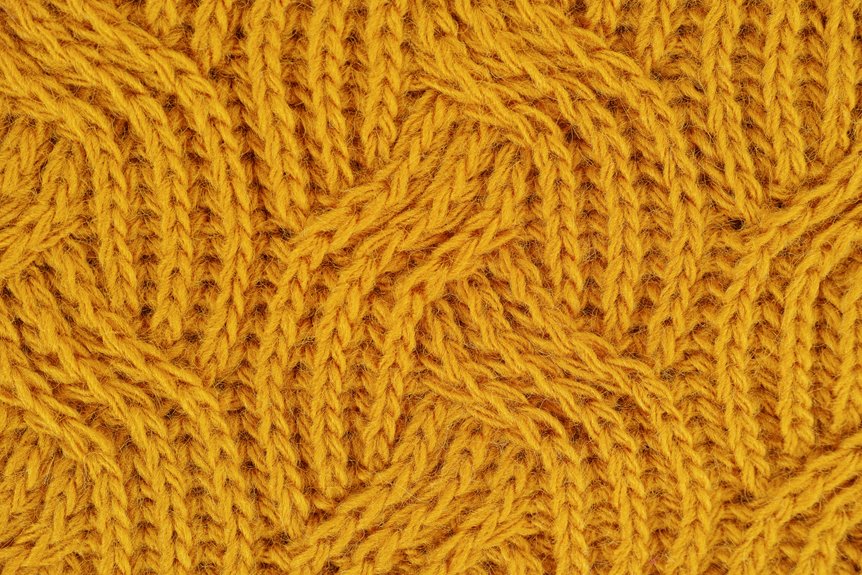
You can knit corduroy-like fabric by using special knitting techniques that recreate its raised ridges and soft texture. Unlike traditional woven corduroy, knitting offers more stretch and comfort, though replicating those thick, durable wales can be tricky. Knitting patterns like ribbing and textured stitches help mimic the look, while plush yarn adds depth. If you want to explore its benefits, challenges, and practical uses, there’s much more to discover about this unique fabric option.
Key Takeaways
- Traditional corduroy is woven, creating raised ridges from extra yarns, which knitting cannot naturally replicate.
- Knitted corduroy mimics texture using ribbing and stitch patterns to form raised vertical lines resembling wales.
- Knitted corduroy offers more stretch, softness, and breathability compared to woven corduroy.
- Challenges include maintaining pile height, pile direction, and fabric durability in knitted corduroy.
- Knitted corduroy suits casual wear, accessories, and home textiles, requiring gentle care to preserve quality.
Understanding the Traditional Structure of Corduroy
Although corduroy is often seen as a simple fabric, its traditional structure is quite distinctive. You’ll notice it’s made by weaving extra sets of yarn into the base fabric to create raised ridges, called wales.
These wales give corduroy its characteristic texture and durability. When you run your fingers over corduroy, you feel those soft, parallel lines—this happens because the extra yarns form cut piles. The number of wales per inch varies, affecting the fabric’s thickness and appearance.
For instance, fine-wale corduroy has more ridges, making it smoother, while wide-wale corduroy feels chunkier. This structure not only defines its look but also provides warmth and resilience, making corduroy a popular choice for both casual and sturdy garments.
Differences Between Knitting and Weaving Techniques
The traditional structure of corduroy relies on weaving to create its distinctive ridges, but you might wonder how this differs from knitting, another common fabric-making technique.
Weaving interlaces two sets of yarns—warp and weft—at right angles, producing a firm, stable fabric. This method lets corduroy develop its characteristic wales, or ridges, by adding extra yarns tucked into the weave.
Knitting, on the other hand, loops yarn continuously in one direction, creating a stretchy, flexible fabric. While weaving builds structure through interlacing threads, knitting forms fabric through interlocking loops.
These fundamental differences affect texture, durability, and elasticity—qualities that define corduroy’s feel and appearance. Understanding this helps you appreciate why corduroy traditionally depends on weaving rather than knitting for its unique surface.
Challenges in Knitting Corduroy Fabric
When you try to knit corduroy fabric, you quickly face several obstacles that stem from its distinctive ridged texture. The raised wales that define corduroy’s look don’t naturally form through traditional knitting patterns, making it tough to replicate.
You’ll find it hard to maintain the fabric’s structural integrity while trying to create those parallel ridges. Knitting needles and yarns struggle to mimic the thickness and durability corduroy demands, often resulting in a softer, less defined fabric.
Additionally, managing pile height and direction presents a challenge since knitting typically produces flat surfaces. These factors complicate achieving corduroy’s characteristic look and feel, meaning you must overcome both technical and material limitations when attempting to knit corduroy fabric.
Innovative Knitting Methods to Mimic Corduroy Texture
You can create a corduroy-like texture by using ribbing techniques that add raised lines to your knitting.
Choosing yarns with varied thickness or a plush feel helps bring depth to the fabric.
Combining specific stitch patterns lets you imitate the classic ridges found in corduroy with surprising accuracy.
Ribbing Techniques for Texture
Although corduroy’s distinct ridged texture might seem hard to replicate in knitting, ribbing techniques offer a clever solution. You can use alternating knit and purl stitches to create raised vertical lines that resemble corduroy’s signature ribs.
For example, a 2×2 ribbing pattern—knit two stitches, purl two stitches—forms prominent ridges that mimic corduroy’s texture. Adjusting the number of knit and purl stitches changes the rib width, allowing you to customize the fabric’s appearance.
Adding slipped stitches or using twisted stitches enhances the texture further, giving the fabric a more pronounced cord-like effect. By experimenting with these ribbing variations, you can achieve a tactile, stretchy fabric that captures corduroy’s visual and structural essence through knitting.
Yarn Choices for Depth
Building on ribbing techniques to mimic corduroy’s ridges, selecting the right yarn adds another layer of depth and realism to your fabric.
Choose yarns with a slight halo or fuzziness, like mohair blends or brushed wool, to recreate corduroy’s soft nap. Bulky or textured yarns can enhance the raised effect of the ridges, making them stand out visually and tactilely.
Cotton or cotton blends offer a smooth base that contrasts well with fuzzy fibers, amplifying the corduroy look. Additionally, varying yarn thickness subtly between ridges and valleys can emphasize the fabric’s dimensionality.
Experiment with colors that highlight shadows and light on the ridges, as tonal contrast boosts the three-dimensional feel. These yarn choices bring your knitted corduroy-inspired fabric closer to the authentic texture you want.
Stitch Patterns Imitating Corduroy
Creating the unmistakable texture of corduroy hinges on selecting stitch patterns that cleverly mimic its signature ridges. You can achieve this by focusing on patterns that emphasize vertical lines and raised textures.
Here are three innovative knitting methods to help you imitate corduroy’s look:
- Rib Stitch Variations – Use wide ribbing with alternating knit and purl stitches to create prominent vertical ridges.
- Slip Stitch Patterns – Slip stitches on certain rows produce a raised effect, adding depth similar to corduroy’s channels.
- Twisted Stitches – Incorporate twisted knit stitches to enhance texture and define the ridges clearly.
Benefits of Knitted Corduroy Compared to Woven Corduroy
When you compare knitted corduroy to woven corduroy, you’ll notice several advantages that make knitted versions stand out.
Knitted corduroy offers greater stretch and flexibility, allowing you to move more freely without feeling restricted. This makes it ideal for activewear or garments that require comfort throughout the day.
Additionally, knitted corduroy tends to be lighter and softer, providing a cozy feel against your skin. You’ll also find it less prone to wrinkling, so your clothes look fresh longer without extra care.
Because of the knitting process, it often has better breathability, helping regulate your body temperature. Plus, knitted corduroy usually drapes more naturally, enhancing the overall fit and silhouette of your garments.
These benefits make knitted corduroy a versatile and comfortable alternative to traditional woven varieties.
Applications and Uses for Knitted Corduroy
Knitted corduroy suits a wide range of applications thanks to its stretch, softness, and breathability.
You can easily incorporate it into your wardrobe or home projects without sacrificing comfort or style.
Here are three popular uses:
- Casual Clothing: Knitted corduroy works great for everyday wear like joggers, skirts, and lightweight jackets, giving you warmth and flexibility.
- Children’s Apparel: Its softness and stretch make it ideal for kids’ clothes, allowing freedom of movement and durability.
- Home Textiles: You can use it for cozy cushion covers or throws, adding texture and comfort to your living space.
Care and Maintenance of Knitted Corduroy Garments
To keep your knitted corduroy garments looking and feeling their best, proper care plays a big role. Always check the care label before washing.
Use cold water and a gentle cycle to prevent shrinking or damaging the fabric’s texture. Avoid harsh detergents; instead, opt for mild, fabric-friendly options.
When drying, lay your garment flat on a clean towel to air dry—never use a dryer, as heat can weaken the knit and distort the corduroy ribs.
If wrinkles appear, use a low-heat iron with a pressing cloth to protect the fabric.
Store your knitted corduroy folded or hung on padded hangers to maintain shape and avoid creases.
With these steps, you’ll extend the life and look of your knitted corduroy pieces.
Frequently Asked Questions
What Historical Origins Does Corduroy Fabric Have?
You’ll find corduroy dates back to ancient Egypt, but it became popular in 18th-century England as “corded cloth.” It evolved as durable workwear, prized for its ridged texture and strength, blending function with style.
Can Corduroy Be Made From Sustainable or Organic Fibers?
Like finding a hidden garden in Eden, you can choose corduroy made from sustainable or organic fibers. You’ll enjoy eco-friendly fabrics crafted from organic cotton or recycled materials, blending comfort with conscientious style perfectly.
How Does Corduroy Compare to Velvet in Feel and Appearance?
You’ll find corduroy has a textured, ribbed feel with a casual look, while velvet feels smoother and more luxurious with a shiny finish. Both are soft, but velvet’s sheen makes it more elegant and formal.
What Are Common Fashion Trends Involving Corduroy?
Corduroy’s like a cozy hug you wear — you’ll spot it in vintage jackets, flared pants, and skirts. You’ll love how it adds texture and warmth, perfect for layering during chilly, stylish days.
Are There Cultural Significances Tied to Corduroy Fabric?
You’ll find corduroy carries cultural significance, especially in workwear and academic settings. It’s linked to durability and tradition, often symbolizing practicality and intellectualism, shaping how people perceive you when you wear this classic fabric.