
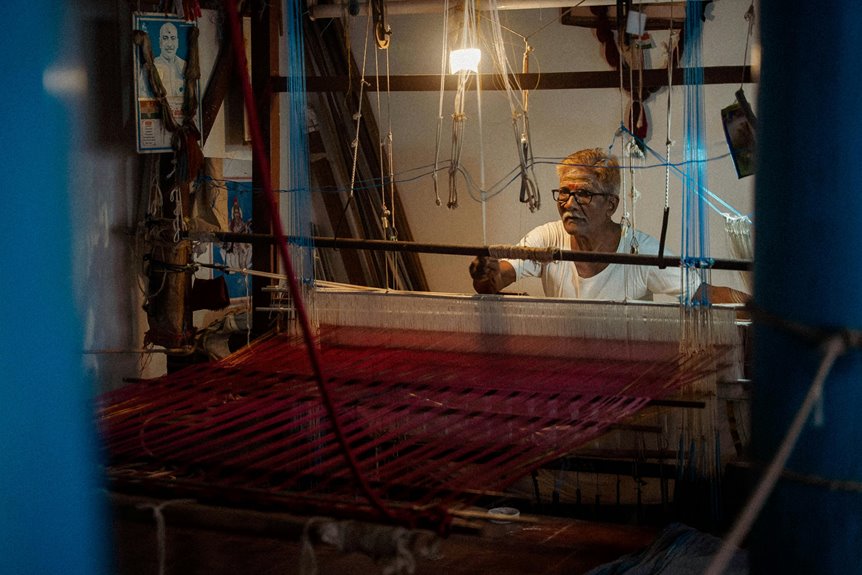
A floating selvedge is a weaving edge where some warp threads aren’t tightly bound, creating a flexible, less bulky border that reduces tension and fabric distortion. You’ll want to use it when working with delicate yarns or designs needing flexibility and durability without restricting movement. This technique also helps prevent fraying and makes finishing edges easier later on. Keep exploring, and you’ll find how to create and care for floating selvedges to enhance your weaving projects.
Key Takeaways
- A floating selvedge is a weaving edge where warp threads are left unattached, creating a flexible, less bulky border that reduces fabric distortion.
- It differs from fixed selvedges by allowing some warp threads to “float,” enhancing edge flexibility and minimizing tension-related issues.
- Floating selvedges work best with natural fibers like cotton, linen, silk, and fine wools that benefit from balanced tension and moderate drape.
- Use floating selvedges for projects requiring edge flexibility, frequent tension changes, or delicate yarns prone to breakage under tight tension.
- Benefits include reduced fraying, easier finishing options, preserved fabric shape, and improved durability during handling and washing.
Understanding the Basics of Selvedges
Selvedges are the tightly woven edges of fabric that prevent it from unraveling. When you weave, these edges form naturally as the weft thread turns at the end of each row, locking the fabric’s structure in place.
You’ll notice selvedges are usually stronger and less prone to fraying than the fabric’s interior. Understanding this basic function helps you appreciate why selvedges are essential for handling, cutting, and sewing fabric. They act as a built-in border, keeping your work tidy and durable.
When you work with woven textiles, recognizing the selvedge guarantees you maintain fabric integrity during projects. Plus, these edges can influence how a fabric behaves on your loom and in finished garments or crafts.
Defining the Floating Selvedge Technique
When you understand how selvedges function in weaving, you can better appreciate techniques that enhance their performance—like the floating selvedge. This technique involves leaving the edge warp threads unattached or “floating” across the fabric’s edge rather than being woven tightly into the weft. It creates a flexible, less bulky edge that can reduce tension and prevent distortion.
Here’s a simplified visualization:
| Warp Thread | Weft Thread | Floating Selvedge Status |
|---|---|---|
| Thread 1 | Woven | Attached |
| Thread 2 | Floating | Unattached |
| Thread 3 | Floating | Unattached |
| Thread 4 | Woven | Attached |
| Thread 5 | Woven | Attached |
How Floating Selvedges Differ From Other Selvedges
You’ll notice floating selvedges differ quite a bit from fixed ones, both in structure and appearance.
Unlike fixed selvedges, floating selvedges aren’t anchored tightly, giving your fabric more flexibility.
Let’s explore how these differences affect your weaving and the final look.
Floating vs. Fixed Selvedges
Understanding the difference between floating and fixed selvedges helps you choose the right edge for your fabric projects.
Floating selvedges aren’t anchored to the fabric’s edge; their warp threads float loosely alongside the woven area, allowing flexibility during weaving and finishing.
Fixed selvedges, on the other hand, are tightly bound or interlaced at the edge, creating a firm, stable border that prevents unraveling.
When you need an edge that won’t shift or fray, fixed selvedges give you that solid structure.
But if your project calls for more drape or you plan to finish edges later, floating selvedges offer versatility.
Structural and Visual Differences
Choosing between floating and fixed selvedges sets the stage for how your fabric will behave and look.
Floating selvedges don’t lock the edge threads tightly, allowing them to float freely along the fabric’s edge. This gives your fabric more flexibility and less distortion, especially in delicate or loosely woven textiles.
Structurally, floating selvedges are less rigid than fixed ones, which are tightly woven to create a firm, stable edge.
Visually, floating selvedges often appear softer and less defined, while fixed selvedges show a clear, crisp border.
When you want a clean, strong edge for heavy-duty use, fixed selvedges suit best.
But if you need drape and subtle edges without stiff lines, floating selvedges offer that advantage.
Understanding these differences helps you choose the right edge for your weaving project.
Materials Best Suited for Floating Selvedges
Although floating selvedges can work with various fabrics, some materials perform better than others due to their flexibility and weave structure.
You’ll find that natural fibers like cotton, linen, and silk respond well because they’re pliable and hold the floating threads securely without puckering. Wool also works nicely, especially finer wools, since its elasticity helps maintain tension along the edge.
On the other hand, stiff or loosely woven fabrics, such as some synthetics or loosely spun yarns, may struggle to keep the floating selvedge intact, causing distortion or fraying.
Stiff or loosely woven fabrics can cause floating selvedges to distort or fray, compromising edge integrity.
When selecting materials, prioritize those with a balanced weave and moderate drape to guarantee your floating selvedge remains neat and functional throughout your weaving project.
Step-by-Step Process to Create a Floating Selvedge
To create a floating selvedge, you’ll start by carefully preparing your warp threads to guarantee smooth edges.
Then, you’ll focus on weaving the floating edges correctly to maintain flexibility and prevent tightness.
Following these steps helps you achieve clean, durable selvedges every time.
Preparing Warp Threads
Creating a floating selvedge starts with carefully preparing your warp threads to assure smooth edges and even tension. Begin by selecting strong, consistent yarns for the selvedge area. Next, separate these edge threads slightly wider than the main warp to allow for the floating effect. Tie your warp threads securely onto the loom, guaranteeing the selvedge threads are tensioned evenly. Finally, check for any twists or knots that could disrupt the float.
| Step | Action | Tip |
|---|---|---|
| 1 | Choose selvedge yarn | Use strong, smooth yarn |
| 2 | Separate edge threads wider | Prevent tight tension |
| 3 | Tie warp securely | Keep consistent tension |
| 4 | Align threads on heddles | Avoid twists or knots |
| 5 | Inspect warp | Assure smooth edges |
Weaving Floating Edges
With your warp threads prepared and selvedge yarns securely in place, you’re ready to start weaving the floating edges.
Begin by passing your weft yarn over and under the selvedge warp threads without interlacing tightly. This creates the “float” effect, allowing the selvedge yarn to run smoothly along the fabric’s edge.
Keep your tension even but gentle, so the floating selvedge stays loose enough to prevent puckering. As you continue, maintain consistent beat pressure with your beater to secure the fabric’s body while preserving the floating edges.
Repeat the process on both sides to guarantee symmetry. By carefully weaving these floating edges, you’ll achieve clean, flexible selvedges that reduce distortion and enhance your finished piece’s durability.
Common Mistakes to Avoid When Weaving Floating Selvedges
Although floating selvedges can enhance your weaving, you’ll likely encounter some common pitfalls if you’re not careful. One mistake is leaving your floating threads too loose, which can cause unstable edges and snagging. Make sure you maintain consistent tension to keep the selvedge firm.
Another issue is weaving the floating selvedge too tightly; this might pull your fabric’s edge inward, distorting the overall piece. Also, avoid neglecting to secure the ends properly—if the floating threads aren’t anchored well, they can unravel easily.
Finally, don’t forget to check your loom setup; incorrect threading can lead to uneven selvedges. By staying attentive to these details, you’ll create clean, reliable floating selvedges that support your weaving projects.
Advantages of Using Floating Selvedges in Your Projects
When you use floating selvedges, your fabric gains enhanced durability that stands up to wear and tear.
You’ll also notice improved edge stability, which keeps your project looking neat and professional.
These benefits make floating selvedges a smart choice for any weaving project.
Enhanced Fabric Durability
Floating selvedges greatly boost the durability of your fabric by minimizing fraying and wear along the edges. When you use floating selvedges, the edges remain intact and less prone to unraveling, which means your fabric lasts longer, especially in high-stress areas.
This technique protects the threads at the perimeter, so your finished piece resists damage during handling, washing, and everyday use. You’ll notice that fabrics with floating selvedges maintain their shape and texture over time, saving you from frequent repairs or replacements.
Improved Edge Stability
Since edge stability plays an essential role in the overall quality of your fabric, using floating selvedges can greatly enhance this aspect.
Floating selvedges create a clean, secure edge by preventing yarns from pulling or shifting during weaving. This means your fabric maintains its shape and structure better, especially during finishing processes like washing or pressing.
You’ll find your edges less prone to fraying or distortion, which saves time and effort in post-weaving corrections. Plus, improved edge stability guarantees your fabric holds up well under tension, making it easier to handle in subsequent steps.
When to Choose Floating Selvedges Over Other Types
Although other selvedge options might suit certain projects, you’ll want to choose floating selvedges when flexibility and ease of adjustment are priorities during weaving.
If your design requires frequent tension changes or you need to shift warp threads without disturbing the entire fabric edge, floating selvedges offer that adaptability. They’re especially helpful when working with delicate or uneven yarns that might break or distort under strict tension.
Floating selvedges also come in handy if you plan to finish the edges later or add fringe, since they don’t lock the warp threads as tightly as other selvedge types.
Floating selvedges allow easy edge finishing or adding fringe without tightly locking warp threads.
In short, whenever you want control over edge behavior without sacrificing fabric integrity, floating selvedges give you that balance better than fixed or woven-in edges.
Design Ideas Incorporating Floating Selvedges
When you incorporate floating selvedges into your weaving projects, you gain more freedom to experiment with edge treatments and textures. You can create softer edges, add visual interest with contrasting colors, or introduce patterns that wouldn’t work with fixed selvedges. Floating selvedges also allow you to adjust tension easily, making them perfect for delicate or complex designs.
| Design Idea | Effect | Best For |
|---|---|---|
| Color Contrast | Highlights fabric edges | Bold, modern textiles |
| Textured Edges | Adds tactile interest | Scarves, shawls |
| Pattern Extension | Creates seamless motifs | Decorative panels |
| Soft Finishing | Produces gentle drape | Garments, curtains |
| Adjustable Width | Customizes fabric dimensions | Sampling, prototypes |
Troubleshooting Issues With Floating Selvedges
Exploring design ideas with floating selvedges opens up many creative possibilities, but it can also present specific challenges.
If you notice uneven edges or puckering, check your tension settings first. Uneven tension often causes distortion along the selvedge. Also, make sure your floating threads aren’t too loose or too tight—they need just the right balance to maintain fabric integrity.
Uneven edges or puckering? Check tension and balance your floating threads to keep fabric integrity intact.
If you find fraying or thread breakage, inspect the floating threads for damage and adjust your weaving technique to minimize stress. Sometimes, the problem lies in inconsistent beat pressure, so keeping a steady rhythm can help.
Finally, if the selvedge doesn’t lay flat, consider modifying your floating length or adding a stabilizing thread. Troubleshooting these issues early keeps your weaving smooth and your final fabric flawless.
Care and Maintenance of Fabrics With Floating Selvedges
Caring for fabrics with floating selvedges requires special attention to preserve their unique structure and appearance. You should always handle these fabrics gently to avoid pulling or snagging the floating threads.
When washing, opt for a mild detergent and cold water, either by hand or on a delicate machine cycle. Avoid wringing or twisting the fabric; instead, press out excess water carefully.
Lay the fabric flat to dry, reshaping it to maintain its dimensions and prevent distortion. Iron on a low setting with a pressing cloth to protect the selvedges.
Storing your fabric rolled or folded loosely can help prevent creases and damage to the floating edges. By following these steps, you’ll keep your floating selvedge fabric looking its best for years to come.
Inspiring Examples From Expert Weavers Using Floating Selvedges
Maintaining fabrics with floating selvedges keeps them in top shape, but seeing how expert weavers use these unique edges can spark your creativity.
Take, for example, Sarah’s intricate scarves where floating selvedges add subtle texture and flexibility, enhancing both durability and design.
Or consider James, who incorporates floating selvedges in handwoven blankets, allowing for a softer edge that reduces bulk.
These weavers don’t just treat floating selvedges as functional—they use them to elevate their work’s aesthetic and structural integrity.
Floating selvedges transform fabric beyond function, enhancing both beauty and strength in weaving projects.
When you try similar techniques, you’ll appreciate how floating selvedges offer creative freedom while maintaining fabric strength.
Watching pros blend technique and artistry helps you envision new possibilities for your own projects.
Let their examples inspire you to experiment confidently with floating selvedges.
Frequently Asked Questions
Can Floating Selvedges Be Used in Handwoven Scarves?
Imagine your scarf’s edges dancing freely; yes, you can use floating selvedges in handwoven scarves. They give flexibility and prevent puckering, so your work stays sleek and smooth, adding a touch of elegance to every thread.
How Does Floating Selvedge Affect Fabric Durability?
You’ll find floating selvedges can reduce fabric durability slightly since the edges aren’t tightly bound. However, they ease tension and prevent edge distortion, so they’re great for delicate or loosely woven fabrics.
Are Floating Selvedges Suitable for Machine Washing?
You can machine wash fabrics with floating selvedges, but you should use gentle cycles and cold water to prevent fraying. Avoid harsh detergents and high heat to keep your fabric durable and looking its best.
What Historical Cultures Used Floating Selvedges?
Imagine ancient threads whispering secrets: cultures like the Navajo and Andean weavers used floating selvedges to craft sturdy, intricate textiles. You’ll find their weaving techniques echoing through time, blending function with artistry flawlessly.
Can Floating Selvedges Be Combined With Other Weaving Techniques?
You can definitely combine floating selvedges with other weaving techniques like twill or tapestry. Doing so adds strength and flexibility to your fabric, allowing you to create more complex and durable woven designs.