
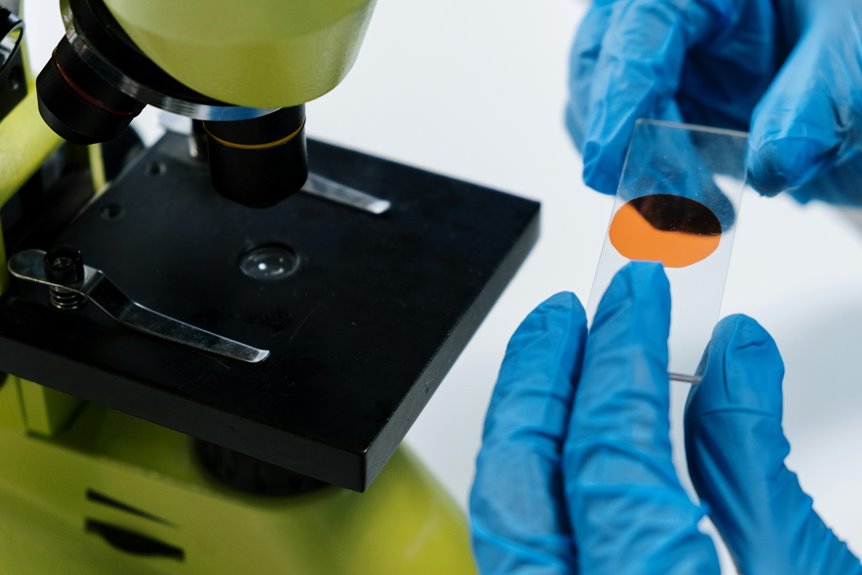
You’ll want to start by understanding dye chemistry—acidic dyes bind positive cell parts, while basic dyes target negatives like nucleic acids. Prepare samples with appropriate fixation to preserve structures and guarantee dye penetration. Use differential staining to distinguish cell types or structures, applying precise protocols to avoid issues like background noise. Proper imaging and documentation maintain data quality. Keep these basics in mind, and as you explore further, you’ll uncover more advanced techniques and troubleshooting tips.
Key Takeaways
- Understand chemical properties of dyes to predict their interaction with cellular components for effective staining results.
- Ensure proper sample fixation and permeabilization to stabilize structures and facilitate dye penetration.
- Clean slides thoroughly with distilled water and mild detergents to remove contaminants that hinder dye absorption.
- Apply differential staining protocols, such as Gram or acid-fast staining, to distinguish specific cellular features.
- Calibrate imaging settings and document staining details meticulously to ensure reproducibility and accurate analysis.
Understanding the Chemistry of Common Biological Dyes
How do common biological dyes interact with cells to reveal intricate details? You’ll find that these dyes work through specific chemical properties that allow them to bind selectively to cellular components.
For example, acidic dyes carry negative charges and attract positively charged structures like cytoplasmic proteins. Conversely, basic dyes have positive charges, which makes them stick to negatively charged elements such as nucleic acids.
Some dyes form covalent bonds, while others rely on ionic or hydrophobic interactions. Understanding these chemical affinities helps you predict which dye highlights which part of the cell.
Preparing Samples for Effective Staining
To get the best results from staining, you need to prepare your samples carefully.
That means fixing the samples properly, cleaning your slides thoroughly, and sectioning tissues with precision.
Mastering these steps guarantees your dyes will highlight the structures you want to study.
Sample Fixation Methods
Although staining enhances the visibility of cellular structures, you can’t achieve accurate results without proper sample fixation. Fixation preserves the sample’s morphology and prevents degradation, ensuring that dyes bind effectively.
You typically choose between chemical and physical fixation methods. Chemical fixatives like formaldehyde or glutaraldehyde crosslink proteins, stabilizing cellular components. Alcohol-based fixatives dehydrate and precipitate proteins, useful for nucleic acid staining.
Physical fixation, such as heat fixation, rapidly kills and adheres cells to slides but can distort delicate structures. When fixing, control time and temperature carefully to avoid over- or under-fixation, which can lead to poor staining or artifacts.
Always rinse samples post-fixation to remove residual fixative. By mastering fixation, you set the stage for clear, reliable staining results that reveal true cellular details.
Slide Cleaning Procedures
Three essential steps guarantee your slides are perfectly clean before staining: removing dust, grease, and residues.
Start by rinsing slides with distilled water to wash away loose particles. Next, use a mild detergent or ethanol to eliminate grease and oils that can interfere with dye absorption. Finally, air-dry the slides or use lint-free wipes to avoid introducing new contaminants.
Remember to:
- Handle slides with gloves to prevent oil transfer from your hands.
- Avoid scratching the surface during cleaning to guarantee smooth staining.
- Store cleaned slides in dust-free containers until use.
Tissue Sectioning Techniques
Once your slides are spotless, the next step is preparing tissue samples that will allow dyes to penetrate and reveal key structures.
You’ll begin by fixing the tissue to preserve its architecture, then embed it in a medium like paraffin to provide support. Using a microtome, you’ll slice the embedded tissue into thin sections—usually 4 to 10 micrometers thick. Thin sections guarantee dyes can easily penetrate and bind to cellular components.
After sectioning, carefully mount the slices onto slides, avoiding folds or tears that could interfere with staining. Finally, deparaffinize and rehydrate the sections before applying your dyes.
Mastering tissue sectioning techniques is essential because quality cuts directly impact staining clarity and the accuracy of your microscopic observations.
Differential Staining Techniques and Their Applications
Now that you’ve prepared your samples, it’s time to learn about differential staining techniques like Gram staining, which helps you distinguish between bacterial types.
You’ll also explore acid-fast stains, essential for identifying organisms with waxy cell walls, such as Mycobacterium.
These methods give you powerful tools to analyze microbial structures and diagnose infections accurately.
Gram Staining Procedure
The Gram staining procedure uses a series of dyes to differentiate bacterial species based on their cell wall structure.
You start by applying crystal violet, a primary stain, which penetrates all cells. Then, you add iodine, which forms a complex with the dye, locking it inside. After that, you decolorize with alcohol or acetone; this step washes the dye out of some cells but not others. Finally, you counterstain with safranin to color the decolorized cells.
This method helps you:
- Identify Gram-positive bacteria, which retain crystal violet and appear purple
- Detect Gram-negative bacteria, which lose the violet and take up safranin, appearing pink
- Understand bacterial cell wall differences critical for diagnosis and treatment decisions
Acid-Fast Stain Uses
Although acid-fast staining requires more steps than Gram staining, you’ll find it invaluable for identifying bacteria with waxy cell walls that resist conventional dyes. This technique targets mycolic acid in the cell walls, which is abundant in genera like Mycobacterium and Nocardia.
You’ll often use acid-fast staining to diagnose diseases such as tuberculosis and leprosy, caused by Mycobacterium tuberculosis and Mycobacterium leprae, respectively. It also helps detect certain environmental and opportunistic pathogens.
When you apply this stain, acid-fast bacteria retain the primary dye despite acid-alcohol decolorization, appearing bright red against a blue or green background. This contrast makes it easier to distinguish them in clinical samples or environmental specimens.
Using acid-fast staining, you can accurately identify and differentiate these unique microbes, guiding diagnosis and treatment decisions effectively.
Protocols for Simple Staining Methods
Mastering simple staining methods starts with understanding a few essential protocols that guarantee clear and consistent results.
First, prepare your smear by spreading a thin, even layer of your specimen on a clean slide and let it air dry completely. Next, heat-fix the slide by passing it briefly through a flame to adhere cells and preserve morphology.
Then, apply your chosen stain—such as methylene blue or crystal violet—letting it sit for the recommended time before rinsing gently with water. Finally, blot the slide dry and observe under the microscope.
Remember these key steps:
- Always use a thin smear to avoid clumping.
- Control staining time precisely to prevent overstaining.
- Handle heat-fixation carefully to maintain cell structure.
Following these protocols guarantees you get sharp, reliable staining results every time.
Advanced Multiplex Staining Approaches
When you want to analyze multiple cellular components simultaneously, advanced multiplex staining approaches offer powerful solutions. You can combine several dyes or fluorophores with distinct emission spectra to label different targets in one sample. This lets you visualize complex interactions and colocalizations without needing separate staining runs.
To succeed, carefully select compatible dyes that minimize spectral overlap and autofluorescence. Use specialized imaging systems like confocal or spectral microscopes to capture clear signals from each marker. Additionally, optimize antibody concentrations and incubation times to reduce background noise.
Troubleshooting Common Staining Problems
Even the best staining protocols can run into issues, but you don’t have to let common problems derail your experiments. When your staining results look off, pinpointing the cause quickly saves time and resources.
Start by checking your dye concentration and incubation times; too much or too little can cause weak or overly intense staining. Make sure your samples are properly fixed and permeabilized to allow dye penetration.
Don’t overlook washing steps—they remove excess dye and reduce background noise.
Consider these quick troubleshooting tips:
- Verify dye stock freshness and storage conditions.
- Adjust incubation temperature to optimize binding.
- Confirm compatibility of dyes with your sample type and fixation method.
Best Practices for Imaging and Documentation
After troubleshooting your staining process, capturing clear and accurate images becomes the next priority.
Start by calibrating your microscope and camera settings to guarantee consistent exposure and focus. Use appropriate magnification to highlight key features without losing detail. Always include a scale bar for reference.
Minimize background noise by adjusting illumination and using clean slides. When documenting, label images clearly with staining details, date, and sample information. Save images in high-resolution, lossless formats to preserve data quality.
Organize your files systematically for easy retrieval and comparison. Finally, maintain detailed records of your staining protocol alongside images to support reproducibility and analysis.
Following these practices helps you produce reliable, interpretable visual data that effectively communicates your findings.
Frequently Asked Questions
How Should Stained Samples Be Disposed of Safely?
You should dispose of stained samples by placing them in designated biohazard containers. Always wear gloves, follow your lab’s safety protocols, and never pour chemicals down the drain to prevent contamination and environmental harm.
What Are the Environmental Impacts of Common Staining Dyes?
Imagine a lab releasing methylene blue waste into waterways, harming aquatic life by disrupting photosynthesis. You should know many staining dyes are toxic, non-biodegradable, and can accumulate, so proper disposal is essential to protect ecosystems.
Can Staining Techniques Be Automated in High-Throughput Labs?
You can definitely automate staining techniques in high-throughput labs. Automated systems speed up processes, improve consistency, and reduce human error, letting you handle large sample volumes efficiently while maintaining accuracy and reproducibility in your results.
How Do Staining Methods Vary Across Different Species?
Like different languages, staining methods change with species. You’ll need to adjust dyes and protocols since cell structures and compositions vary. Tailoring your approach guarantees clear, accurate visualization across diverse biological samples.
What Are the Costs Associated With Various Staining Protocols?
You’ll find that staining costs vary based on dye type, protocol complexity, and required equipment. Some dyes are pricey, while simpler methods save money. Always balance cost with accuracy and your specific experimental needs.