
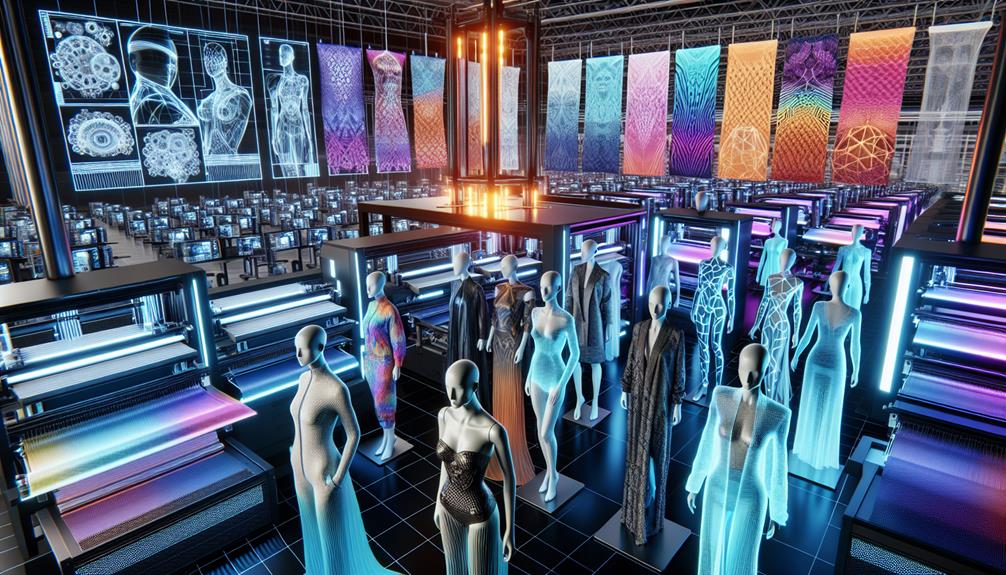
Imagine the age-old art of textile making colliding with cutting-edge technology—3D printing has transformed how you can design and produce fabrics. This isn't just about aesthetics; it's about creating intricate patterns and structures that were once impossible. You'll discover how additive manufacturing methods, like FDM and SLS, enable customization and sustainability in ways traditional methods can't match. Additionally, the integration of conductive polymers opens doors to smart textiles and advanced wearables. Curious about the challenges and future potential of this innovative approach? Let's explore the essential aspects you need to know.
Key Takeaways
- 3D printing in textiles enables intricate patterns and customized fabrics, enhancing design possibilities beyond traditional weaving and knitting methods.
- Technologies like Fused Deposition Modeling (FDM) and Selective Laser Sintering (SLS) revolutionize textile production with precision and innovative material integration.
- Conductive polymers and flexible filaments allow for the creation of smart textiles, expanding applications in wearable technology and activewear.
- 3D printing reduces waste and conserves resources by using only necessary materials, promoting sustainability and energy efficiency in textile manufacturing.
- The future of 3D printing in textiles includes personalized fashion, complex fabric structures, and minimized production costs, with significant potential in fashion and healthcare industries.
History and Evolution
The journey of 3D printing in textiles began in the early 2010s, revolutionizing design and production methods. With technological advancements, designers found new ways to push boundaries, creating intricate patterns and structures previously impossible.
You saw the rise of unique, customized fabrics that fused technology with traditional textile-making, offering a fresh wave of design inspiration.
This period marked a significant shift in how textiles were perceived and manufactured. Creative possibilities expanded exponentially; you no longer had to rely solely on weaving or knitting. Instead, you could use 3D printing to create complex, three-dimensional forms directly from digital models.
This artistic evolution allowed for greater experimentation in fashion and interior design, where the texture, form, and functionality of textiles could be endlessly reimagined.
As you explored further into the history of 3D printing in textiles, it became clear that this technology wasn't just a fleeting trend. It was a transformative force that empowered designers to explore new domains of creativity and innovation.
Key Technologies
When exploring 3D printing in textiles, you'll encounter two vital aspects:
additive manufacturing methods and material innovations.
These technologies transform how fabrics are designed and produced, offering unprecedented flexibility and customization.
Understanding these key technologies will help you appreciate the revolution happening in the textile industry.
Additive Manufacturing Methods
Frequently, innovative additive manufacturing methods like Fused Deposition Modeling (FDM) and Selective Laser Sintering (SLS) revolutionize the textile industry. These technologies enable you to integrate complex surface textures directly into fabrics, creating unique and functional designs. FDM lays down material layer-by-layer, while SLS uses a laser to sinter powdered material, offering precision and durability.
In the world of wearable technology, these methods facilitate the creation of smart textiles that can sense and respond to environmental stimuli. Imagine a fabric that can monitor your heart rate or adjust its thermal properties based on the weather. With FDM and SLS, these possibilities become realities, allowing you to push the boundaries of what textiles can achieve.
Here's a quick comparison of FDM and SLS:
| Method | Key Features |
|---|---|
| FDM | Layer-by-layer material deposition |
| Excellent for fabric integration | |
| Ideal for creating surface textures | |
| SLS | Laser sintering of powdered material |
| High precision and durability | |
| Perfect for wearable technology |
Material Innovations
Building on the advanced manufacturing methods, exploring new materials like conductive polymers and flexible filaments opens up unprecedented opportunities in textile innovation. You can now create textiles that aren't only aesthetically appealing but also highly functional.
Conductive polymers allow for the integration of electronics directly into fabrics, paving the way for smart textiles used in healthcare, sports, and fashion. Imagine garments that can monitor your heart rate or even charge your phone.
Flexible filaments, on the other hand, bring a new level of comfort and adaptability to textiles. These materials stretch and move with the body, making them ideal for activewear and ergonomic designs. The production processes involved in incorporating these materials are becoming increasingly sophisticated, enabling mass customization and rapid prototyping.
Material advancements like these are revolutionizing fabric enhancements. You're no longer restricted to traditional fibers; you've got a toolkit of innovative materials at your disposal. This shift is transforming textile applications, allowing for more durable, lightweight, and multi-functional fabrics.
Benefits and Advantages
You'll find that 3D printing in textiles offers incredible benefits, particularly in customization and personalization.
This technology also promotes sustainability and efficiency, making it a game-changer for the industry.
Let's examine how these advantages can transform your approach to textile production.
Customization and Personalization
With 3D printing, you can create custom-fit garments that perfectly match your unique body shape and style preferences. This technology offers unparalleled design freedom, allowing you to produce unique products that stand out in a sea of mass-produced clothing.
Imagine having the ability to design and print garments that not only fit flawlessly but also express your individuality in ways traditional methods simply can't match.
Tailored solutions are now within reach without the need for extensive alterations or compromises on style. By leveraging 3D printing, you can cater to specific consumer preferences, ensuring that each piece is a perfect blend of form and function.
Whether you desire intricate patterns, unconventional materials, or avant-garde designs, 3D printing makes it possible to bring your vision to life with precision and ease.
Moreover, this approach eliminates the guesswork often involved in sizing and fit, providing a more personalized shopping experience. You're no longer bound by standard sizes and limited options. Instead, you can enjoy the luxury of clothing that's made specifically for you, enhancing both comfort and confidence.
Embrace the future of fashion with 3D printing and discover the myriad ways it can revolutionize your wardrobe.
Sustainability and Efficiency
3D printing in textiles offers a sustainable and efficient alternative to traditional manufacturing methods, reducing waste and conserving resources. By adopting 3D printing, you can implement sustainable practices that not only benefit the environment but also enhance your production efficiency. This technology minimizes material usage and allows for precise control over the manufacturing process, ensuring that you produce exactly what's needed, nothing more, nothing less.
Here's how 3D printing in textiles promotes sustainability and efficiency:
- Resource Conservation: Traditional textile manufacturing often involves significant waste. 3D printing uses only the necessary amount of material, drastically reducing excess and minimizing environmental impact.
- Energy Efficiency: 3D printing requires less energy compared to conventional methods. You can streamline your production processes, leading to lower energy consumption and reduced carbon footprint.
- Waste Reduction: By using sustainable practices, such as recycling and reusing materials, 3D printing helps in reducing textile waste. This method allows for the creation of complex designs with minimal leftover material.
Current Applications
Innovative designers are using 3D printing to create custom-fit clothing and intricate textile patterns that were previously impossible to achieve. In the fashion industry, 3D printing allows for unprecedented customization and creativity. You can now see garments that perfectly fit individual body shapes, crafted with a precision that traditional methods can't match. High fashion houses and avant-garde designers are leveraging this technology to push the boundaries of what's possible in textile design. Imagine wearing a dress that's not only stylish but also fits you like a second skin, thanks to 3D-printed fabrics.
Beyond fashion, 3D printing is revolutionizing medical textiles. Here, the focus is on functionality and patient-specific solutions. For instance, custom 3D-printed braces and prosthetics offer improved comfort and performance. The technology even extends to bio-textiles, where researchers are developing 3D-printed scaffolds for tissue engineering. This could lead to significant advancements in wound care and implants, enhancing patient outcomes.
As you can see, the current applications of 3D printing in textiles are as diverse as they're transformative. Whether it's redefining fashion or providing critical medical solutions, 3D printing is setting new standards in both industries.
Challenges and Limitations
Despite its transformative potential, 3D printing in textiles faces several significant challenges and limitations that need addressing. Understanding these constraints is essential for anyone aiming to master this innovative technology.
First, design flexibility and cost implications can be a double-edged sword. While 3D printing allows for intricate designs, the cost of materials and specialized equipment can be prohibitive. You'll need to carefully balance creative ambitions with budget constraints to make viable products.
Second, production speed remains a formidable hurdle. Traditional textile manufacturing processes can churn out products at a much faster rate. In contrast, 3D printing is often slower, making it less suitable for large-scale production runs. This discrepancy can limit your ability to meet high demand efficiently.
Third, quality control is another critical issue. Ensuring consistent quality in 3D-printed textiles can be challenging due to variables like material quality, printer calibration, and environmental factors. Achieving uniformity in texture, durability, and appearance requires rigorous testing and fine-tuning.
Future Potential
Given the rapid advancements in technology, the future potential of 3D printing in textiles is incredibly promising. You'll witness market growth driven by innovative designs, opening up a myriad of creative possibilities. Imagine creating customized, intricate fabric structures that were once deemed impossible. This technology is not just about aesthetics; it also holds a significant economic impact, potentially reducing costs and waste associated with traditional textile manufacturing.
| Aspect | Future Potential |
|---|---|
| Market Growth | Surge in demand for customized textiles |
| Innovative Designs | Complex and unique fabric structures |
| Creative Possibilities | Personalized fashion and home decor |
| Economic Impact | Reduced production costs |
| Environmental Benefits | Minimized waste and resource usage |
You'll see how 3D printing can transform fashion and home decor by allowing unparalleled customization. This shift could lead to personalized garments tailored precisely to individual preferences, and home textiles that reflect unique artistic visions. Additionally, the economic impact can't be overstated. By streamlining production processes, 3D printing can markedly cut manufacturing costs and minimize material waste, leading to a more sustainable industry. As you keep an eye on this evolving technology, prepare to embrace a future where creativity and efficiency go hand in hand.
Industry Examples
Leading companies in the fashion and textile industries are already harnessing 3D printing technology to create groundbreaking products. By merging cutting-edge science with creative artistry, they've delivered innovations that push the boundaries of traditional design and functionality.
Let's look at some industry examples that showcase this transformative technology:
- Fashion collaborations: Partnerships between designers and tech companies have resulted in stunning, avant-garde pieces. For instance, Iris van Herpen's collaboration with MIT's Mediated Matter Group produced intricate, 3D-printed dresses that are as much art as they're fashion.
- Performance enhancements: Sportswear giants like Adidas have integrated 3D printing to create custom midsoles for their running shoes. This not only improves athlete performance by providing tailored support, but also reduces waste through on-demand manufacturing.
- Sustainable practices: Companies like Ministry of Supply are leveraging 3D printing to minimize fabric waste. They've developed efficient manufacturing processes that produce zero-waste knit garments, reflecting a sustainable approach without compromising on quality.
Frequently Asked Questions
How Can Individuals Get Started With 3D Printing in Textiles at Home?
You might think it's complex, but starting 3D printing in textiles at home is doable. Begin with DIY projects, explore different printing techniques, and create creative designs for various home applications. Mastery comes with practice.
What Materials Are Best Suited for 3D Printed Textiles?
When you're selecting materials for 3D printed textiles, choose flexible filaments like TPU or TPE. These choices enhance your design possibilities and printing techniques while also offering sustainability benefits. Master these materials for best results.
Are There Any Safety Concerns With 3D Printed Textiles?
Imagine maneuvering through a labyrinth—health risks can lurk in 3D printed textiles. You must wear your armor, taking protective measures like proper ventilation and handling materials safely to avoid any potential hazards. Safety's your guiding compass.
How Can 3D Printed Textiles Be Customized for Personal Use?
You can customize 3D printed textiles with endless options. Design flexibility allows you to create unique patterns, textures, and fits tailored to your style. Mastering these tools empowers you to bring your creative visions to life.
What Are the Environmental Impacts of 3D Printing in the Textile Industry?
Like Pandora's box, 3D printing in textiles can release both hope and challenges. You'll need to navigate environmental concerns, recycling options, and sustainable practices to manage waste effectively and guarantee eco-friendly production.